
Mobile Signals: Building Real-Time Labor Market Maps from Digital Traces
Towards Real-Time Prediction of Unemployment and Profession
The paper presents a framework for real-time prediction of individual unemployment and 18 profession categories in a South-Asian developing country using mobile phone network logs. Utilizing a Deep Neural Network (DNN) on a large-scale dataset of 76,000 users, the authors achieved 70.4% accuracy in predicting unemployment and an average of 67.5% across all professions.
TL;DR
In developing nations, official unemployment data is often a "black hole." This paper presents a breakthrough by using mobile phone metadata to predict individual employment status and 18 different professions with over 70% accuracy. By analyzing how we spend money (top-ups), how we move (GPS-lite via towers), and who we talk to, the authors created a high-resolution map of economic productivity that outperforms traditional, slow-moving surveys.
Background & Motivation: The Data Gap in the Global South
In many developing economies, the lack of timely labor statistics isn't just a technical hurdle—it's a massive obstacle to growth. Measuring unemployment usually requires nationwide surveys that are too expensive to run frequently. By the time the data is processed, the economic "shocks" have already occurred.
The authors' insight is simple yet profound: our mobile phones are digital proxies of our socioeconomic lives. They moved beyond simple "top-down" regional estimates to a bottom-up individual prediction model, validated against massive household surveys of 200,000 people.
Methodology: Decoding the Behavior of Professions
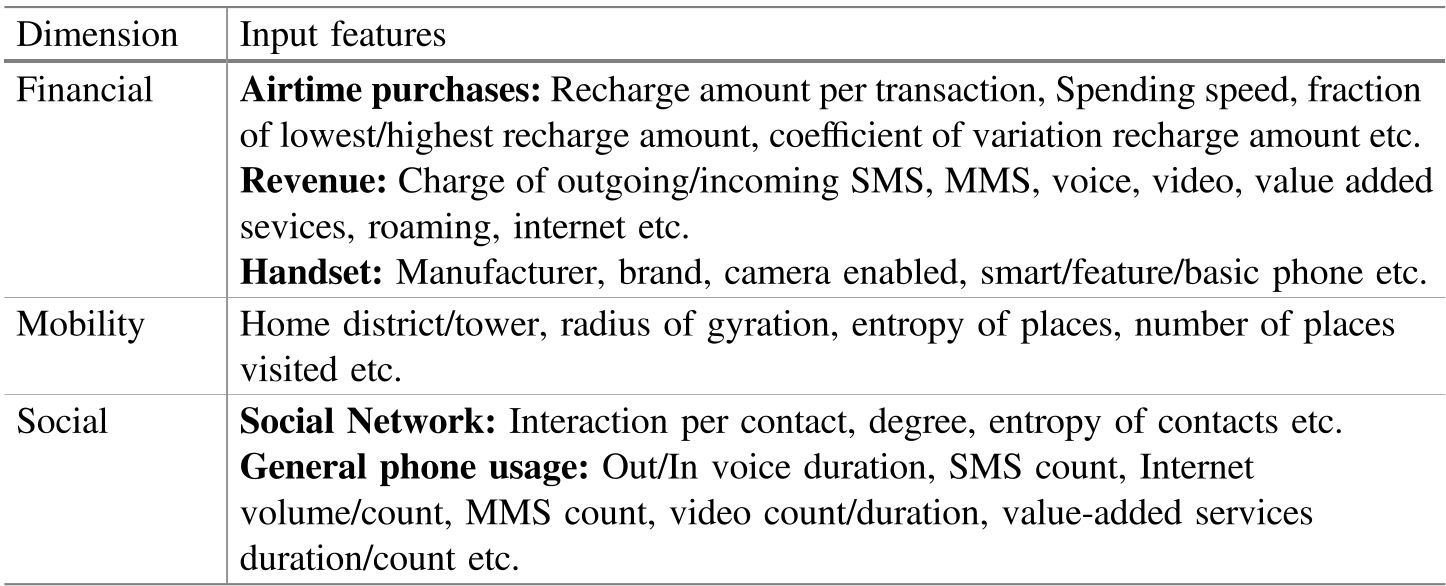
The model processes 160 features categorized into three pillars:
- Financial: Airtime purchase frequency, "spending speed," and recharge amounts.
- Mobility: The "Radius of Gyration" (how far you travel), towers visited, and entropy of locations.
- Social: Network size, call duration, and call timing (e.g., night-time calls when rates are cheaper).
These features feed into a Deep Neural Network (DNN) designed to handle highly imbalanced data (since the unemployed are often a small minority of callers in specific datasets).
Key Findings: The "Digital Fingerprint" of a Job
One of the most fascinating aspects of this research is the discovery of unique behavioral signatures for different professions:
- Clerks: Showed a very low "radius of gyration"—consistent with the static nature of office work—making them the easiest to identify.
- Students: Primarily identified through high SMS usage and mobile internet consumption.
- Unemployed Individuals: Tend to have fewer social interactions, make calls during "discount hours" at night, and use the lowest possible recharge amounts.
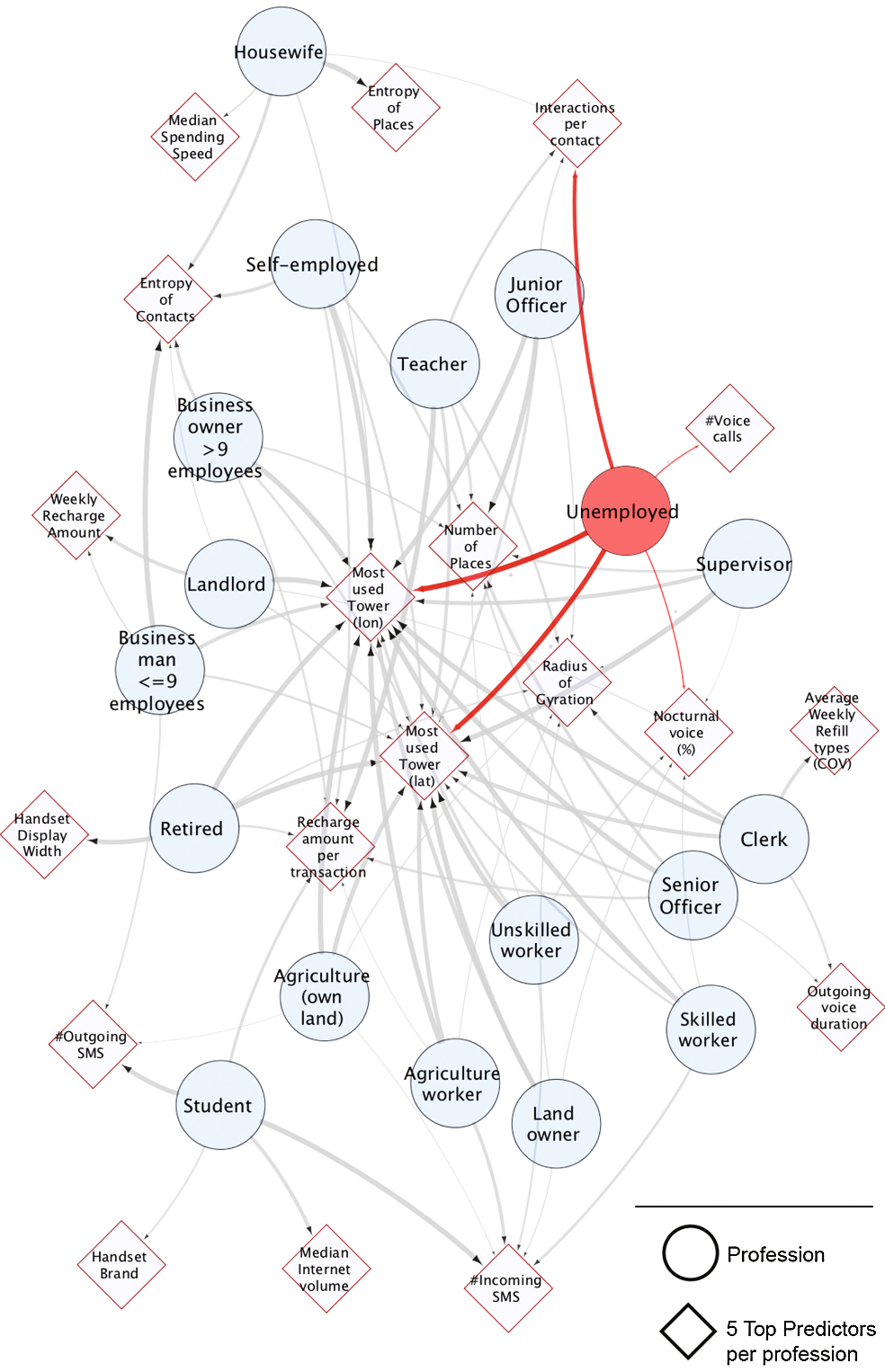
The importance of "financial" features (airtime purchases) was a major win for the study. It confirms that in developing markets, how you buy credit is as telling as who you call.
Spatial Intelligence: Mapping the City
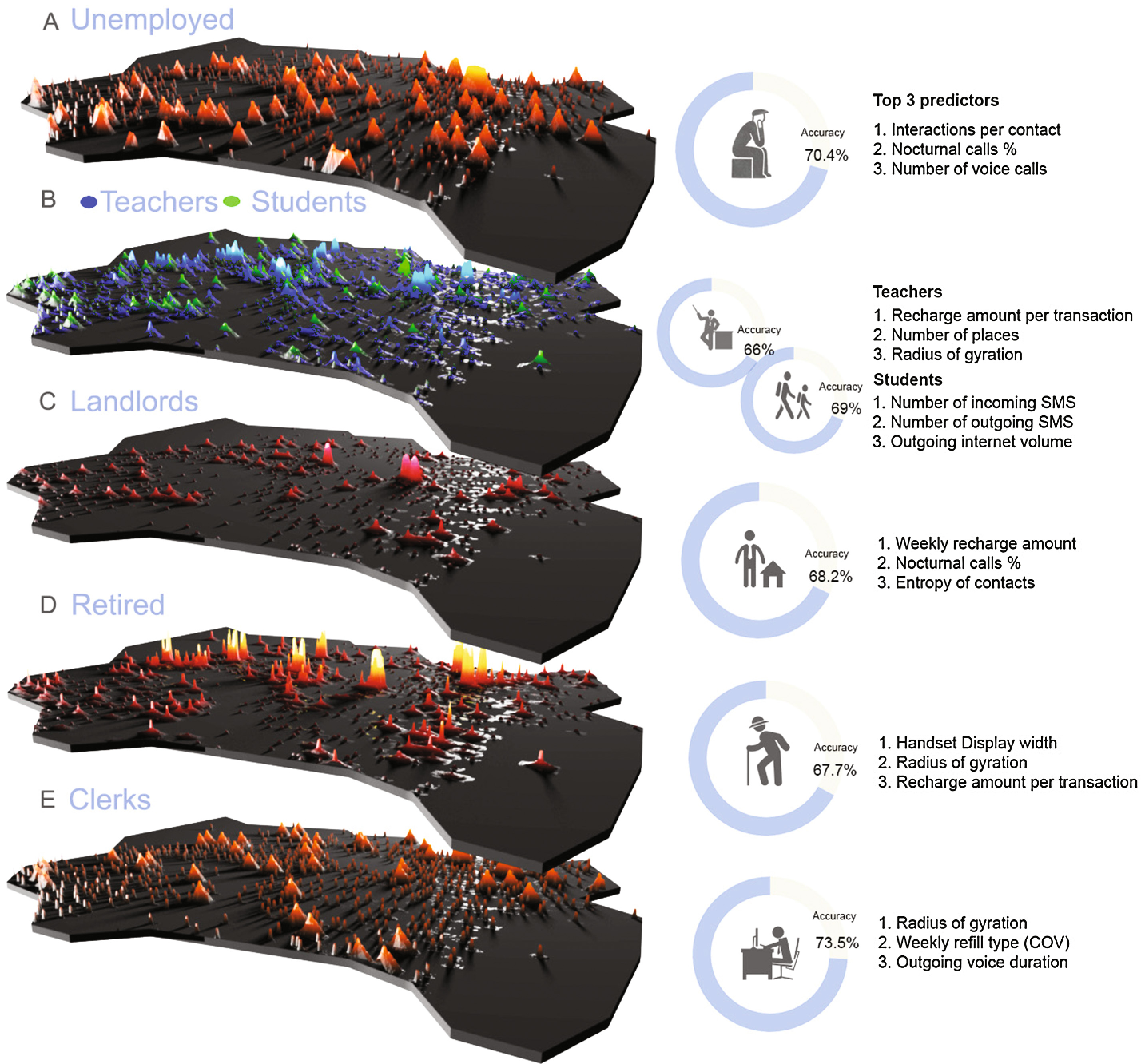
By aggregating individual predictions, the authors generated a cell-tower-level heat map. Unlike traditional surveys that might provide a single number for a whole city, this method identifies "pockets" of unemployment, showing that it is often spatially dispersed rather than concentrated in single sectors.
Critical Insight & Future Outlook
While the accuracy is impressive (70.4%), the real value is the temporal frequency. A government could, in theory, run this model every week to see how a new policy or a global economic shift is affecting specific neighborhoods in real-time.
Limitations: The study acknowledges that it depends on mobile penetration. While 87% of households had a phone, the remaining 13%—often the most vulnerable—might be "invisible" to this digital lens. However, as a supplement to traditional methods, this work provides a powerful new tool in the fight against economic uncertainty.
Conclusion
This paper bridges the gap between machine learning and development economics. It proves that the "exhaust" of our digital lives can be refined into a high-octane fuel for smarter, faster, and more targeted economic policy.