
SQAw-IoT: Optimizing Cardiac Monitoring Through Signal Quality Awareness
Real-Time Signal Quality-Aware ECG Telemetry System for IoT-Based Health Care Monitoring
This paper introduces a novel signal quality-aware (SQAw) IoT-enabled ECG telemetry system designed for continuous cardiac monitoring. The core contribution is a light-weight Signal Quality Assessment (SQA) module that classifies ECG signals into "Good," "Intermediate," or "Bad" categories to optimize transmission and diagnosis.
TL;DR
Researchers have developed a real-time, light-weight ECG monitoring system that "knows" when its data is noisy. By implementing a Signal Quality Assessment (SQA) module on the edge (e.g., smartphones and Arduino), the system filters out uninterpretable data, extending battery life by 33% and reducing false clinical alarms.
Background Positioning
In the landscape of IoT healthcare, we are moving from "always-on" transmission to "intelligent-event" triggering. This paper bridges the gap between raw hardware sensing and reliable clinical diagnosis by introducing a quality-gatekeeper that operates with minimal computational cost.
Problem & Motivation: The "Trash In, Trash Out" Dilemma
Existing remote ECG monitors face two major hurdles:
- Energy Poverty: Transmitting high-frequency ECG data is the most power-hungry task for a wearable device.
- Diagnostic Paradox: Clinical algorithms are sensitive. If a patient is jogging, the resulting "muscle artifacts" look like arrhythmias to a computer, leading to dangerous false positives.
The authors recognized that if the system can identify "unacceptable" signals locally, it can put the radio to sleep, saving energy and maintaining the integrity of the cloud-based diagnostic server.
Methodology: The Core Quality Engine
The proposed system decomposes signal quality analysis into three distinct, low-complexity steps:
1. Baseline Wander (BW) Removal
Using DFT-based filtering, the system extracts the low-frequency drift (breathing/movement). It specifically looks for Abrupt Baseline Wander (ABW); if the baseline shifts more than 0.2 mV suddenly, the signal is flagged as it might distort critical ST-segments used for heart attack detection.
2. Signal Absence (Flat-Line) Detection
The system uses a Turning Points (TP) algorithm. By adding a tiny amount of random noise and counting local maxima/minima, the system can mathematically distinguish between a true heart signal and an electronic "flat-line" caused by a disconnected electrode.
3. High-Frequency (HF) Noise Detection
This stage identifies muscle artifacts (EMG noise) and power line interference. By measuring the distance between "Turning Points," the system determines if the signal is too jittery to be clinically useful.
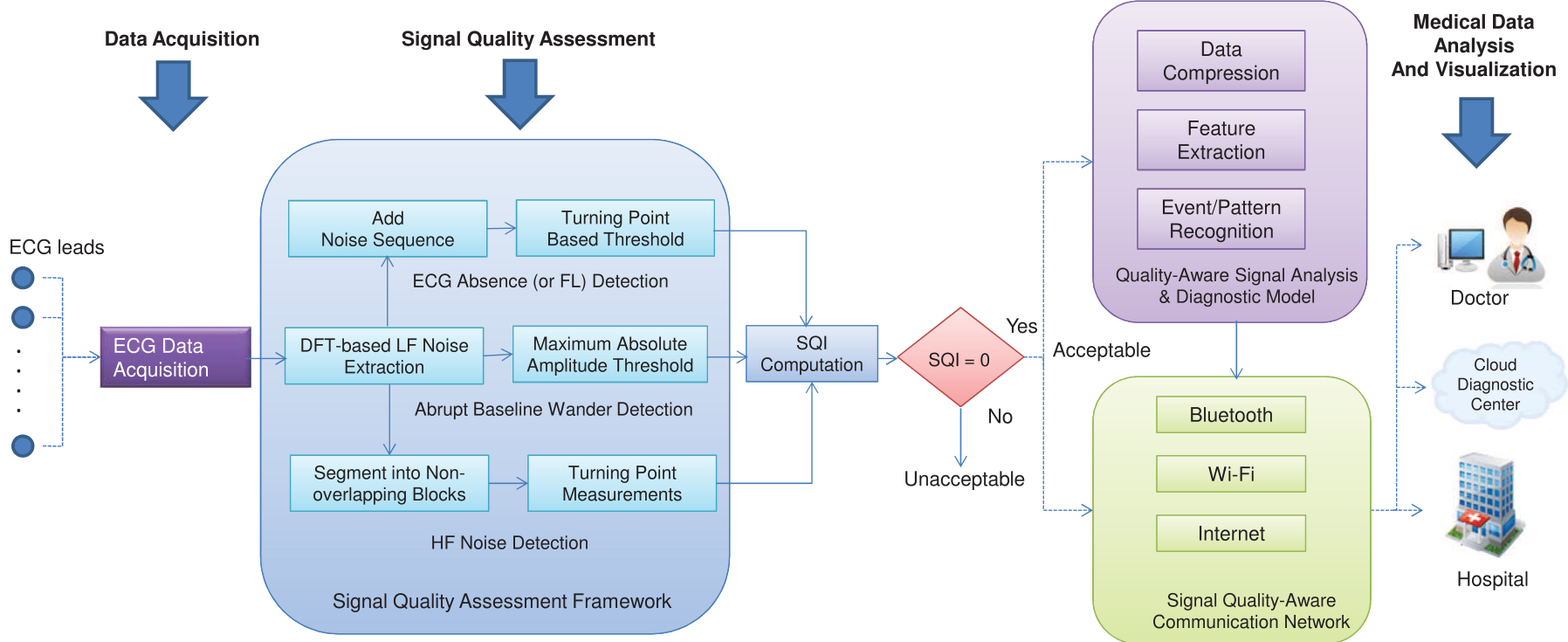 Figure 1: The SQAw-IoT framework consisting of sensing, automated quality assessment, and transmission modules.
Experiments & Results
The framework was validated using the MIT-BIH arrhythmia database and real-time smartphone recordings from 20 subjects.
- Efficiency: While traditional SVM-based quality assessment takes ~350ms per segment, this method takes only 7ms.
- Battery Gains: By suppressing the transmission of bad data (e.g., during intense jogging), the system realized a 33% reduction in power consumption.
- Classification Performance: The system achieved a sensitivity (Se) of 97.85% on noisy data, outperforming complex machine learning benchmarks.
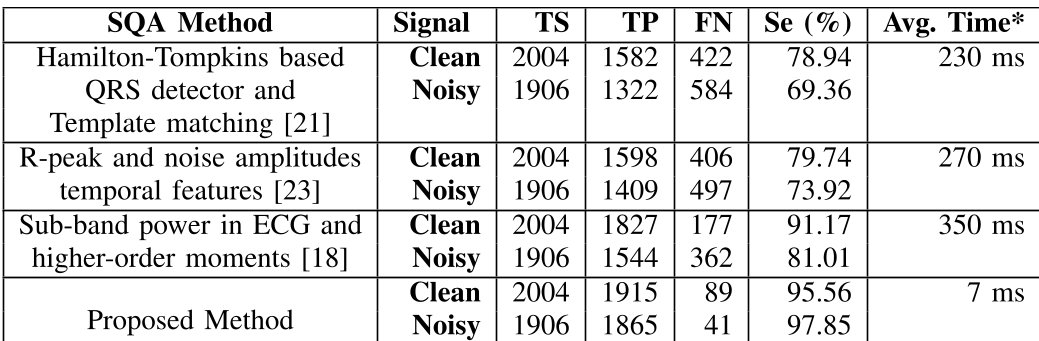 Table 1: Performance comparison showing the superior speed and sensitivity of the proposed method.
Critical Analysis & Conclusion
Takeaway
Quality-aware IoT is the future of mobile health. By moving the "logic" of data acceptability to the edge, we create more sustainable and clinically trustworthy devices.
Limitations
- Contextual Complexity: The system currently categorizes most high-activity signals as "Bad." However, recording ECG during exercise is a specific clinical need (Stress Testing).
- Hardware Variance: The thresholds (like 0.05 mV) may need dynamic calibration depending on the specific ADC (Analog-to-Digital Converter) resolution of different wearable sensors.
Future Outlook
The logical next step is integrating this with Physical Activity Recognition. If the system knows the user is "Running," it could adapt its noise tolerance rather than simply discarding the data, providing a more context-aware health profile.