
Decoding the Anxious Heart: Real-Time Social Anxiety Detection via Heartbeat Complexity
Toward Constructing a Real-time Social Anxiety Evaluation System: Exploring Effective Heart Rate Features
This paper introduces a real-time social anxiety evaluation system based on heart rate analysis, specifically proposing the Range of Local Hurst Exponents (RLHE) as a key feature. Using SVM classification, the system achieves an 81.82% generalization accuracy in detecting high-anxiety states in real-world thesis defense scenarios.
TL;DR
Social anxiety doesn't just make your heart beat faster; it fundamentally changes the pattern and complexity of your heart rhythm. This paper presents a breakthrough system that uses the Range of Local Hurst Exponents (RLHE) to detect acute social anxiety in real-time. By moving beyond simple heart rate averages to complex fractal analysis, the researchers achieved over 81% accuracy in predicting anxiety during actual university thesis defenses.
Background Positioning
While most "stress-detecting" wearables rely on simple heart rate or skin conductance, this work elevates the field into Affective Computing. It transitions from observing pathological heart conditions to detecting temporary physiological shifts caused by social evaluation, establishing a new SOTA for individual-independent anxiety monitoring.
The Core Insight: Loss of Complexity
The fundamental motivation of this study lies in a biological paradox: a healthy heart is not a metronome. Healthy heartbeats exhibit "multi-fractal" structures—complex, self-similar patterns across different time scales.
The authors hypothesized that social anxiety triggers a "loss of complexity." When the sympathetic nervous system takes over during a high-stakes speech, the heart's natural fractal behavior is suppressed. To measure this in real-time (where you only have a few minutes of data), they developed a modified version of the Hurst exponent that works on much smaller time scales than previous medical models.
Methodology: The RLHE Advantage
The researchers combined 11 conventional features (like Mean RR interval and Power Spectra) with their novel RLHE feature.
1. Data Acquisition
They induced anxiety using the Trier Social Stress Test (TSST), where subjects speak in front of a panel. They then validated the model using a "wild" scenario: graduate students defending their master's theses.
2. Feature Architecture
The RLHE is calculated using Wavelet Transforms. Unlike standard HRV metrics that look at overall variance, RLHE looks at the "local" fractal scaling. As shown in the architecture, they used a running window of 104 heartbeats—short enough for real-time feedback but long enough for mathematical stability.
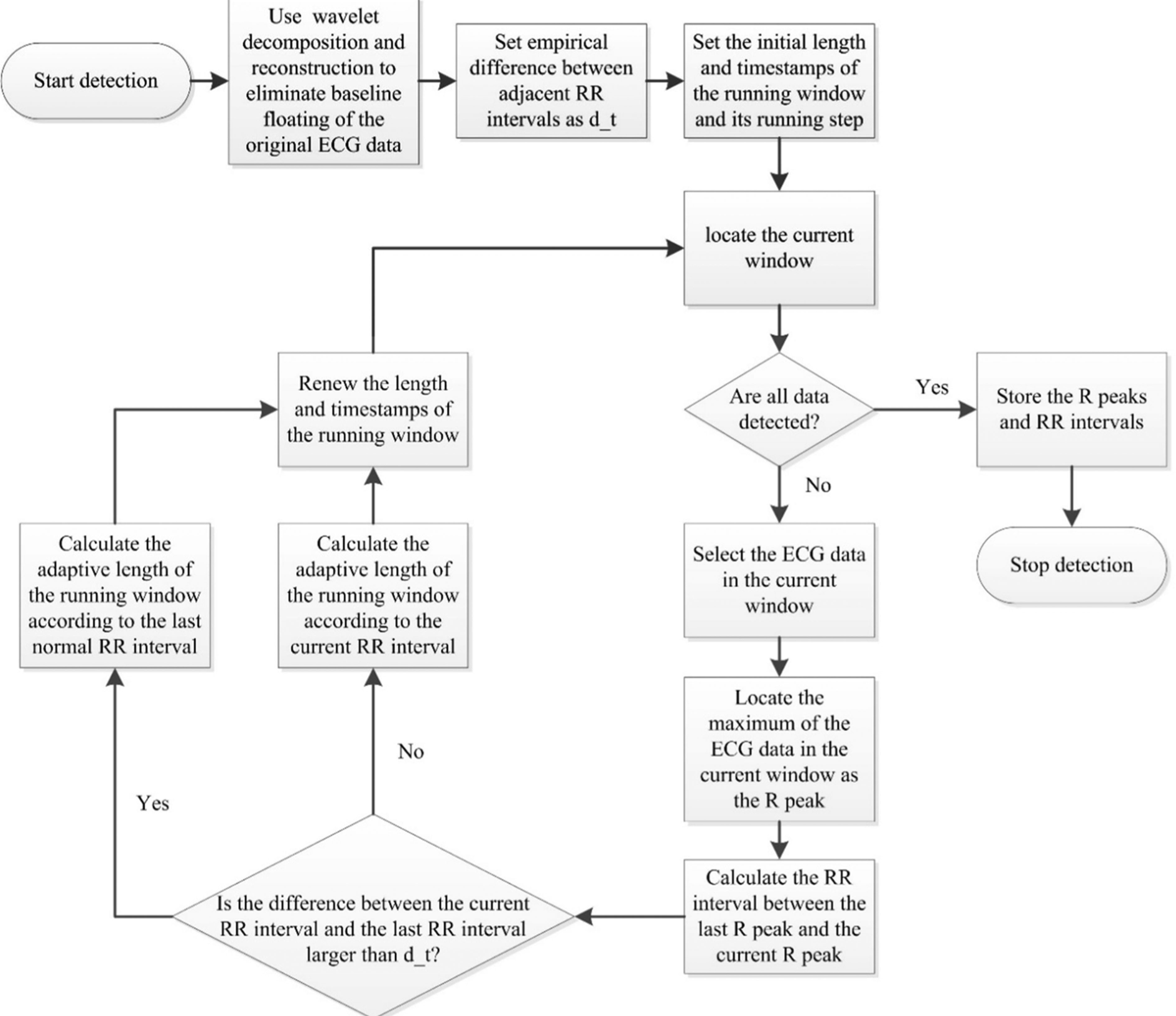 Figure 1: The automatic R-peak detection algorithm ensures precise Inter-Beat-Interval (IBI) extraction, the foundation for complexity analysis.
Experimental Results and SOTA Comparison
The results were striking. The t-test revealed that high anxiety significantly reduced the RLHE (p-value < 0.00001).
- Classification Performance: Using an SVM classifier, they reached an F1-score of 0.905.
- Feature Importance: Through backward feature selection, RLHE remained the most critical feature across all classifiers (SVM, Naive Bayes, KNN).
- Real-World Validation: In the thesis defense group, the system correctly identified high-anxiety moments (listening to harsh questions or receiving negative feedback) with an 81.82% success rate.
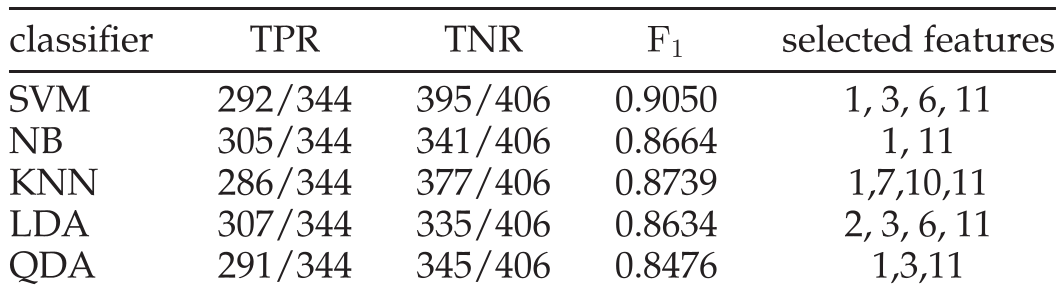 Table 1: Performance metrics showing the superiority of the SVM classifier when RLHE is included in the feature set.
One of the most compelling visualizations in the paper is the scatter plot below, which shows how RLHE (Feature #11) provides much cleaner separation between high and low anxiety states compared to traditional frequency-domain features.
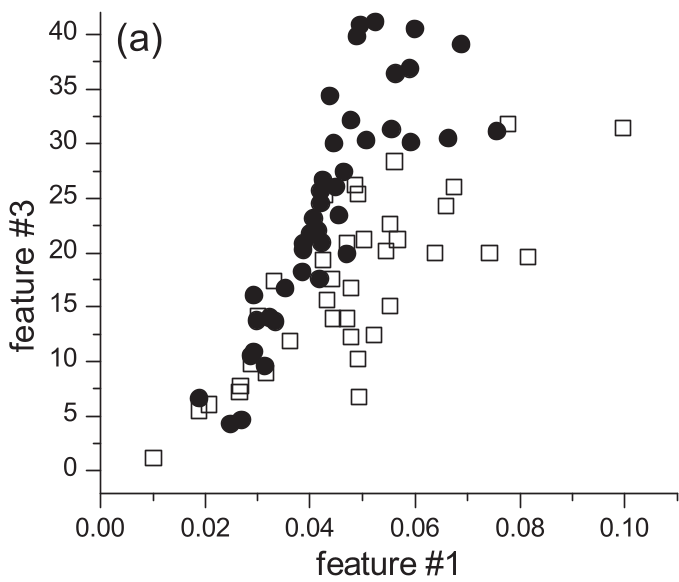 Figure 2: Scatter plot of pairwise features. Notice how Feature 11 (RLHE) significantly reduces the overlap between anxiety classes.
Critical Insight & Conclusion
The true value of this work is its generalizability. Most emotion recognition models struggle with "individual differences"—what is high heart rate for one person is normal for another. By focusing on complexity (fractal structure) rather than absolute levels, this system transcends individual baseline variations.
Limitations & Future Work
- Motion Artifacts: While a 400Hz sampling rate is good, physical movement during a speech can still "pollute" ECG data.
- Cumulative Effects: The authors suggest this system could eventually track the cumulative damage that chronic social anxiety does to the heart over years.
In summary, this paper effectively moves psychological monitoring from the lab to the "real world," providing a mathematical lens (RLHE) through which we can see the hidden stress of the human heart in real-time.