
EmotionPi: Bridging the Gap in Real-Time Speech Emotion Recognition on Embedded Systems
An Investigation of the Accuracy of Real Time Speech Emotion Recognition
This paper investigates the accuracy of Real-Time Speech Emotion Recognition (SER) on embedded systems, specifically using a Raspberry Pi 3 B+. The researchers propose a hybrid ensemble classifier that aggregates predictions from multiple models (SVM, MLP, CNN, etc.) to achieve State-of-the-Art performance on Emo-DB (83.27%) and RAVDESS (67.19%) datasets.
Executive Summary
TL;DR: This research tackles the "accuracy gap" in Speech Emotion Recognition (SER) by deploying a hybrid ensemble system on a Raspberry Pi 3 B+. By combining 222 global audio features with a voting-based ensemble of non-linear classifiers (SVM, MLP, NN), the authors achieved up to 83.27% accuracy. Their key discovery: personalizing the model with user-specific data is the most effective way to overcome the limitations of standard emotional databases.
Background: Within the landscape of Human-Computer Interaction (HCI), SER is a critical frontier for making AI like Siri or Alexa feel "human." This work moves SER from high-compute cloud environments to localized embedded hardware, addressing the practical hurdles of noise, latency, and model robustness.
The "Acted" vs. "Real" Paradox
The fundamental motivation for this study is the failure of traditional models in the real world. Most existing SOTA models are trained on databases like Emo-DB, where professional actors exaggerate emotions. When these models meet the "induced" (natural) emotions of a real user via a low-cost microphone, accuracy plummets.
The authors identify three main pain points:
- Environment Noise: Microphones pick up static and reverberation.
- Algorithmic Variance: No single classifier is universally "best" for non-linear speech features.
- Training Mismatch: Lab datasets don't match the specific vocal characteristics of individual users.
Methodology: The Hybrid Ensemble Approach
The authors propose a system called EmotionPi. The core innovation isn't just a new model, but a robust pipeline designed for the constraints of a Raspberry Pi.
1. Robust Voice Detection
Instead of a standard Voice Activity Detector (VAD) which often mistakes noise for speech, the system uses Snowboy, a hotword detector. This ensures the system only activates and records when intentionally prompted.
2. High-Dimensional Feature Extraction
The system extracts 222 global features, including:
- Spectral Features: MFCCs, Spectral Centroid, and Rolloff.
- Teager Energy Operator (TEO): Specifically included to detect "stressed" emotions like anger.
- Chroma Vectors: To capture harmonic content.
3. The Ensemble Classifier
Rather than relying on one model, the system uses an Ensemble Classifier that takes a majority vote from:
- SVM (with a linear kernel)
- MLP (Multi-Layer Perceptron)
- NN1 & NN2 (Keras-based models with Adam and RMSprop optimizers)
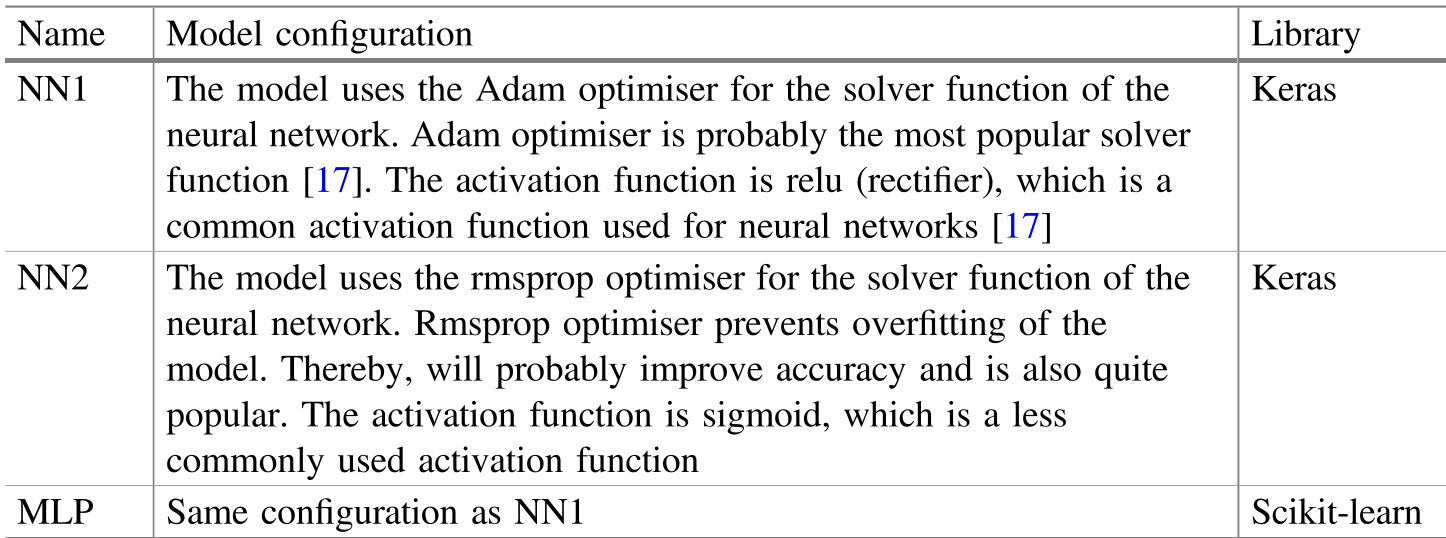 The configuration of MLP and Neural Network models used in the ensemble.
Experimental Insights
Acted vs. Induced Accuracy
The experiments confirmed the difficulty of induced emotions. While the system soared on the acted Berlin dataset (83.27%), it reached 67.19% on the more realistic RAVDESS dataset.
The Noise Reduction Counter-Intuition
Interestingly, the authors found that complex noise reduction sometimes decreased accuracy. As seen in Figure 6, the highest accuracy was often achieved with raw audio, suggesting that aggressive noise filters might be "cleaning away" the subtle emotional cues (like breathiness or micro-pitch shifts) that the models rely on.
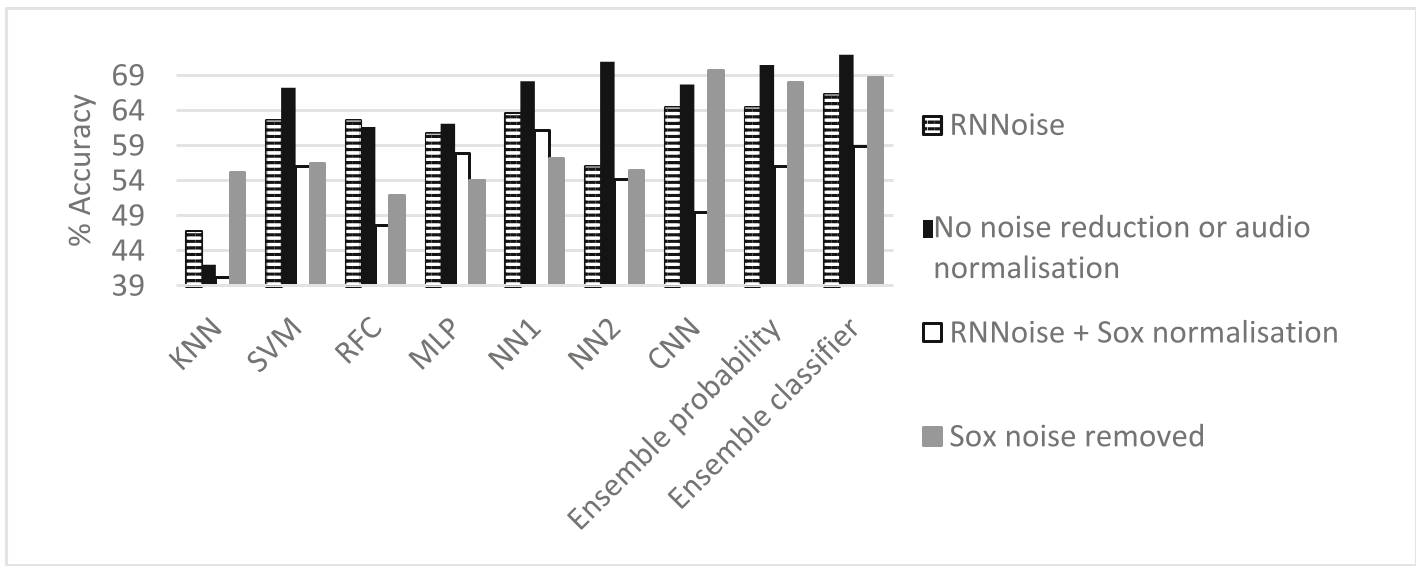 Comparison of accuracy across different noise reduction techniques. Note that Sox-based filtering performed slightly better than RNNoise.
The Case for Personalization
The most striking result came from the real-time case study. When the system was trained only on the general database, it struggled to detect "Anger." However, when the system was fine-tuned on the specific user’s voice, the detection of anger and other emotions improved drastically (see Figure 8).
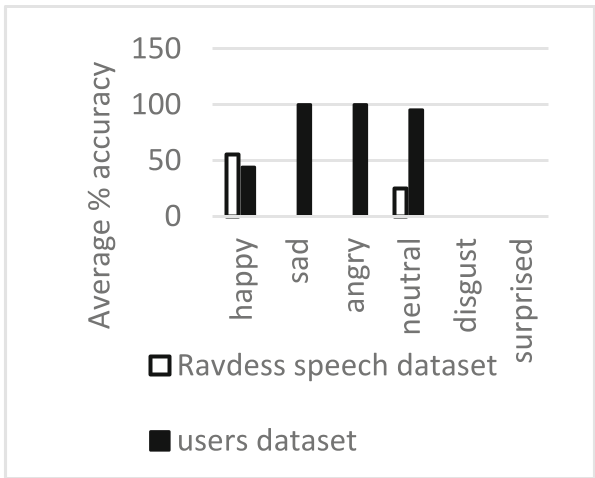 Dramatic accuracy gains when training on user data vs. standard speech datasets.
Critical Analysis & Future Outlook
Takeaways:
- Ensembles Matter: The hybrid approach successfully smoothed out the "dips" in accuracy of single models.
- Edge Constraints: Convolutional Neural Networks (CNNs) were found to be too slow for training on the Raspberry Pi (8 hours vs. 1 hour for MLP), leading the authors to remove them from the real-time training pipeline.
Limitations: The study is limited by a small sample size for real-world testing (N=3). Additionally, features like Fourier Parameters (FP) and Wavelet Packet Cepstral Coefficients (WPCC)—which might offer higher accuracy—were not implemented due to library limitations in Python for the Raspberry Pi.
Conclusion: EmotionPi demonstrates that high-accuracy SER is possible on inexpensive hardware, provided we shift our focus from "generic SOTA models" to "user-adaptive ensemble models." The future of emotional AI lies in edge devices that learn your voice, rather than trying to understand everyone's voice at once.