
Turning Tweets into Traffic Sensors: High-Accuracy Real-Time Event Detection
14348_Real-Time Detection of Traffic From Twitter Stream Analysis.
The paper presents a real-time traffic monitoring system that leverages Twitter as a "social sensor" to detect road events. Using a Service Oriented Architecture (SOA) and Support Vector Machines (SVM), it achieves state-of-the-art accuracy in binary (95.75%) and multi-class (88.89%) traffic classification within the Italian road network.
TL;DR
Researchers have developed a sophisticated monitoring system that treats Twitter users as "social sensors" to detect traffic jams and accidents in real-time. By applying advanced text mining and Support Vector Machines (SVM) to Italian tweets, the system achieves an impressive 95.75% accuracy, often beating official news websites by over an hour in reporting road incidents.
The Motivation: Why Your Feed is Better Than a Camera
Traditional Intelligent Transportation Systems (ITS) are expensive. Installing physical loop detectors and cameras every few kilometers is economically unfeasible for many suburban and secondary roads.
The authors argue that we already have a ubiquitous sensor network: people. When drivers get stuck in a "coda" (queue), they often tweet about it instantly. However, the technical challenge is "separating the wheat from the chaff"—filtering out the 40% of "pointless" tweets and resolving linguistic ambiguities (e.g., distinguishing "drug trafficking" or "network traffic" from "road traffic").
Methodology: From Raw Text to Structural Insight
The system architecture follows a robust Service Oriented Architecture (SOA) divided into three core modules:
- Fetch & Pre-processing: Capturing raw Italian tweets based on geographic filters and keywords like "traffico," "coda," and "incidente."
- Elaboration: This is the "brain" of the operation. It uses tokenization, removes stop-words, and applies the Porter stemming algorithm to reduce words to their literal roots (e.g., "trafficato" becomes "traffic").
- Feature selection: Not all words are equal. The system uses Information Gain (IG) to identify which "stems" actually help predict traffic and weights them using the Inverse Document Frequency (IDF) index.
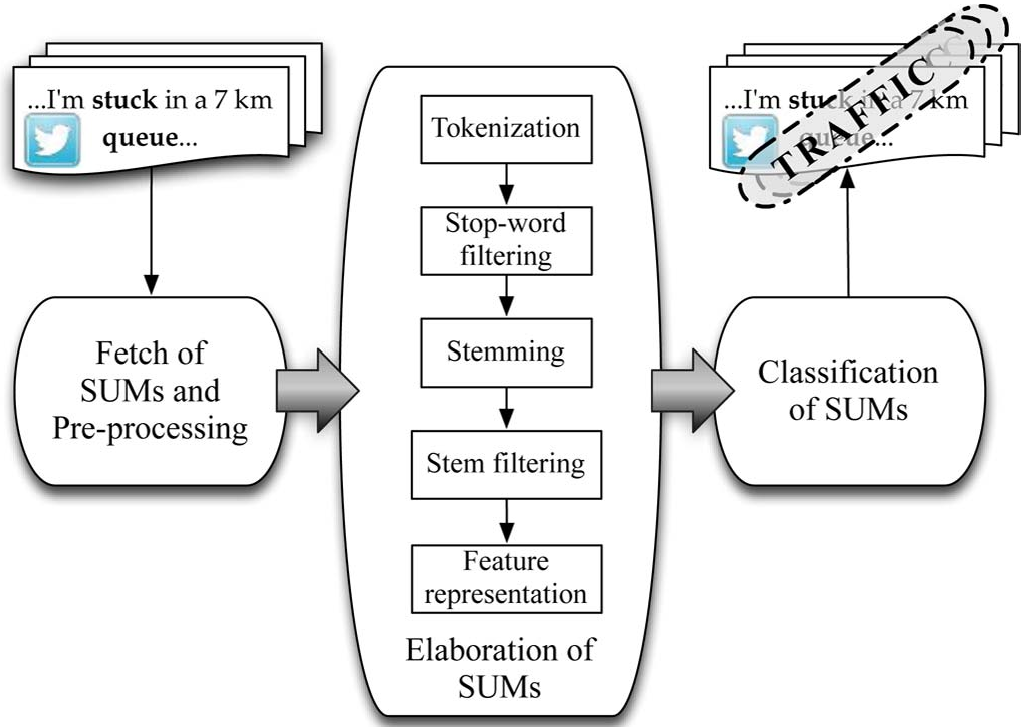 Figure 1: The system's event-driven architecture from data fetch to user notification.
Results: Beating the Industry Standard
The researchers tested several machine learning models, including Naive Bayes, C4.5 Decision Trees, and k-Nearest Neighbor. SVM (Support Vector Machine) emerged as the clear winner.
- Binary Accuracy: 95.75% (Traffic vs. Non-Traffic).
- Multi-class Accuracy: 88.89% (Congestion vs. External Events like concerts/football matches).
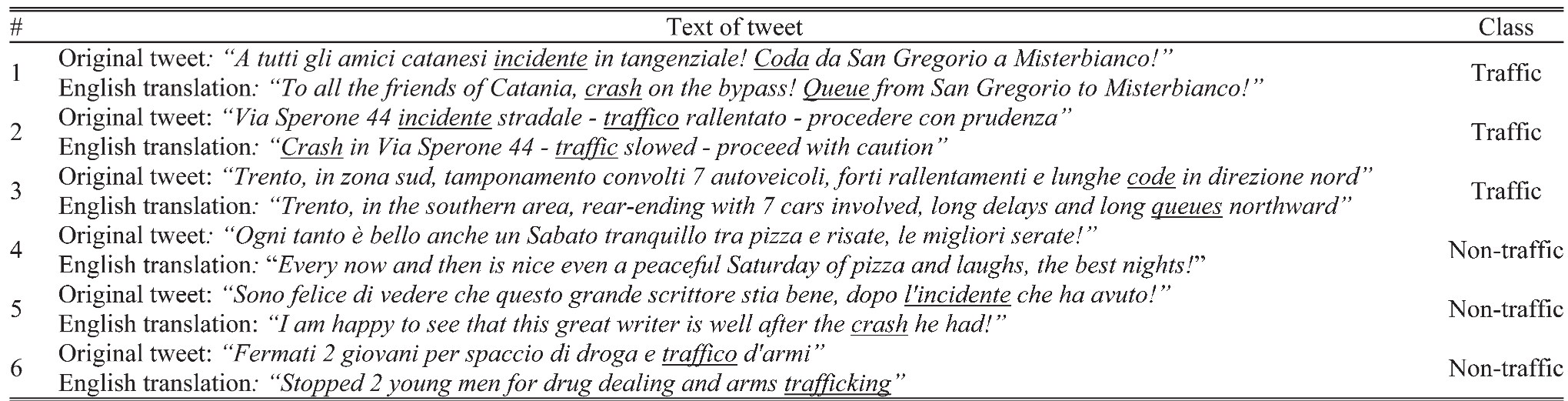 Table: Examples of how the system successfully filters personal "pizza nights" from actual road incidents.
The most striking result was the system's latency. In a field test involving 70 events, the Twitter-based system detected 20 events earlier than official government news channels. For instance, a crash on the A4 highway was detected 66 minutes before official channels posted the news.
Critical Analysis & The Road Ahead
While the accuracy is remarkably high, the system has inherent limitations:
- The "Stop-and-Share" Bias: Drivers only tweet when traffic is so bad they are forced to stop. Minor slowdowns often go unreported by "social sensors."
- Language Specificity: The current model is finely tuned for Italian. While the framework is portable, the stemming and stop-word rules must be rebuilt for other languages.
Conclusion
This research proves that with the right text-mining pipeline, social media is no longer just "noise"—it is a high-fidelity, low-cost tool for urban management. By classifying why traffic is happening (e.g., a planned football match vs. an unplanned crash), city administrations can move from reactive to proactive management.
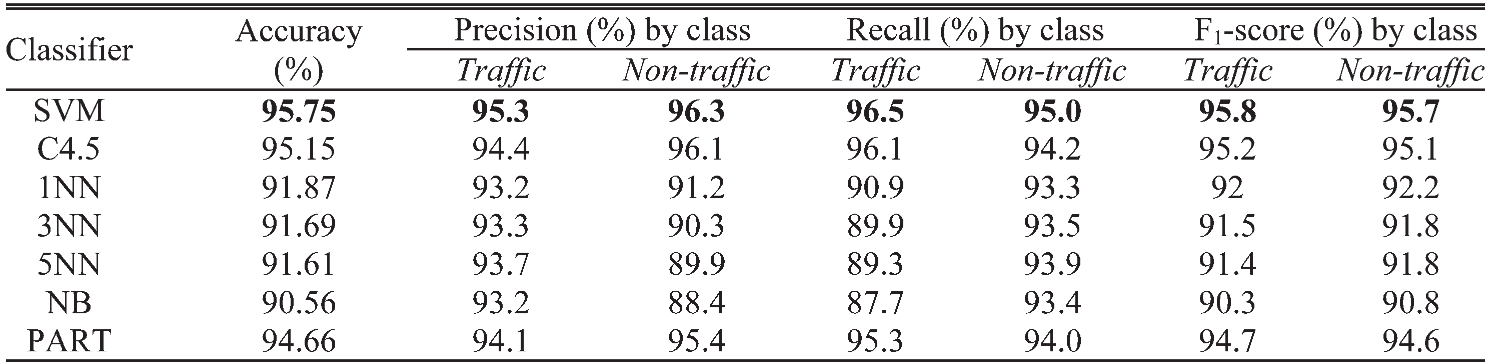 Table: Comparative performance of various classification models.