
Beyond Keywords: Leveraging ConceptNet for Real-Time Twitter Crisis Monitoring
Real-time monitoring of Twier traffic by using semantic networks
This short paper presents the SLAIR framework, a real-time Twitter monitoring system designed for Open Source Intelligence (OSINT). By integrating ConceptNet, a common-sense semantic network, the system achieves SOTA performance in detecting unexpected, unscheduled events like natural disasters or safety threats.
TL;DR
In the fast-moving world of Social Network Analysis (SNA), "keyword matching" is no longer enough to catch emergencies. This paper introduces an enhanced version of the SLAIR framework, which utilizes ConceptNet—a common-sense semantic network—to detect "unexpected" events (like school accidents or attacks) that lack pre-defined watch-lists. By moving from simple word definitions to common-sense reasoning, the system significantly improves the detection of relevant but non-obvious information.
The Problem: The "Unknown Unknowns" of Social Media
Monitoring social media for public safety is notoriously difficult. While we can easily track a "Scheduled Protest" (an expected event) using specific keywords, how do we track a "School Roof Collapse" (an unexpected event) before we even know it happened?
Existing tools often rely on:
- Strict Keywords: If the user doesn't use the exact word, the system misses it.
- Lexical Databases (e.g., EuroWordNet): These focus on synonyms and dictionary definitions, failing to capture the "logic of everyday life" (e.g., the relationship between "rain" and "danger of flooding").
When an unpredicted crisis occurs, the gap between the analyst's general profile and the messy reality of Twitter traffic leads to critical information falling through the cracks.
Methodology: Common-Sense Inference via ConceptNet
The authors propose integrating ConceptNet into the SLAIR (SeaLab Advanced Information Retrieval) pipeline. Unlike EuroWordNet, which is purely lexical, ConceptNet organises knowledge as a semantic network of nodes representing words/phrases and labeled relationships (e.g., Sofa —UsedFor—> Sitting).
The Processing Pipeline:
- Language Identification & Stemming: Cleaning raw tweets at scale.
- Profile Definition: The analyst sets a general "watch-list" of concerns.
- Semantic Augmentation: This is the "secret sauce." The system takes terms from the watch-list, maps them to ConceptNet, and expands the search space to include contextually related common-sense concepts.
- Unsupervised Clustering: An algorithm groups messages based on semantic affinity.
- Regrouping: A final pass "attracts" messages that might not have hit the original keywords but are semantically linked to the identified clusters.
Fig 1: Conceptual representation of the SLAIR framework using semantic network augmentation.
Experimental Evidence: ConceptNet vs. EuroWordNet
The researchers tested three Italian-language scenarios: a Public Holiday (Expected), a Law Court Attack (Unexpected), and a School Accident (Unexpected).
They used three metrics:
- Presentation Effectiveness (PE): Overall relevance of the results.
- Attraction Effectiveness (AE): Ability to find relevant tweets that didn't contain the specific keywords.
- Grouping Effectiveness (GE): The ratio of "attracted" relevant content to "scored" relevant content.
Key Results:
In the Public Holiday Scenario, ConceptNet achieved a GE of 2.03, more than doubling the performance of EuroWordNet (0.91). In the Law Court Attack scenario, while both systems performed well on obvious content, ConceptNet was superior at forming compact, high-value clusters for the analyst.
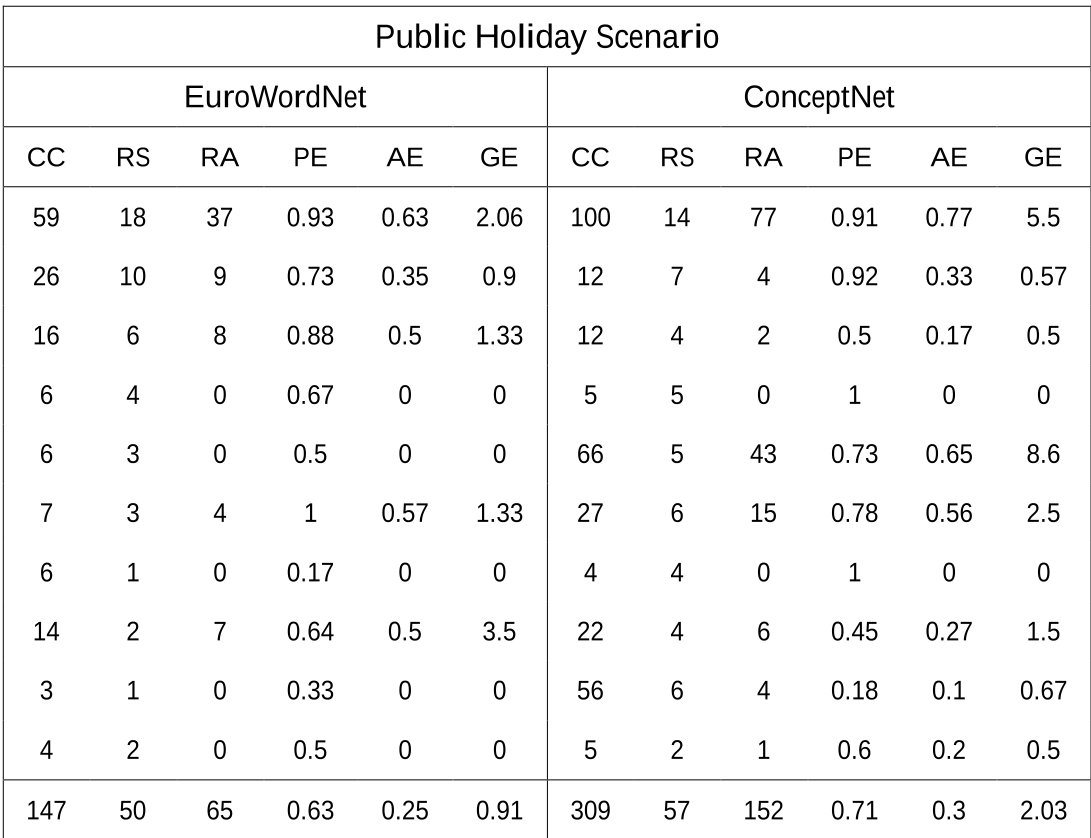 Table 1: Performance metrics comparison revealing ConceptNet's superior attraction capabilities.
The data clearly shows that ConceptNet's "general world knowledge" allows the system to act as a more intuitive filter, effectively "guessing" what information is relevant to an analyst’s goals even during the chaos of an unfolding disaster.
Critical Insight & Conclusion
The core value of this work is the realization that context beats keywords. For Law Enforcement and Public Safety, the ability to "attract" relevant tweets that don't match a pre-defined list is the difference between early intervention and late reaction.
Limitations & Future Directions:
- Computational Cost: Comparing every tweet against a massive semantic matrix in real-time is expensive; the paper notes use of "watch-list-based strategy" for speed.
- Slang & Evolving Language: While ConceptNet is great for common sense, it may still struggle with the rapidly shifting slang and hashtags typical of Twitter "Internet-speak."
Takeaway: By embedding semantic relational knowledge into the monitoring chain, SLAIR transforms from a reactive search tool into a proactive intelligence assistant. Future work may likely combine these semantic networks with modern Transformer-based embeddings (like BERT/RoBERTa) for even deeper nuance.