
Beyond Geographic Overlap: Real-time Mobility Modeling and Temporal Fingerprinting
A Real-Time User Mobility Pattern Modeling and Similarity Measurement for Mobile Social Networks
The paper introduces a real-time data-driven framework for modeling user mobility patterns and measuring user similarity in Mobile Social Networks (MSNs). By integrating a "Fast-HAC" clustering algorithm and a "Composition Similarity" metric that combines spatial and temporal dimensions, the system enables efficient friend recommendation based on raw GPS trajectory data.
TL;DR
The explosion of GPS data in Mobile Social Networks (MSNs) demands more than just "where you go"; it requires knowing "how" and "when" you move, processed in real-time. This paper presents a framework that accelerates Region of Interest (RoI) construction using Fast-HAC and introduces a Composition Similarity metric that combines spatial paths with temporal transition speeds to enable highly accurate friend recommendations.
Problem & Motivation: The Real-time and Temporal Gap
Most existing trajectory mining systems suffer from two fatal flaws:
- Computational Bottlenecks: Hierarchical clustering, while accurate for spatial data, is traditionally too slow for the "explosive growth" of real-time trajectory streams.
- Temporal Blindness: Two users might visit the same three malls in the same order, but if one spends 10 minutes traveling between them and another takes 2 hours, are they really similar? Standard spatial-only metrics would say yes, leading to poor recommendations.
The authors' insight is twofold: optimize the clustering algorithm through caching and priority queues, and treat "transition time" as a first-class citizen in similarity calculation.
Methodology: The Core Framework
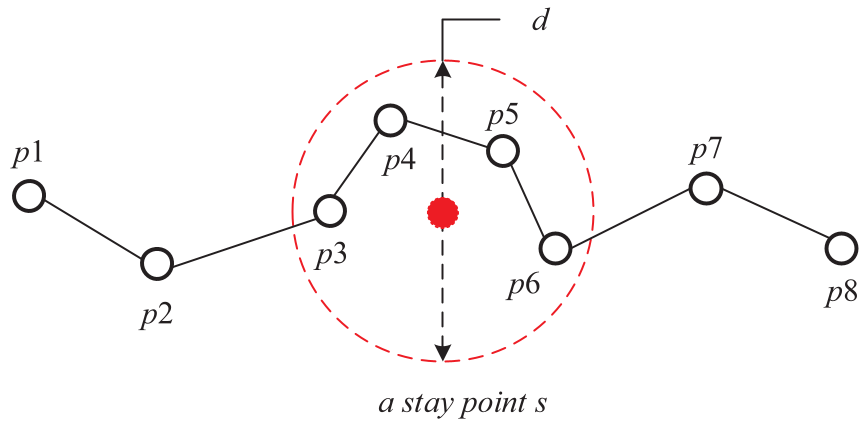
The framework (illustrated below) transforms raw, noisy GPS points into high-level "Maximal Trajectory Pattern Sets."
1. Data Refinement & Fast-HAC
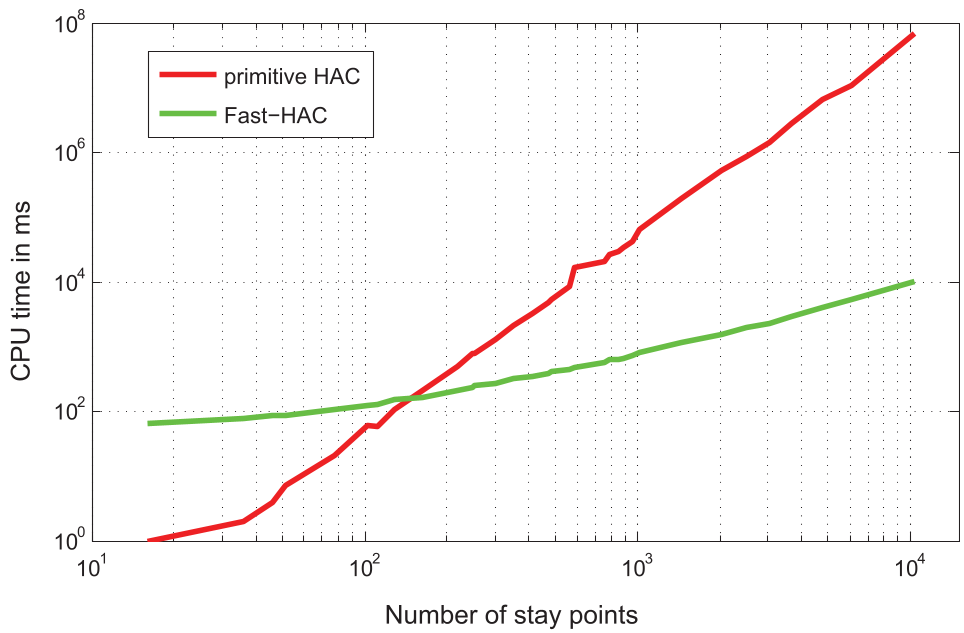
Before clustering, the system uses Fast-LOF (an EM-based outlier detection) to strip away "occasional" visits that bloat the data. The heart of the speedup is Fast-HAC, which addresses the or complexity of standard clustering by maintaining a list of nearest-neighbor candidates and distance lower bounds.
2. Composition Similarity Measurement
Instead of just comparing sequences, the system calculates a weighted score:
- Spatial Similarity: Based on the Longest Common Subsequence (LCSS) of RoIs.
- Temporal Similarity: Measures "Transition Time Coverage" (ttc). If the time taken to move from RoI A to RoI B is significantly different, the similarity score is penalized.
- Importance Weighting: Uses a TF-IDF variant where patterns rare in the general population but frequent for a specific user are given higher weight.
Experiments & Results
The authors validated the system using a real-world dataset of 560 users.
Performance Gains
As seen in the comparison graph, while primitive HAC struggles as data scales, Fast-HAC maintains a near-linear efficiency profile, keeping total processing for large datasets within the critical 10-second window for real-time responsiveness.
Accuracy in Similarity
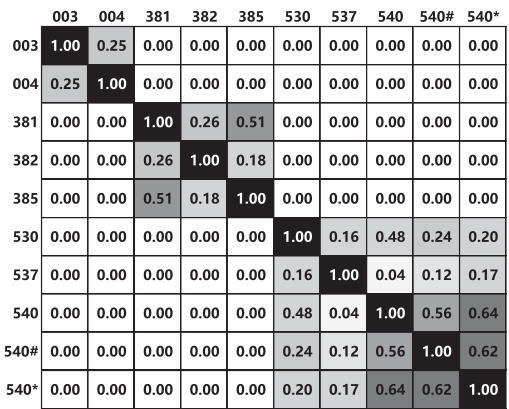
The value of temporal modeling is most striking in the "noise reduction" of user matches. In Fig. 9 (Spatial only), several unrelated users appeared highly similar. In Fig. 10 (Composition), these scores were "discounted" by the temporal mismatch, while the similarity of test-controlled users (540, 540#, 540*) remained robustly high.
Critical Analysis & Conclusion
Takeaways
The transition from "raw points" to "semantic regions (RoIs)" allows for a much more logical understanding of human behavior. By optimizing the HAC algorithm, this paper proves that sophisticated hierarchical models can coexist with real-time requirements.
Limitations & Future Work
While the temporal metric captures transition times, it doesn't fully account for stay durations within an RoI (e.g., spending 5 hours at a library vs. 5 minutes). Future iterations could benefit from including social graph data alongside movement patterns to further refine the "Composition Similarity."
As LBSN applications move towards hyper-personalization, the ability to model the tempo of human life—as done in this study—will likely become a standard requirement for recommendation engines.