
Social Media Lens: Can Virtual Clues Predict Real-World Revolutions?
Real-World Behavior Analysis through a Social Media Lens
This paper explores using social media as a computational "lens" to analyze and predict real-world collective behavior, specifically during high-impact events like the Arab Spring. By processing 35 million tweets and millions of blog posts, the authors evaluate a four-step model—community selection, collection, analysis, and prediction—to bridge the gap between virtual activity and physical events.
TL;DR
Researchers from Arizona State University and the University of Hawai'i investigated whether the digital footprints we leave on Twitter, Facebook, and the blogosphere can accurately predict large-scale human behaviors, such as the Arab Spring. While social media is incredibly effective at "mining" collective attitudes and identifying key influencers, the study reveals that predicting the actual physical outcomes remains a sophisticated challenge fraught with demographic biases and data noise.
Contextual Positioning
This work sits at the intersection of Computational Social Science and Big Data Analytics. It moves beyond simple sentiment analysis (like predicting movie revenues) into the high-stakes arena of political instability and social movements, acting as a foundational test for whether "passive" digital observation can replace "active" traditional surveys.
The "Mirror" Problem: Why Prediction is Hard
The authors identify a fundamental gap: the virtual world is not a perfect mirror of the physical world.
- Demographic Skew: The people tweeting about a revolution are not always the people on the streets.
- The "Outsider" Noise: In the case of Libya and Egypt, up to 90% of the social media engagement originated from outside the Arab world.
- The Sentiment-Action Paradox: High online praise (e.g., the outpouring of grief after Steve Jobs' death) doesn't always correlate with expected physical outcomes (e.g., Apple stock actually dropped despite the massive online "Like" count).
Methodology: The 4-Step Pipeline
The researchers developed a systematic approach to bridge the virtual-physical divide:
- Community Selection: Identifying stable ethnic or geographic groups online.
- Data Collection: Scraping 35 million tweets and 135k Facebook pages.
- Online Behavior Analysis: Using NLP to extract frequent phrases and mood trajectories.
- Behavior Prediction: Using multivariate regression to see if "word frequency today" predicts "protests tomorrow."
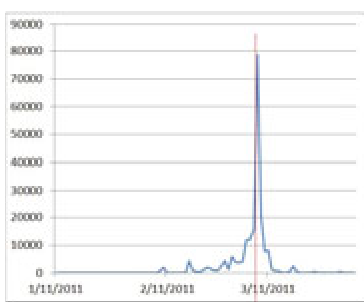
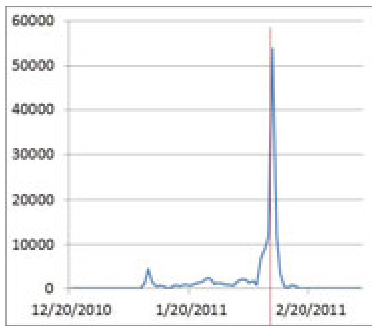 Note: The synchronization between online discourse and real-world peaks (as seen in the paper's figures) supports the hypothesis that digital dialog mirrors ground reality.
Key Insights from the Arab Spring
The study's "lens" revealed fascinating nuances in the collective psyche of the Middle East:
- Attitude Nuance: While Western observers might see the Arab Spring as a monolith, the data showed Yemenis were primarily concerned with Security, while Egyptians focused on Revolution and Freedom.
- The Lag Effect: The authors found they could identify significant predictive categories even with a two-week lag, suggesting that the "ignition" of a social movement happens online well before the first protester arrives.
- Key Figure Detection: The method accurately identified the central "movers and shakers" of the movements by analyzing mention frequencies, showing that digital nodes often represent physical leadership.
Critical Analysis: The Limits of the Lens
Despite the successes, the authors are refreshingly honest about the limitations. Prediction fails when:
- Unexpected Events: "Black Swan" events produce a massive online spike after they happen, making pre-event prediction impossible.
- Data Integrity: In non-democratic regimes, users often use nicknames or hide their geotags to avoid persecution, making the data source "unreliable" for confident geolocated analysis.
- The Spam Factor: Government-sponsored "paid bloggers" can intentionally skew statistical models, creating a false sense of public support.
Conclusion & Future Outlook
The paper concludes that while social media is a "gold mine" for understanding what people think (attitudes), it is not yet a crystal ball for what people will do (behavior).
The path forward lies in Hybrid Modeling. To truly predict the next "Arab Spring," we cannot look at Twitter in a vacuum; we must combine digital sentiment with physical variables like food prices, unemployment rates, and local political structures. The "Social Media Lens" is powerful, but it requires a secondary lens of traditional social science to find the true focus.