
Bridging the Privacy Gap: Social Network Analysis as a Security Layer
Real-world oriented information sharing using social networks
This paper introduces a real-world-oriented information sharing system that leverages automatically mined social networks to manage data privacy. By integrating with Semantic Web standards like FOAF (Friend of a Friend), the system allows users to define fine-grained access control lists (ACLs) based on social relationships and structural network analysis.
TL;DR
The early 2000s marked a shift from static web pages to dynamic "Social Web" content, but privacy controls lagged behind. This paper presents a system that mines real-world social relationships (from co-authorships to shared events) and provides users with Social Network Analysis (SNA) tools to decide exactly who gets to see their data. It transforms privacy from a manual "block/allow" list into a strategic exercise based on network centrality and tie strength.
1. The Paradox of Digital Sharing
In the real world, we share information selectively: you might show a draft paper to a colleague but only family photos to relatives. However, early web tools were blunt instruments. As the authors note, the lack of sophisticated access control makes users feel "unsafe," which remains a primary hurdle for information dissemination. The core motivation here is to replicate real-world trust structures in the digital realm.
2. Methodology: From Raw Data to Social Insights
The system doesn't rely on users manually adding "friends." Instead, it functions as an intelligent layer that extracts relationships from the digital footprint of a community.
Architecture & Extraction
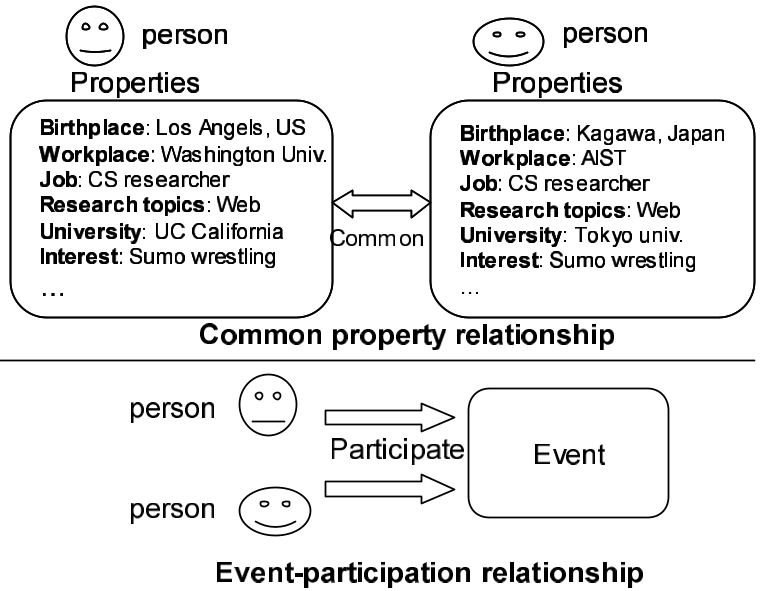
The "plug-in" architecture allows any application (Blog, Wiki, etc.) to query a central social database. The system mining focuses on:
- Web Co-occurrence: Finding if two names appear together frequently in search results.
- Environmental Sensors: Detecting physical proximity at conferences or parties.
- FOAF Integration: Leveraging existing Semantic Web ontologies to maintain metadata.
The Power of Social Network Analysis (SNA)
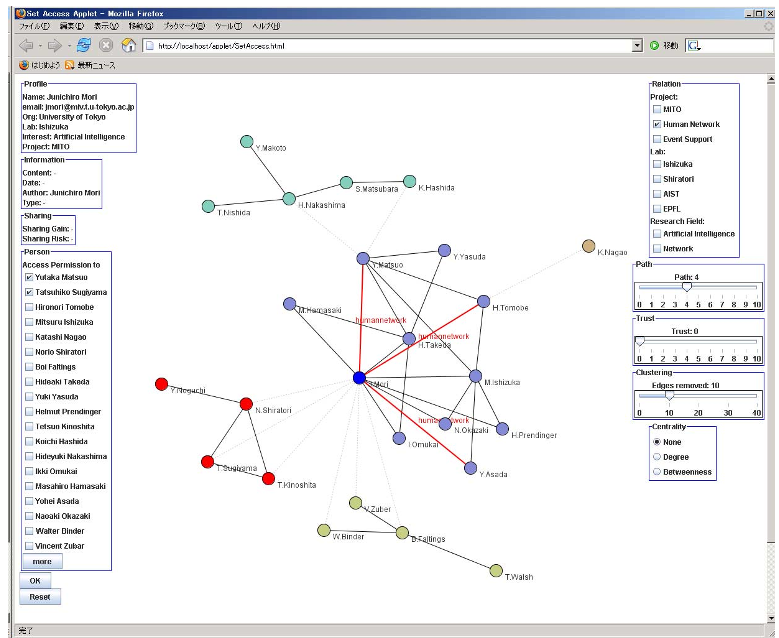
Rather than just "who do you know?", the system empowers users to ask "how central is this person?". The authors incorporate three key metrics to help users understand the potential "leakage" or "reach" of their information:
- Degreeness: How many direct connections does the recipient have? (High = High visibility).
- Betweenness: Does this person act as a "bridge" between two separate groups? (High = Risk of information traveling to unintended communities).
- Closeness: How quickly can information reach the entire network through this person?
3. Real-World Application: The Academic Example
The researchers tested this on an academic community site. This is a perfect test case because academic relationships are multi-faceted: a professor might be a co-author (strong tie) but also a project lead for a different, confidential project (restricted tie).
By using an Extended XACML (eXtensible Access Control Markup Language), the system creates portable policies. A researcher can set a policy like: "Only people with a 'Trust' score > 0.8 who are also in the 'Same Project' cluster can view this report."
4. Critical Insights & Conclusion
The "Strength of Weak Ties"
One of the most profound insights in this work is the practical application of Granovetter’s "Weak Tie" theory. The system warns users about recipients with high betweenness—these individuals are "local bridges." Granting them access is effectively granting access to the entire outside network, a nuance that traditional privacy settings completely miss.
Limitations & Future Work
While the system is proactive, it relies on the accuracy of mining. "Same name" co-occurrence on the web can lead to false positives (identity disambiguation). Furthermore, in a modern context, the "sensors" mentioned (physical proximity devices) have been largely replaced by GPS and Bluetooth in smartphones, though the privacy risks have only scaled upwards.
Final Takeaway
This paper was one of the first to argue that Social Topology is Security. By turning abstract sociological theories into clickable ACL policies, it paved the way for the smarter, context-aware privacy settings we see today in advanced enterprise collaboration tools.