
Beyond the Face: Enhancing Emotional Realism through Hairstyle Synthesis
Realistic emotion visualization by combining facial animation and hairstyle synthesis
This paper presents a realistic visual emotion synthesis system that integrates 3D facial animation with hairstyle synthesis to enhance emotional expressiveness. The system combines anatomical/parameterized facial models with mass-spring and cantilever beam hair models to produce synchronized, multifaceted emotional visualizations, specifically targeting anger and happiness.
TL;DR
While digital emotion research usually stops at the "face," this paper argues that hair is an essential, often overlooked component of emotional expression. By combining a hybrid anatomical facial model with sophisticated mass-spring and cantilever beam hair simulations, the authors create a system that visualizes emotions like "anger" and "happiness" with unprecedented completeness.
The Missing Piece in Emotion Visualization
In human-computer interaction (HCI), facial expressions are the gold standard for communicating emotion. However, we often ignore the "implicit" cues. Think of the idiom "hair standing on end" or the way hair flows during a joyful skip. Existing methods treats the face and hair as separate entities, often using static hair models that fail to react to the character's emotional state.
The challenge is twofold:
- Complexity: Simulating 100,000 hair strands is a computational nightmare.
- Expressiveness: How do you mathematically translate "anger" into hair movement?
Methodology: The Hybrid Architecture
The proposed system uses a three-stage pipeline to achieve realistic results.
1. The Facial Engine
The authors utilize an Anatomical Model consisting of skin, muscle, and skeleton. They specifically use the Waters model to simulate muscle tension. To prevent the "skin-splitting" effect common in pure physical simulations, they integrate a Parameterized NURBS surface to repair the mesh when deformation rates exceed a specific threshold.
2. The Hair Engine: Mass-Spring + Cantilever Beam
This is where the paper shines. They don't just use one model for hair; they use two based on the hair type:
- Mass-Spring Model: Used for the main body of the hair (straight or curly). It handles gravity and air resistance effectively.
- Cantilever Beam Model: Used for "fringes" (bangs). Because fringes require more stiffness and "stereotype" shapes, the cantilever beam provides the necessary structural integrity that springs lack.
 Caption: The overall framework showing the fusion of facial parameters and hair physics.
3. Emotional Mapping
- Anger: The system applies an electrostatic force () to each hair particle, causing it to "burst" out from the center of the head, simulating the cartoonish yet effective "hair-raising" anger.
- Happiness: The system utilizes "binding constraint forces" to synthesize horsetails and braids, coupled with a dynamic Wind Model to simulate the airy, light feeling of joy.
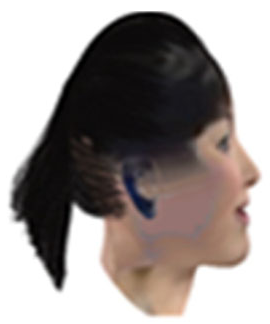 Caption: Visualizing happiness through the synthesis of horsetails and wind-blown hair.
Experiments and Performance
The system was tested on a workstation using an NVIDIA GTX960, achieving a frame rate of 23 FPS (0.043s/frame), making it suitable for real-time applications.
Objective Accuracy
The researchers used Root Mean Square Error (RMSE) to compare synthesized results against captured real-world images. The system achieved an average RMSE of 4.6, proving that the physics-based models closely approximate actual human hair and face geometry.
Subjective Realism
In a study with 20 participants, the "Horsetail" and "Braids" synthesis were the winners, with the majority of users rating them above 90% realism. Interestingly, the "Anger" hairstyle (standing hair) was rated slightly lower in realism, likely due to its cartoonish nature—though it significantly helped in "recognizing" the emotion.
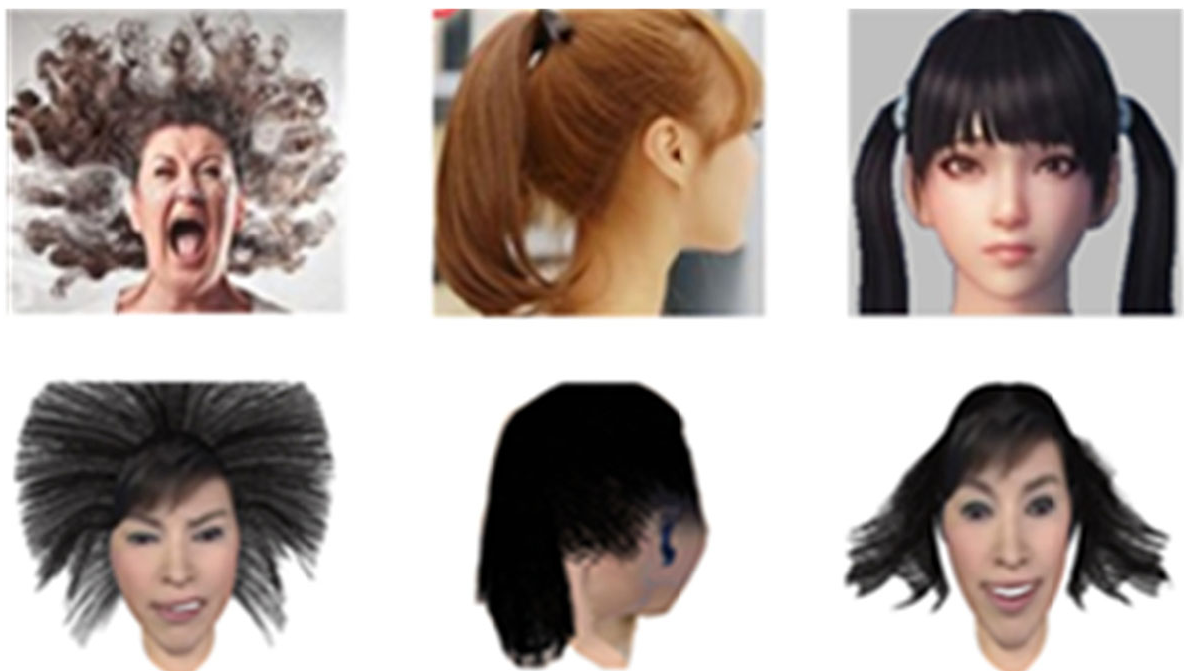 Caption: Comparison between actual human hairstyles (top) and the system's synthesized counterparts (bottom).
Critical Insight & Conclusion
The true value of this work is the validation of Multi-modal Emotional Synthesis. By recognizing that emotions are a "whole-head" experience, the authors have moved beyond simple mesh deformation and into the realm of complex physical storytelling.
Limitations: While the mass-spring model is versatile, it requires heavy manual parameter tuning for different hair types. Future iterations would benefit from automating these parameters through machine learning.
In conclusion, this research marks a significant step toward creating digital humans that don't just "look" like us, but "vibrate" with the same emotional energy—from the tips of their lips to the ends of their hair.