
Socially-Aware Mobility: Bridging the Gap in VANET Simulations
A Realistic Mobility Model Based on Social Networks for the Simulation of VANETs
The paper introduces a macroscopic mobility model for VANETs (Vehicular Ad-Hoc Networks) based on social network theory, implemented within the VNSim simulator. By leveraging algorithms like Girvan-Newman and the Caveman Model, it generates realistic vehicle movement patterns that mimic social groupings and daily routines, outperforming traditional random models.
TL;DR
Traditional VANET simulations often fail because they treat drivers like random particles. This paper presents a novel macroscopic mobility model integrated into the VNSim simulator that uses Social Network Theory to group vehicles by common destinations and social ties. By simulating human-like behavior, the model produces contact patterns (inter-contact time and duration) that match real-world empirical traces from ETH Zurich.
Background & Positioning
In the world of Vehicular Ad-Hoc Networks (VANETs), the validity of a networking protocol is only as good as the mobility model it is tested on. We have reached a point where microscopic models (car-following, braking) are quite mature, but macroscopic models—how flows of cars distribute across a city—remain stuck in "random-walk" logic. This paper positions itself as a "Bridge" work, infusing social logic into macroscopic traffic design to move from random movement to intentional, socially-driven mobility.
Motivation: Why Random Models Fail
The authors argue that human drivers do not move randomly; they move based on social obligations (commuting with colleagues, returning to family).
- Prior Work Limitation: Models like Random Waypoint (RWP) produce exponential distributions for contact times, which contradict the Power Law distributions observed in real-world traces.
- Insight: If we can model the "Social Relationship" between drivers, we can naturally simulate the clustering and "community" behaviors seen in city traffic.
Methodology: The Social Traffic Engine
The core of the methodology is a four-step pipeline that transforms social graph theory into physical movement on a map.
1. Social Clustering
The model uses two primary algorithms to build the social fabric:
- Girvan-Newman Algorithm: To detect and form communities.
- Caveman Model: To create highly cohesive "cliques" of vehicles.
Each vehicle is assigned a Sociability Factor (SF):
eq i\\ m > ct}}^{j = 1..n}m_{ij}$$ *Where $m_{ij}$ represents the connection strength. An SF near 1 indicates a highly social vehicle (frequent traveler in groups), while 0 indicates a solitary driver.* ### 2. Mapping and Social Attraction After importing real road geometries via **TIGER files**, the simulator uses a grid-based approach. The unique "Social Attraction" mechanism ensures that: - Vehicles move toward their destination through **intermediary checkpoints**. - These checkpoints are chosen based on the density of "socially related" vehicles in adjacent grid squares. 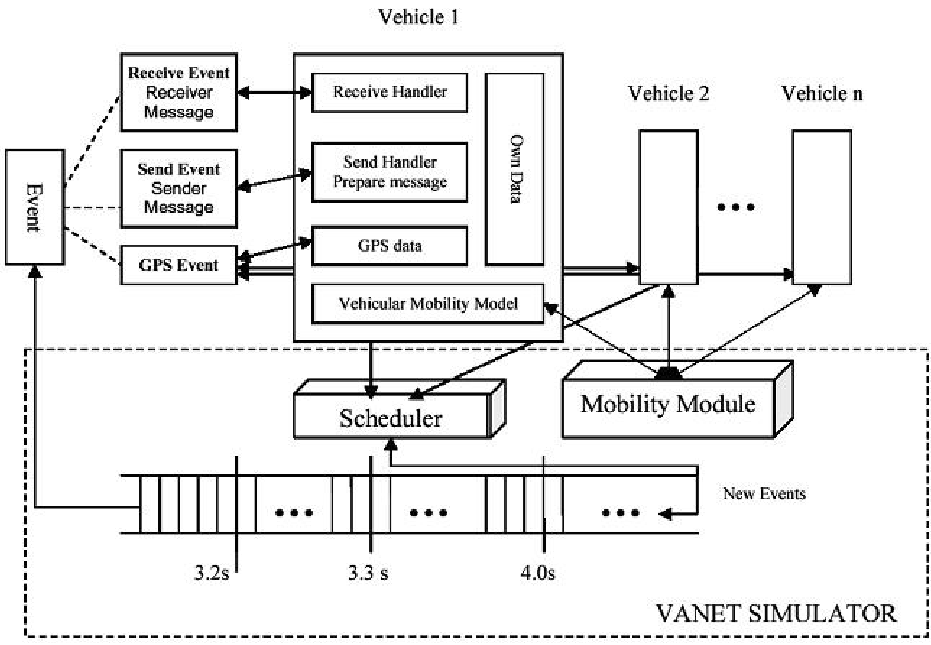 ## Experiments & Real-World Validation The authors compared their model against the **ETH Zurich Realistic Traces**. The evaluation focused on three critical metrics for network performance: **Degree of Connectivity**, **Contact Duration**, and **Inter-contact Time**. ### Essential Performance Findings: - **Distribution Accuracy**: Unlike the flat or purely exponential curves of previous VNSim iterations, the new social model exhibits a Power Law behavior in inter-contact times, perfectly mirroring the ETH data. - **Sensitivity to Density**: As population increases (from 100 to 300 vehicles), the social patterns persist, proving the model's robustness for different urban scales. 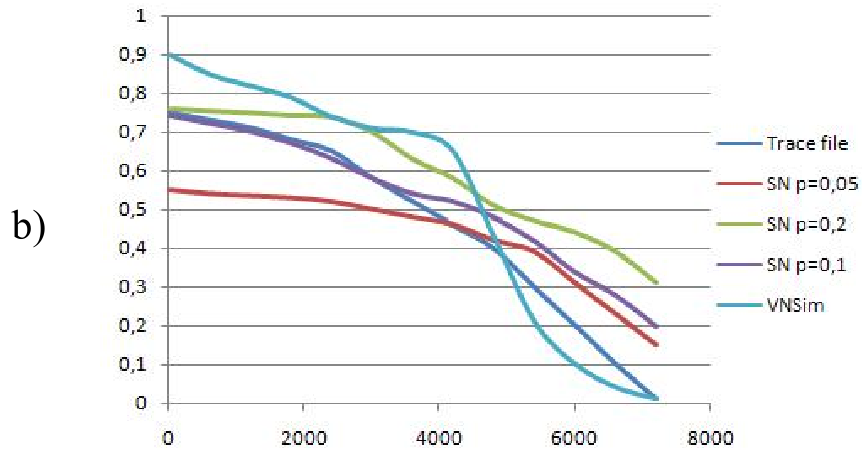 *Figure: The power-law distribution in (a) and (b) confirms that social grouping creates the "long-tail" contact patterns found in real-life movements.* ## Critical Analysis & Conclusion ### Takeaway This work demonstrates that **social context is not noise—it is the signal**. By defining mobility through social cliques, we can simulate the "bursty" nature of network contacts in VANETs, which is vital for testing Delay Tolerant Networks (DTN) and routing protocols. ### Limitations & Future Paths - **Symmetric Relationships**: Currently, the model assumes if A is socially close to B, B is equally close to A. Real-world social hierarchies (e.g., a leader followed by many) are asymmetric. - **Attraction Points**: The model would benefit from more granular "Interest Points" (POI), such as malls or offices, rather than just grid-based social density. By merging the "Micro" (driver personality) and the "Macro" (social networks), VNSim provides one of the most comprehensive environments for high-fidelity VANET testing.