
SmartRecruiter: Leveraging Homophily for Realistic Team Formation in Social Networks
Realistic team formation using navigation and homophily
The paper introduces SmartRecruiter, an informed navigation algorithm for team formation in social networks. It leverages homophily (skill similarity) and semantic distance via the WordNet ontology to recruit experts, outperforming traditional Breadth-First Search (BFS) in decentralized environments.
TL;DR
Building a team within a social network usually assumes you have the "God view" of the entire graph. SmartRecruiter challenges this by operating with only a local view. By using homophily—the tendency of experts to connect with others in similar fields—and semantic ontologies, it finds specialized teams while traversing 40-60% fewer nodes than standard search methods.
Background: The "Local View" Challenge
Most academic papers on team formation treat social networks as static, fully mapped entities. In reality, unless you are the owner of LinkedIn or Facebook, you don't have the global adjacency matrix. You only see who you are connected to.
The authors define Realistic Team Formation through three constraints:
- Impartial Network View: The recruiter only sees immediate neighbors.
- Unclustered Assumption: Skills aren't pre-grouped into neat silos.
- Absence of Statistics: No pre-calculated shortest paths or centrality measures.
Methodology: The Power of Homophily
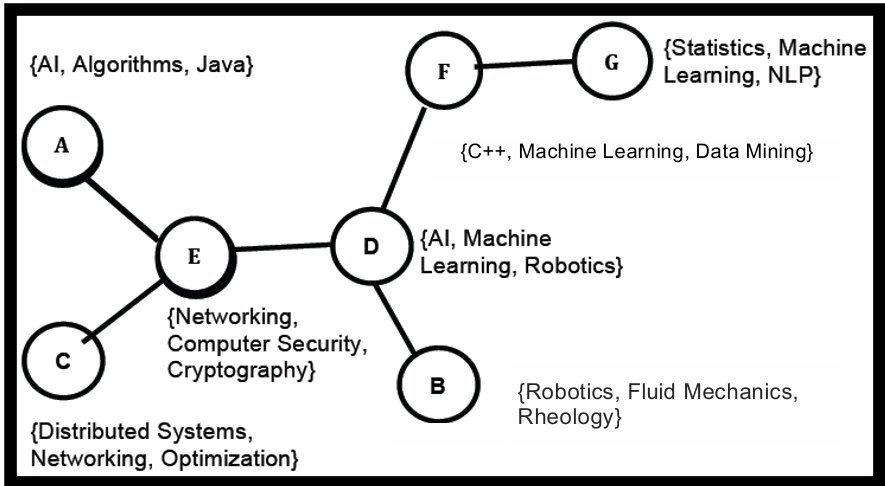
The core insight of the paper is that social networks aren't random. People with Java skills are likely friends with C++ experts. This is homophily.
The Semantic Heuristic
To navigate the graph, SmartRecruiter uses a Greedy Best-First Search guided by a heuristic function . This function calculates the similarity between a candidate and the remaining task skills using the WordNet ontology.

By utilizing the Wu-Palmer similarity, the algorithm can "guess" that a node with "Robotics" skills is a better path to an "AI" expert than a node with "Accounting" skills, even if neither has the exact skill required.
Experiments and Performance
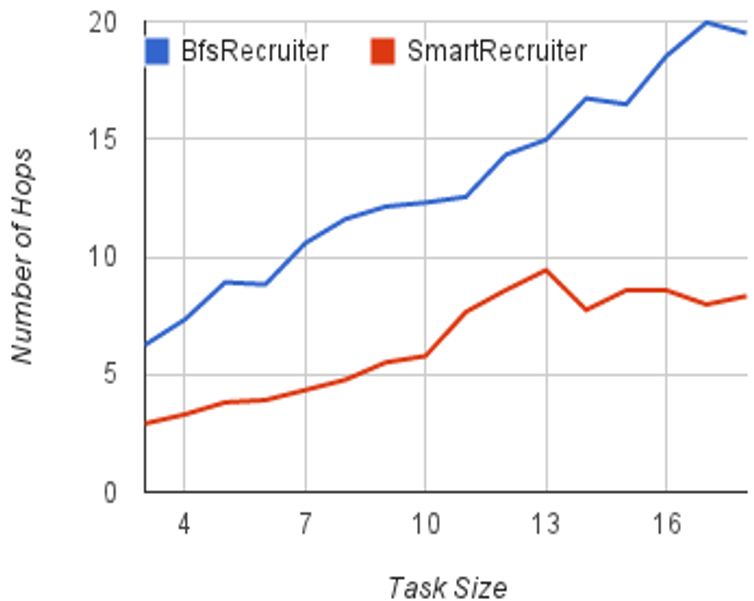
The researchers tested the algorithm against BfsRecruiter (a baseline BFS search) across synthetic networks generated using Power Law Zipfian distributions to mimic real-world social densities.
Key Findings:
- Efficiency: SmartRecruiter consistently explored 40-60% fewer "hops" (visited nodes) to find the same quality of team.
- Team Size: As the task complexity grew, SmartRecruiter found more compact teams compared to uninformed search.
- Network Density: In denser networks (nodes with more skills), the search efficiency improved significantly as "short cuts" between disciplines became more common.
Critical Analysis
The strength of this work lies in its practicality. By moving away from global optimization and toward local navigation, it provides a blueprint for "third-party" recruitment tools that crawl public profiles.
Limitations:
- The current model assumes an edge exists only if a similarity constraint is met, which might be too restrictive for real-world diverse friendships.
- It uses a "one skill per person" contribution constraint, which doesn't reflect multi-disciplinary experts in the real world.
Conclusion
SmartRecruiter demonstrates that "who you know" is a powerful signal for "who you need to find." By embedding semantic intelligence into graph traversal, we can form effective teams even when the map of the network is shrouded in mystery.
Future Outlook: The authors suggest integrating "high-degree hubs" (social influencers) into the navigation logic to further accelerate the discovery of distant talent clusters.