
Reality Check: Decoding the Privacy Paradox Among Indian Social Media Users
Reality Check in Virtual Space for Privacy Behavior of Indian Users of Social Networking Sites
This study investigates the privacy attitudes and behaviors of Indian Social Networking Site (SNS) users using a stratified sample of 401 respondents. It employs Pearson’s Chi-Square tests to validate significant trends, establishing that privacy concern levels directly influence information disclosure and that demographic factors significantly moderate privacy management behaviors.
TL;DR
Is your online persona as cautious as your physical self? This empirical study explores the privacy attitudes of 401 Indian SNS users across diverse professional strata. It reveals that while users disclose data for "free services" or "modern norms," their actual privacy management is deeply tied to their literacy regarding privacy policies and demographic backgrounds. Crucially, the study finds a significant link between how we protect ourselves in the real world versus the digital one.
Problem & Motivation: The Missing Cues of Virtual Space
In the physical world, we use our senses to judge whether to share a secret. We look for narrowed eyes, closed doors, or familiar faces. However, the visually anonymous space of Social Networking Sites (SNS) strips away these "social and cultural cues."
The authors argue that this leads to a "Privacy Paradox": users claim to value privacy yet reveal vast amounts of data. In the Indian context, specifically around 2017, this was exacerbated by a lack of fundamental legal rights to privacy (prior to the landmark Supreme Court ruling). The study seeks to understand if users' cognitive management in the offline world translates to the deliberative actions required online.
Methodology: A Rigorous Statistical Approach
The research moves beyond simple observation by using a stratified, purposive sampling of 401 respondents, including Law Enforcement, Legal Professionals, and Academic experts.
The methodology is grounded in:
- The Theory of Planned Behavior (TPB): Predicting behavior through intentionality.
- Statistical Validation: Utilizing Pearson’s Chi-Square (v²) tests of independence and Cramer’s V (ɸ′) to measure the strength of associations.
- Reliability: The survey instrument achieved a high Cronbach Alpha of 0.795.

Methodology Detail: The Core Hypotheses
The study tested five primary null hypotheses (H01 to H05) to determine if variables like privacy concern, default settings, and demographics truly impact behavior.
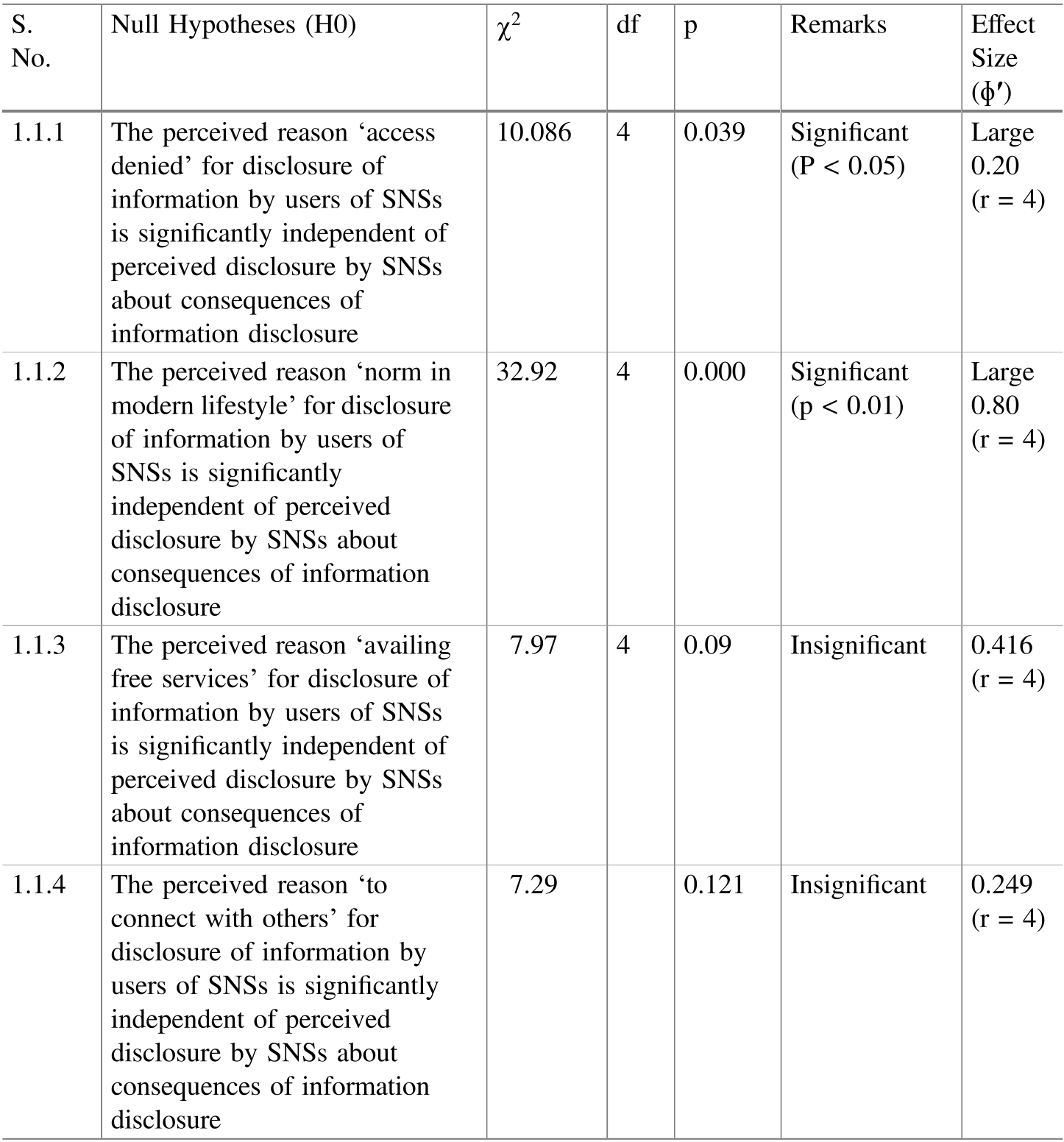
1. The Disclosure vs. Concern Link
The researchers found that the reason for disclosure (e.g., "access denied" or "modern lifestyle norm") is heavily influenced by how much the user thinks the SNS has informed them about the consequences.
2. The Literacy-Action Connection
One of the most significant findings was the rejection of the idea that understanding a policy is unrelated to action. There is a Medium Effect Size (0.4) correlation between understanding privacy policies and the active management of default settings.
Key Results & Insights
The analysis yielded several "Reality Checks":
- Privacy Policies Work (When Read): Contrary to popular belief that policies are ignored, the study found that reading and understanding policies lead to a statistically significant behavioral change (Large Effect Size: 0.9).
- The Physical-Digital Mirror: The null hypothesis that behavior is different in physical vs. online environments was rejected. This suggests that a user's fundamental risk-aversion or openness in the real world is a strong predictor of their digital footprint.
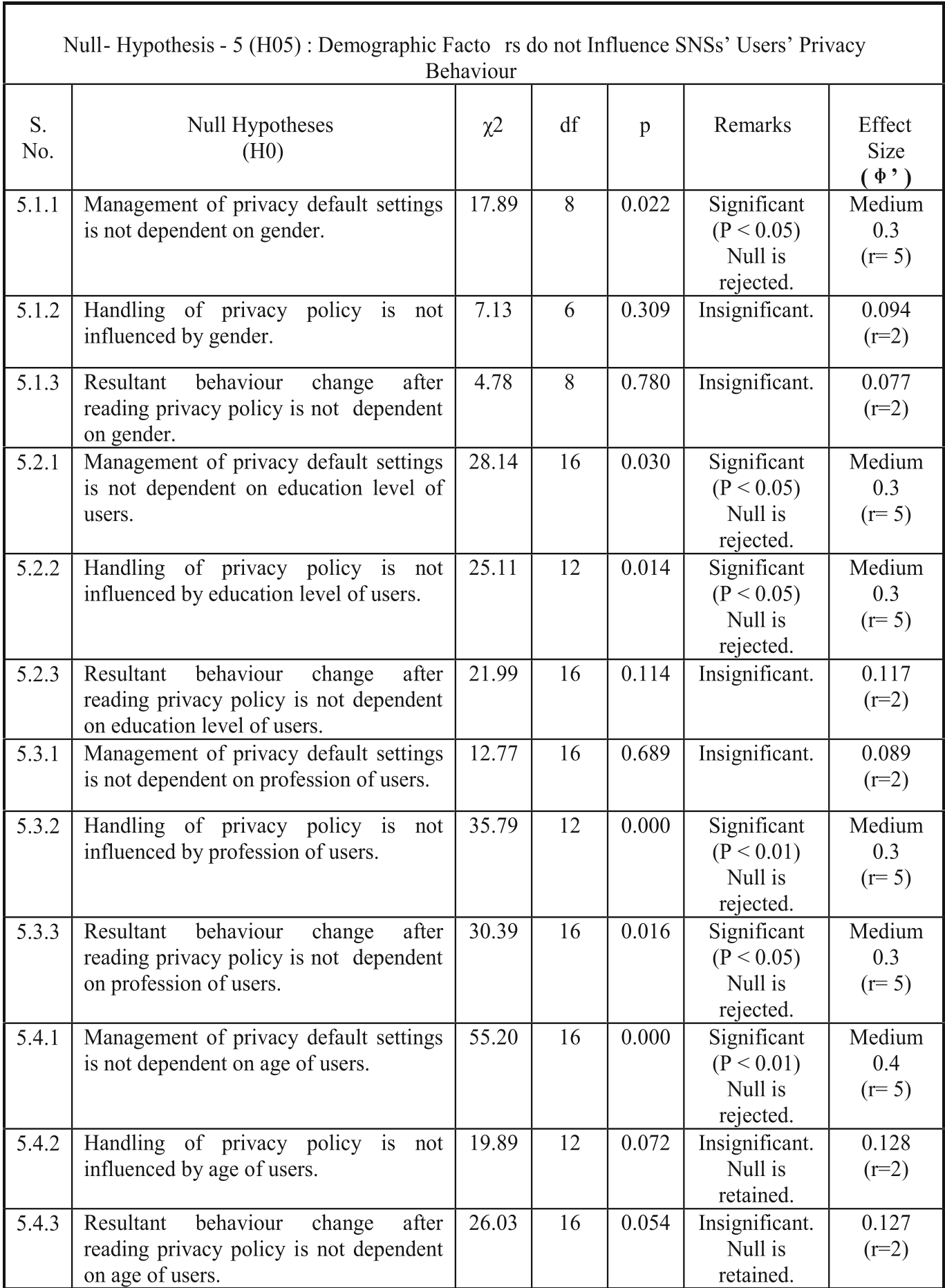
- Demographics Matter: Gender, education, and age are not just statistics; they are drivers. Age particularly showed a high impact on the management of default privacy settings (p < 0.01).
Critical Analysis & Industry Impact
Takeaways
The study serves as a foundational "maiden attempt" to map the Indian privacy landscape. Its core value lies in proving that online privacy is not an isolated skill, but an extension of general social behavior. For developers and policymakers, this means privacy tools should be designed to feel as intuitive as physical boundary-setting.
Limitations
- Sample Bias: The use of convenience sampling might limit generalization to the broader, non-professional Indian population.
- Demographic Gaps: The study excludes minors (under 18), who represent a massive portion of SNS users and often possess different privacy mentalities.
Future Outlook
As India implements its new data protection regimes (like the DPDP Act), this research highlights that legislative success will depend heavily on "Online Privacy Literacy." Simply having a law isn't enough; the bridge between understanding a policy and clicking "save settings" is where the battle for privacy is won or lost.