
Decoding the HR Mindset: Why Professionals Choose English Over Local Languages in Job Ads
Reasons for Using English or the Local Language in the Genre of Job Advertisements: Insights From Interviews With Dutch Job Ad Designers
This study investigates the motivations behind language choice (English vs. Dutch) in job advertisements within the Netherlands, a prominent EFL (English as a Foreign Language) country. By conducting 25 qualitative interviews with HR practitioners, the authors categorize reasons into a genre-based framework, achieving a comprehensive map of professional decision-making that significantly expands upon existing scholarly literature.
TL;DR
Why do Dutch companies publish job ads in English when both the recruiter and the candidate speak Dutch? While scholars often assume it’s about "status" or "modernity," this study goes straight to the source. By interviewing 25 HR professionals, the researchers uncovered 33 reasons—most of which never appeared in textbooks—ranging from corporate "jargon" and international workflows to mundane reasons like "being too busy to translate."
Background: The Gap Between Theory and Reality
In the world of Genre Theory, we often analyze texts as artifacts. We look at a job ad and assume the use of English is a calculated effort to look "global" or "innovative." This study posits that scholars have been guessing from the outside. To truly understand the Inductive Bias of the recruitment genre, we must listen to the "Specialist Informants"—the practitioners themselves.
Problem & Motivation: Beyond "Puffed-Up" Language
Public discourse often criticizes the use of English in Dutch job ads as "snobbish" or "exaggerated." However, the authors argue that language choice is a functional response to complex professional constraints. The motivation for this study was to bridge the gap between academic interpretation and the messy reality of workplace writing.
Methodology: The Practitioners' Perspective
The researchers categorized the practitioners' responses using a refined Genre Theory framework. They looked at three specific buckets:
- Contextual Factors: Organization size, sector norms, and job requirements.
- Reader-Writer Factors: Target audience needs and the writer’s personal situation.
- Textual Factors: The search for the "perfect word" or the lack of local equivalents.
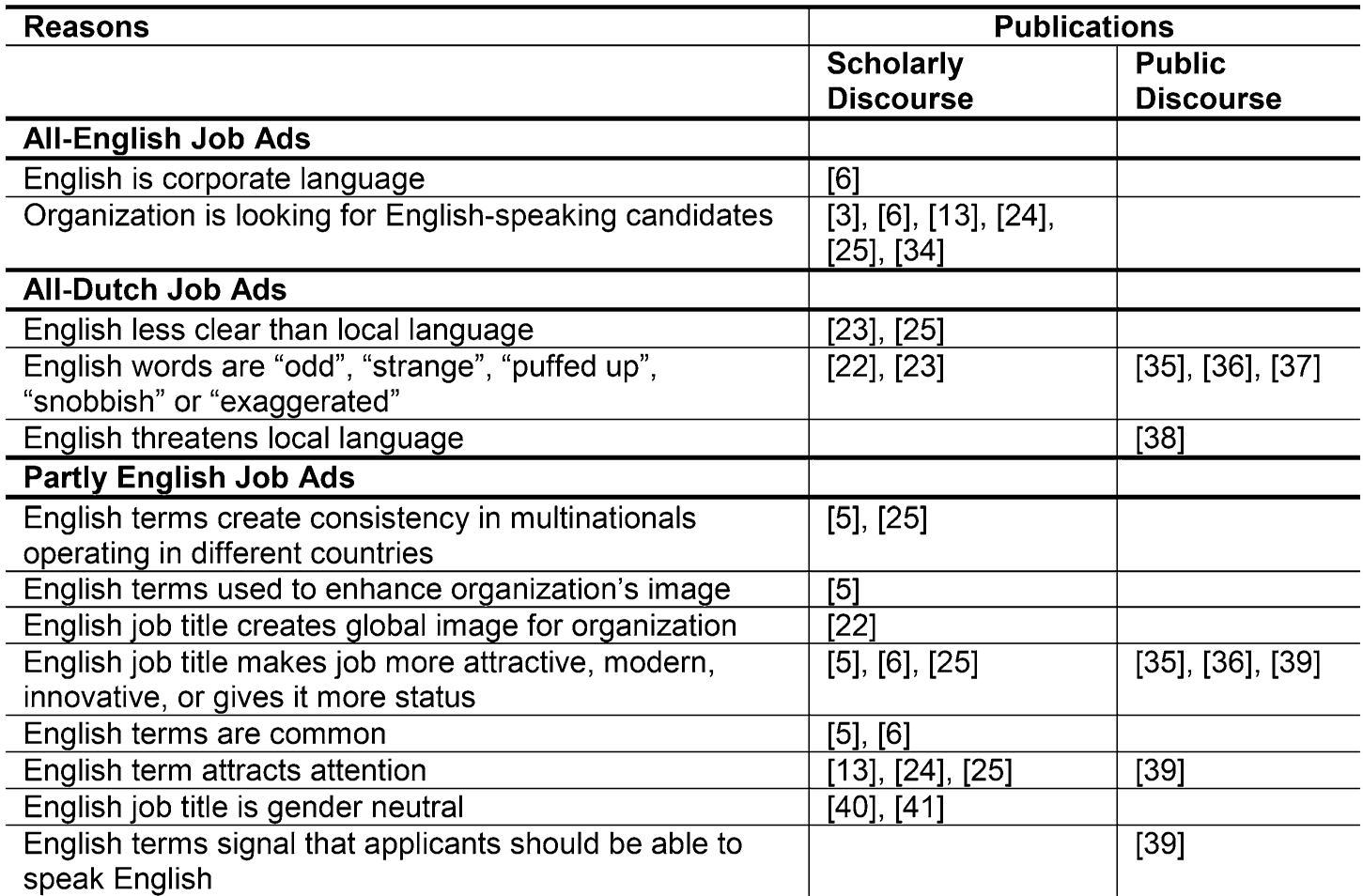 Above: The initial inventory of reasons derived from existing literature, which served as the baseline for the study.
Key Insights: The "Insider" Secrets
The findings were a wake-up call for genre theorists. While traditional literature focused on Image Enhancement, practitioners cited practical, workflow-related reasons:
- The "Corporate Language" Reality: In many Dutch tech or finance firms, English isn't a choice; it's the internal infrastructure. If the daily stand-up is in English, the ad must be too.
- The Translation Trap: Some writers admitted they used English simply because the source material from headquarters was in English, and they lacked the time or departmental budget to translate it accurately.
- Common Usage/Jargon: In sectors like IT or Shipping, English terms (e.g., "Human Resource Manager") are so fossilized that using the Dutch equivalent sounds "odd" or confusing to qualified candidates.
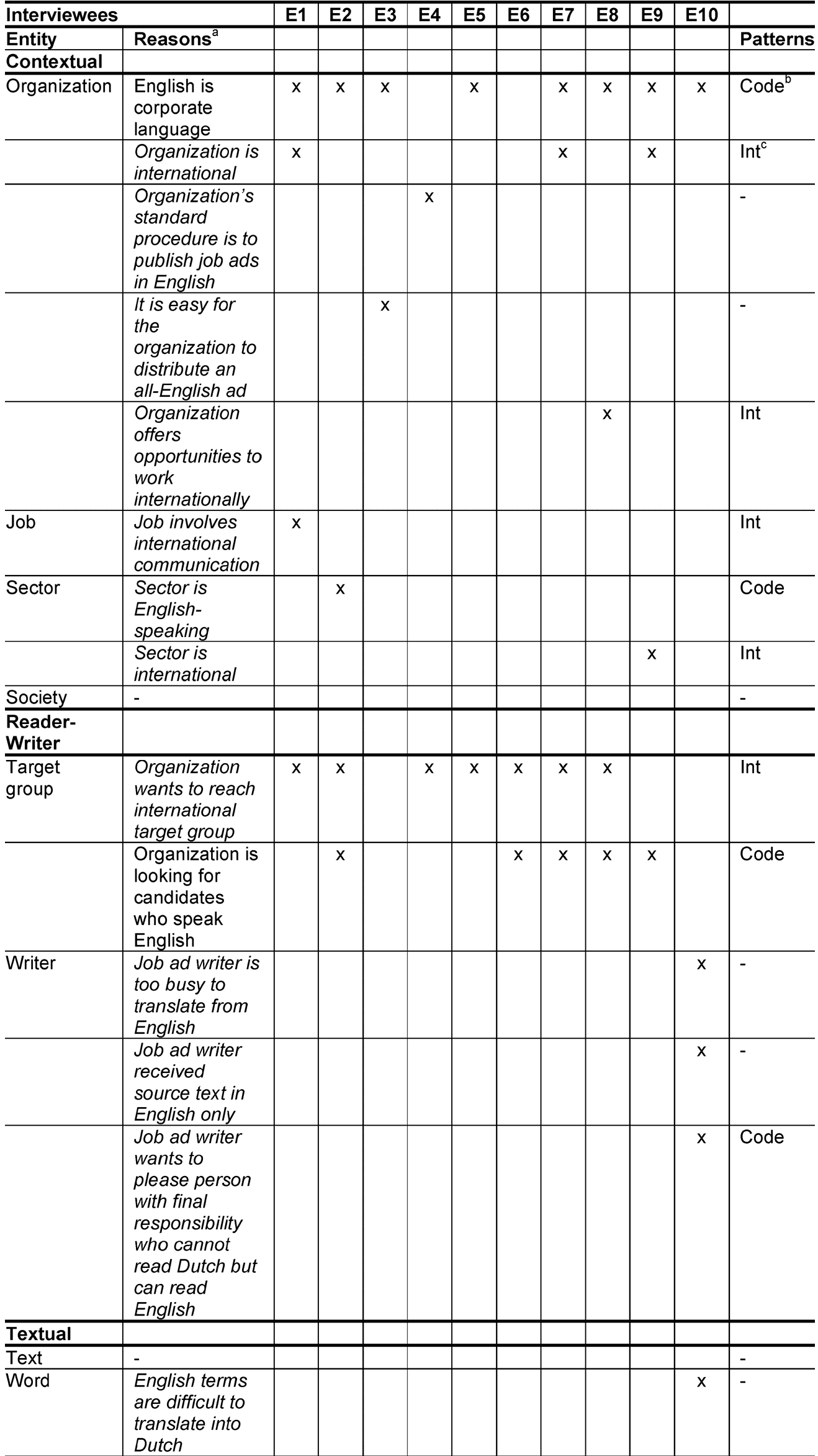 Above: Note the prevalence of "Corporate Language" and "International Target Group" as dominant drivers.
Deep Insight: Internationality vs. National Identity
An interesting correlation emerged: 100% of all-English ads were placed by internationally operating employers. Conversely, all-Dutch ads were exclusively the domain of nationally focused organizations (like local city councils). This suggests that Organizational Scope is the primary predictor of code choice.
However, the "status" of English—a favorite topic of scholars—was rarely mentioned by practitioners. They viewed English as a Communication Code (utility) rather than a Symbolic Asset (image).
Critical Analysis & Conclusion
Takeaway
This study proves that genre features are shaped by "private intentions" and logistical constraints as much as by communicative purposes. For HR professionals, the takeaway is clear: Language choice should be a deliberate strategy aligned with the firm's operational reality, not just a default setting.
Limitations
The study’s main weakness is its reliance on Post-hoc Rationalization. Interviewing a writer three months after they published an ad might lead them to provide "logical" reasons for what was originally an intuitive or hurried decision. Furthermore, it does not measure whether these choices actually helped find better candidates—only why they were made.
Future Outlook
Future research should apply Think-Aloud Protocols during the actual drafting of ads to catch these decisions in real-time. As digital platforms like LinkedIn and Monsterboard become more dominant, the barrier to English usage continues to drop, making the "Insider Knowledge" of practitioners more vital than ever for understanding the evolution of professional genres.