
ReCall: Turning Basic Phones into Economic Engines for Voice Forums
ReCall: Crowdsourcing on Basic Phones to Financially Sustain Voice Forums
This paper introduces ReCall, an IVR-based crowdsourcing marketplace that allows low-income rural residents in India to transcribe audio content via basic mobile phones. By leveraging vocal "re-speaking" and a majority-voting merging mechanism, ReCall achieves 85% transcription accuracy while generating enough profit to grant users free airtime for voice forums.
TL;DR
ReCall is an innovative crowdsourcing marketplace designed for the "Next Billion Users"—those with basic phones, no internet, and limited literacy. By transcribing audio through phone calls, rural residents in India can earn money and "free airtime" to use social voice forums. The system achieves 85% accuracy and proves that micro-labor can solve the long-standing financial sustainability crisis of development-focused ICT services.
The Problem: The High Cost of Listening
In rural India, voice forums (like Mobile Kunji or CGNet Swara) are the "Facebook of the illiterate," allowing people to share health tips or local news via phone calls. However, these services face a grim reality: Financial Instability.
- User Poverty: Low-income users cannot pay for calls.
- Expensive Infrastructure: NGOs must pay for toll-free lines, which becomes unsustainable as usage scales.
- The Utility Gap: Most crowdsourcing platforms require smartphones and English, excluding the very people who need income the most.
Methodology: Re-Speaking the Future
ReCall adapts the concept of "re-speaking"—where a human listens to audio and repeats it clearly for a machine. Unlike its predecessor, Respeak, which required a smartphone, ReCall works on a $10 basic phone.
The Technical Workflow
- Segmentation: The engine chops long audio into 3–6 second clips.
- IVR Interface: Users call a local number, listen to a clip, and re-speak it.
- ASR & TTS: The re-spoken audio is processed by Google’s ASR. The result is read back to the user via Text-to-Speech (TTS) for verification.
- Majority Voting (MSA): Because individual transcriptions on 8kHz voice channels are noisy, the system merges transcripts from multiple users (K=11) using Multiple String Alignment to produce a high-accuracy final text.
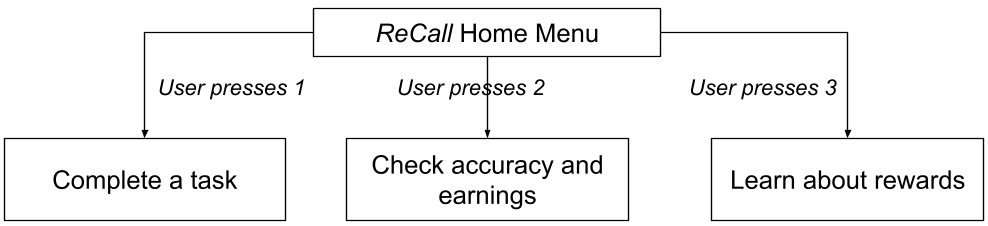 Figure 1: The IVR call flow allows users to navigate tasks using simple keypad inputs.
Experimental Insights: Smartphone vs. Basic Phone
The authors conducted controlled experiments to find the "cost of inclusion."
- Audio Quality: Moving from a 44kHz data channel (smartphone) to an 8kHz voice channel (basic phone) increased Word Error Rates (WER) from 5% to 16%.
- Human Factor: Users found listening to synthetic TTS voices harder than reading text.
- The Verdict: While ReCall is slower and more mentally demanding than smartphone apps, it is accessible to the most vulnerable populations who have no other digital options.
Field Results: A Path to Sustainability
During a 15-day deployment in rural India, 24 users earned ₹20,500 ($310).
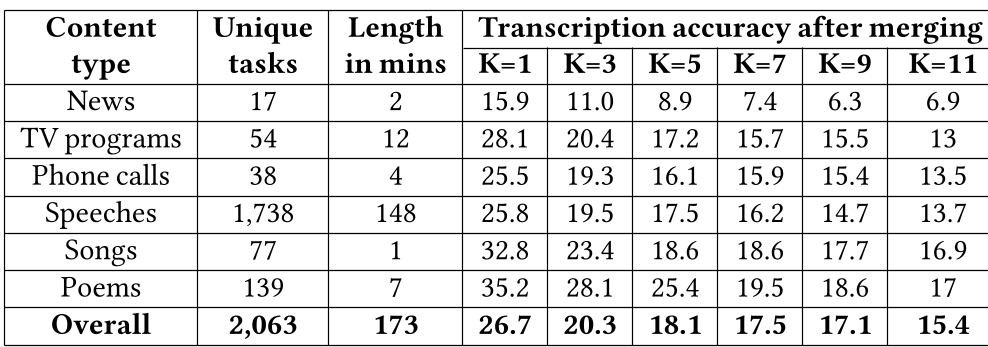 Figure 2: Accuracy increases significantly as more crowd workers (K) are added to the merging process.
The Economic Breakthrough
The most critical finding is the Reciprocity Ratio:
- ReCall produces Hindi transcripts at $1.86 per minute.
- The market rate is $4.99 per minute.
- This profit margin is huge. In practice, 1 minute of work on ReCall buys 8 minutes of airtime on a companion voice forum.
Critical Analysis & Takeaways
ReCall is more than just a transcription tool; it is a financial loop. It allows users to "work off" their access fees.
Strengths:
- Inclusive Design: Works on any phone, requires no internet.
- Social Impact: Provides an hourly wage comparable to the national average.
Limitations:
- The TTS Gap: Hindi Text-to-Speech still sounds robotic, leading to verification errors.
- Context Switching: Users occasionally found it disruptive to jump from "socializing" on a forum to "working" on ReCall.
Future Outlook: As India’s telecom landscape shifts toward unlimited voice plans (STVs), ReCall can pivot from subsidizing calls to purely supplementing income, potentially giving rural laborers a 300% boost over their daily wage through just two hours of "phone work" per day.