
Advancing Swarm Intelligence: The Evolution of Population Structure and Behavior in PSO
Recent advances in particle swarm optimization via population structuring and individual behavior control
This paper provides a comprehensive review of recent advances in Particle Swarm Optimization (PSO), focusing on population structuring and individual behavior control. It highlights how evolving from single-population to multi-subpopulation models and integrating dynamic topologies significantly enhances the algorithm's global search capabilities and convergence stability.
TL;DR
Particle Swarm Optimization (PSO) has evolved from a simple bionic simulation into a sophisticated family of algorithms. This review delves into how modern PSO variants overcome premature convergence by redesigning how populations are structured (from single swarms to competing sub-populations) and how individual particles learn (via constriction factors and hybrid intelligence).
The Core Conflict: Exploration vs. Exploitation
The "Achilles' heel" of the original 1995 PSO was its rapid loss of diversity. In a standard global version (gbest), particles converge so quickly toward the best known position that they stop "looking around," effectively turning a global search into a narrow local search.
The author highlights that the secret to a robust optimizer lies in the Topology—the map of who talks to whom. While a fully connected swarm converges fast, it is brittle. A ring lattice or a "small-world" network allows information to trickle through the population, preserving the diversity needed to escape local traps.
Methodology: Two Pillars of Improvement
1. Population Structuring & Topology
The paper classifies structures into two main types:
- Single Population with Variable Size: Approaches like "Incremental Social Learning" add particles gradually, reducing the initial "knowledge acquisition cost" and allowing for a more thorough initial scan of the search space.
- Multiple Sub-populations: Inspired by biological niches, the swarm is divided into groups that compete or cooperate.
2. Individual Behavior Control
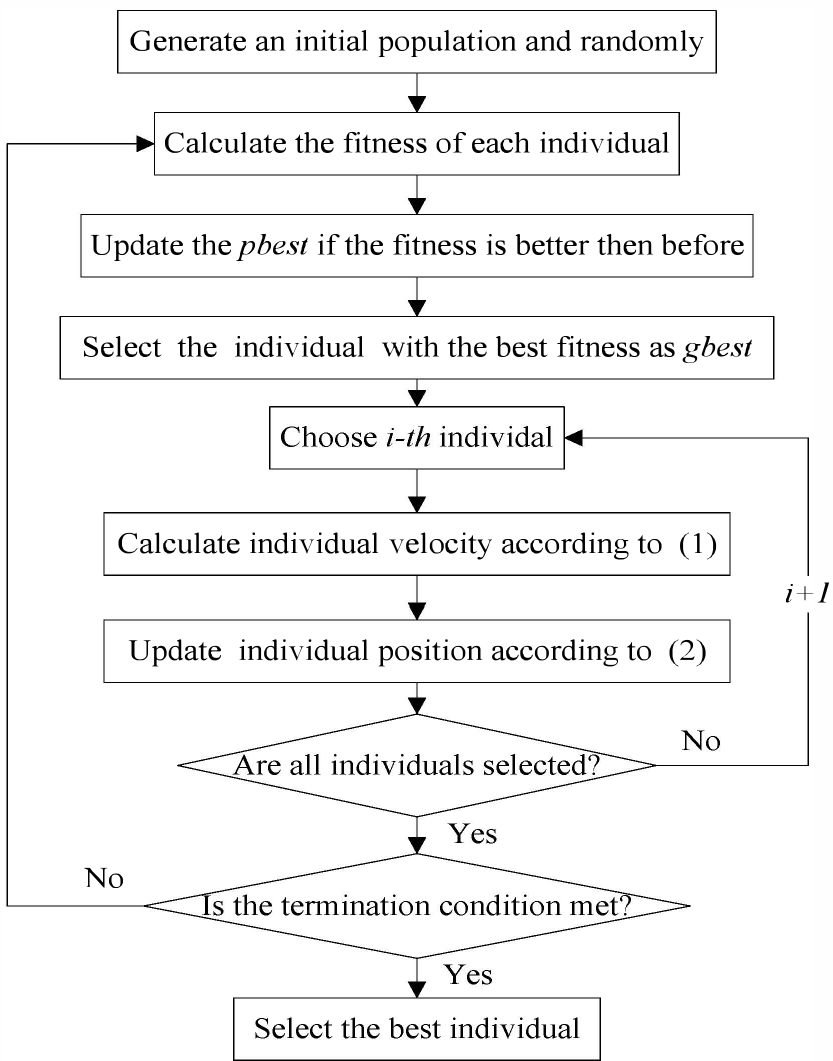
The movement of a particle is governed by its velocity update equation. The review explores three critical refinements:
- Inertia Weight (): A high weight encourages global exploration, while a low weight focuses on local refinement. Modern versions use fuzzy logic or non-linear decay to adjust this dynamically.
- Constriction Factor (): Introduced by Clerc and Kennedy, this mathematical multiplier ensures that the swarm stays stable and converges without needing manual velocity clamping ().
- FIPS (Fully Informed Particle Swarm): Unlike the standard model where a particle only looks at the "best" neighbor, FIPS calculates influence from all neighbors, creating a more "democratic" and often more accurate search.
Performance Benchmarks
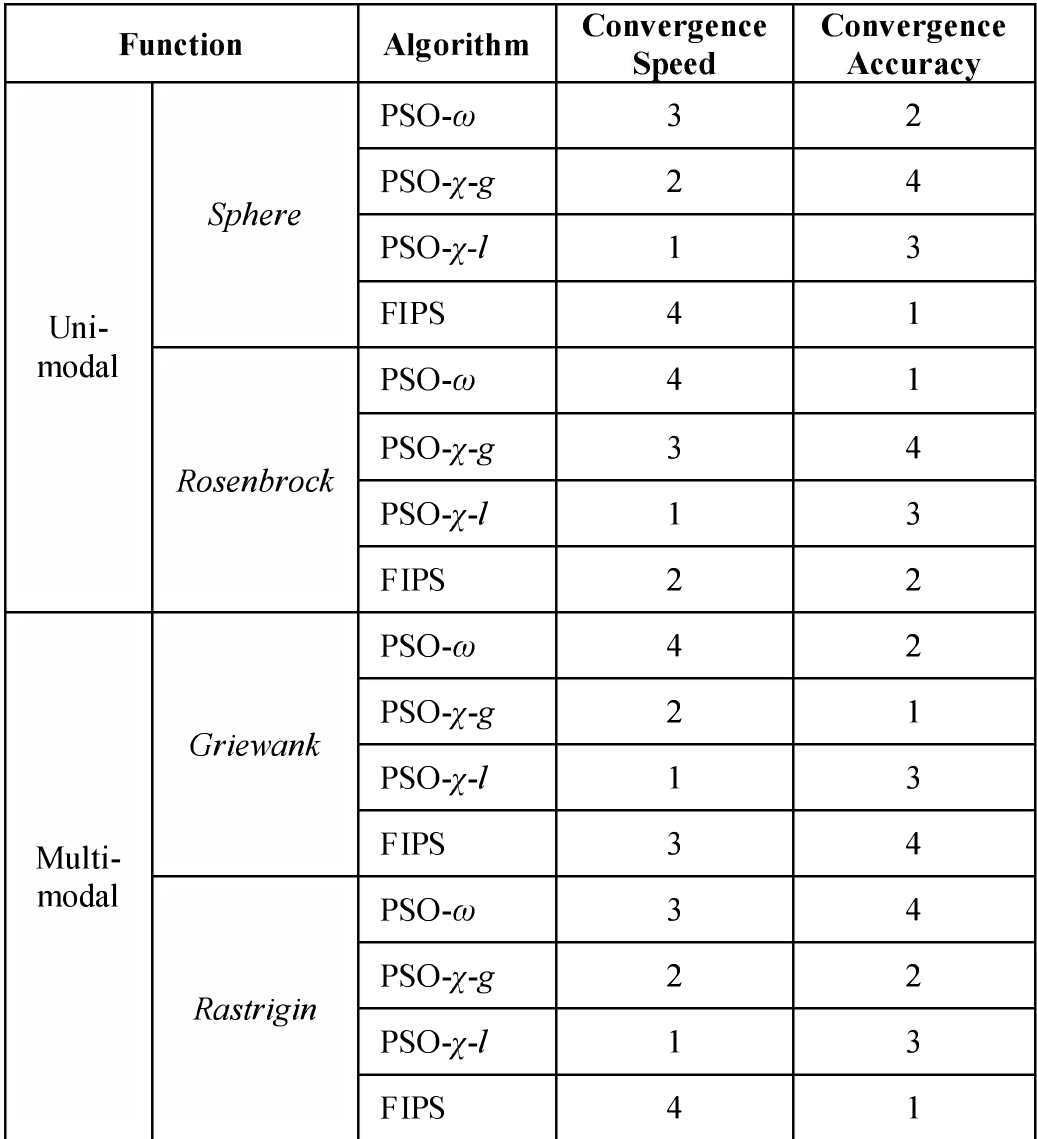
The paper provides a relative ranking of prominent PSO versions. A key takeaway is that there is no "free lunch"—algorithms like PSO--l (local version with constriction) dominate in convergence speed across almost all benchmarks, but FIPS often achieves higher final precision in complex landscapes like the Rastrigin function.
| Function | Algorithm | Convergence Speed | Accuracy |
|---|---|---|---|
| Sphere | FIPS | 4 (Slowest) | 1 (Best) |
| Sphere | PSO--l | 1 (Fastest) | 3 |
| Rastrigin | FIPS | 4 (Slowest) | 1 (Best) |
Critical Insight: The "Social" Intelligence
One of the most intriguing sections discusses Passive Congregation. In nature, animals stay in groups not just to find food, but for safety. By adding a "random neighbor" component to the velocity equation—simulating a particle's desire to stay with the swarm regardless of finding a "best" position—diversity is naturally maintained, preventing the "stagnation" that plagues traditional EAs.
Conclusion & Future Directions
The field is moving toward Hybridization. By combining PSO’s fast convergence with Genetic Algorithms' (GA) mutation operators or the pheromone-tracking of Ant Colony Optimization (ACO), researchers are creating "Super-Heuristics."
However, the author warns that as we increase individual intelligence (e.g., Quantum-behaved particles), we must be careful not to increase computational overhead to the point where the algorithm's primary advantage—its simplicity—is lost.