
Mobile Social Device Caching: Solving the Backhaul Bottleneck via Human Intuition
SPECIAL SECTION ON RECENT ADVANCES IN SOCIALLY-AWARE MOBILE NETWORKING
This paper introduces the framework of Mobile Social Device Caching (MSDC), a strategy that offloads backhaul traffic by storing content directly on user devices via D2D communication. It systematically categorizes social-aware mechanisms for content placement, radio resource management, and routing to optimize the efficiency of edge caching in future 5G/6G networks.
TL;DR
As mobile data traffic explodes, traditional backhaul architecture is hitting a hard limit. This paper proposes Mobile Social Device Caching (MSDC)—a paradigm shift that turns every smartphone into a smart cache node. By exploiting social network characteristics (who you know and where you go), the authors demonstrate that we can significantly increase cache hit ratios and reduce backhaul load without needing massive new infrastructure.
Background: The Limits of Traditional Caching
The industry has tried two main approaches to solve the data crunch: CDN (caching at the core) and Femto-Caching (caching at small cell base stations). However, both have a fatal flaw: they are static. Femto-cells require costly hardware and cannot move to where users congregate.
The paper argues that Device Caching is the superior path. Why? Because the aggregate storage of all user devices forms a massive "virtual cache." The challenge, however, is that device communication is opportunistic, wireless, and limited by human behavior.
The Core Concept: The Layered MSDC Architecture
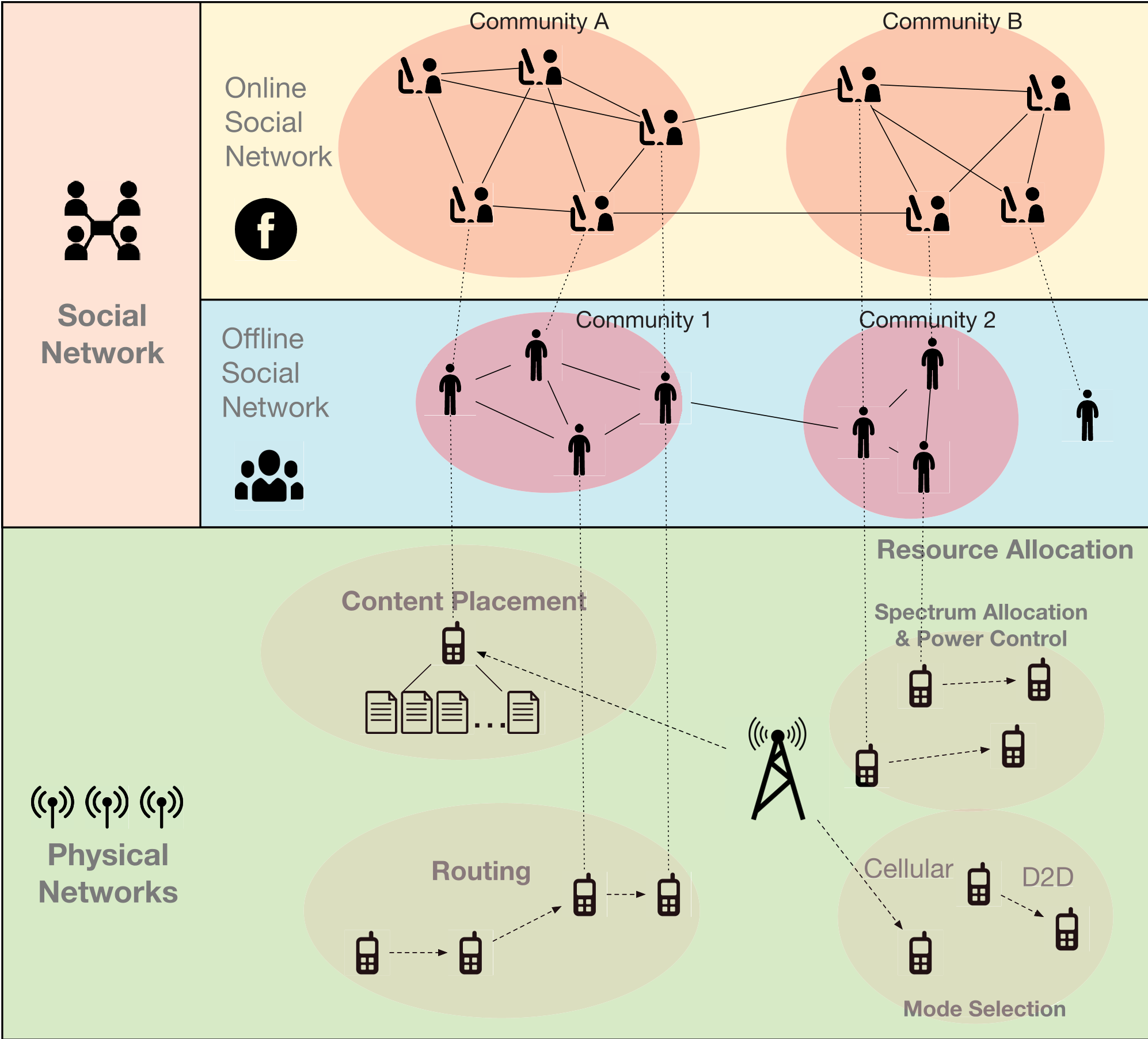
The authors visualize MSDC through two abstract layers:
- Social Network Layer: Divided into Online (virtual relationships/interests) and Offline (physical contacts/mobility).
- Physical Network Layer: The hardware, D2D links, and cellular infrastructure.
By mapping social metrics like Centrality (how influential a person is) and Community (groups with similar interests) onto the physical transmission layer, the network can predict what to store and where to send it before a request even happens.
Technical Deep Dive: Socially-Aware Strategies
1. Social-Aware Content Placement
Standard caching is reactive. MSDC suggests being Proactive. If a user is at the "center" of a social community, the system caches popular files on their device during off-peak hours.
- Coded Caching: Instead of storing a whole file, the system stores "coded fragments" across a community. Even if a user only encounters a few friends, they can reconstruct the original data, maximizing the "virtual cache" efficiency.
- Incentive Mechanisms: Addressing the "selfishness" of users who don't want to drain their battery for others by using reputation or social-trust-based rewards.
2. Radio Resource Management (RRM)
D2D links often interfere with cellular links. The paper suggests Social-Aware RRM, where users in the same community cooperate to reuse spectrum. For example, high-centrality users are prioritized for cellular access so they can quickly disseminate content to their D2D peers.
3. Social-Aware Routing
When a target device is out of range, MSDC uses a Store-Carry-Forward model. The intuition is academic but simple: if you want to reach a "destination" user, send the data to someone in the same "Community" or someone with high "Centrality" who is statistically likely to cross paths with the target.
Does it actually work? (Experimental Evidence)
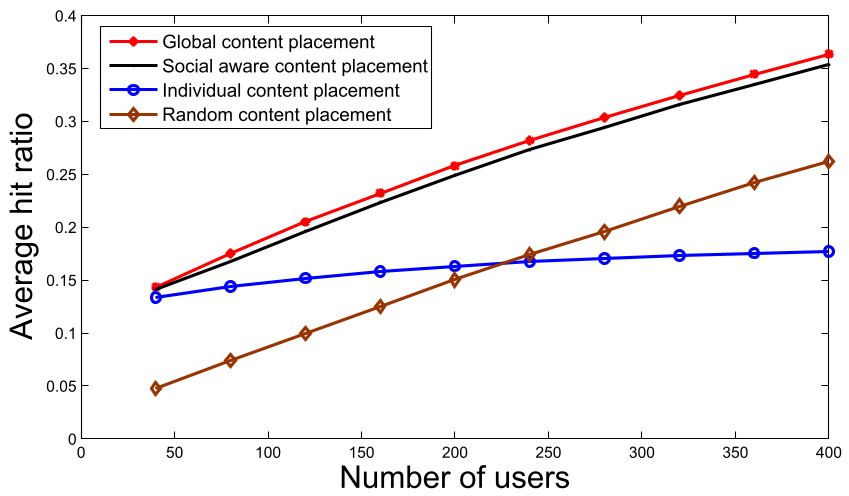
The authors compared four strategies: Global, Social-Aware, Individual, and Random.
The results are revealing. Social-Aware Caching (which only uses local community data) performs almost as well as Global Caching (which requires "God-mode" knowledge of the whole network).
Key findings from the figures:
- Scalability: As the number of users increases, the social-aware hit ratio grows rapidly, whereas individual caching plateaus.
- Social Benefit: Utilizing social ties provides a massive leap over random placement, proving that "who uses the data" is just as important as "what the data is."
Critical Analysis & Conclusion
The real value of this paper is its recognition that wireless networks are not just physical links, but human ones. By defining "Socially-Aware" parameters, the authors provide a mathematical framework to solve the randomness of D2D movement.
Limitations: However, the paper acknowledges a major hurdle: Privacy and Security. Sharing "who your friends are" or "what you like" to optimize a cache creates massive privacy risks. Furthermore, "Trust" is dynamic—a user who is helpful today might turn "selfish" when their battery hits 10%.
Future Outlook: MSDC is a cornerstone for 6G. As we move toward Decentralized AI and Mobile Edge Computing (MEC), using social graphs to optimize resource allocation will be the difference between a congested network and a seamless one.