
Decoding Human Affect: How Empirical Studies Shape the Future of NEU-FACES
Recent Developments in Automated Inferencing of Emotional State from Face Images
The paper presents an empirical study investigating human facial expression classification to establish design requirements for an automated system called NEU-FACES. It evaluates how human observers identify seven core emotions—neutral, happy, sad, surprised, angry, disgusted, and bored—and identifies the specific facial features that provide the highest discriminatory power for neural network-based classifiers.
TL;DR
This paper bridges the gap between psychological perception and computer vision. By analyzing how 300 humans classify emotions, the authors identify that isolated facial parts (eyes, mouth, and brow texture) often provide clearer emotional signals than an entire face. These findings serve as the foundation for NEU-FACES, a neural network-based system designed to automate facial expression classification with high precision by focusing on localized feature deviations.
Background: The Challenge of the Non-Rigid Face
The human face is a complex, non-rigid surface capable of thousands of subtle movements. For an AI to understand if a user is "bored" or "disgusted" during a human-computer interaction (HCI) session, it must overcome:
- Inter-personal variability: Different people express the same emotion differently.
- The Pretense Problem: Facial expressions don't always match internal psychological states.
- Technical Noise: Variations in lighting, pose, and texture.
The authors argue that to build a successful automated system, we must first understand the "ground truth" of human perception.
Problem & Motivation: Why is this Hard?
Existing studies (like those by Ekman or Russell) disagree on whether emotions are discrete categories or points in a multidimensional space. Furthermore, there is a shortage of empirical data on the human "error rate" in recognition. If we don't know how well humans perform, how can we set benchmarks for AI? The authors' insight is that by decomposing the face into specific regions, we can identify which "parts" hold the most discriminatory information.
Methodology: The Questionnaire as a Probe
The researchers developed a three-stage study involving 300 participants to validate the features used in their NEU-FACES system.
1. The Human Benchmark
Participants were shown 14 images and asked to classify them into seven categories: Neutral, Happy, Sad, Surprised, Angry, Disgusted, and Bored-Sleepy. They also rated their certainty.
2. Feature Isolation
This is the core of the study. Participants were shown isolated parts of the face (brows, eyes, mouth, etc.) to see if recognition accuracy improved or degraded.
3. Feature Mapping to NEU-FACES
The system extracts features as deviations from the neutral state. By locating corner points of regions like the mouth or brows, it calculates size ratios and textures, converting raw pixels into high-level configuration data.
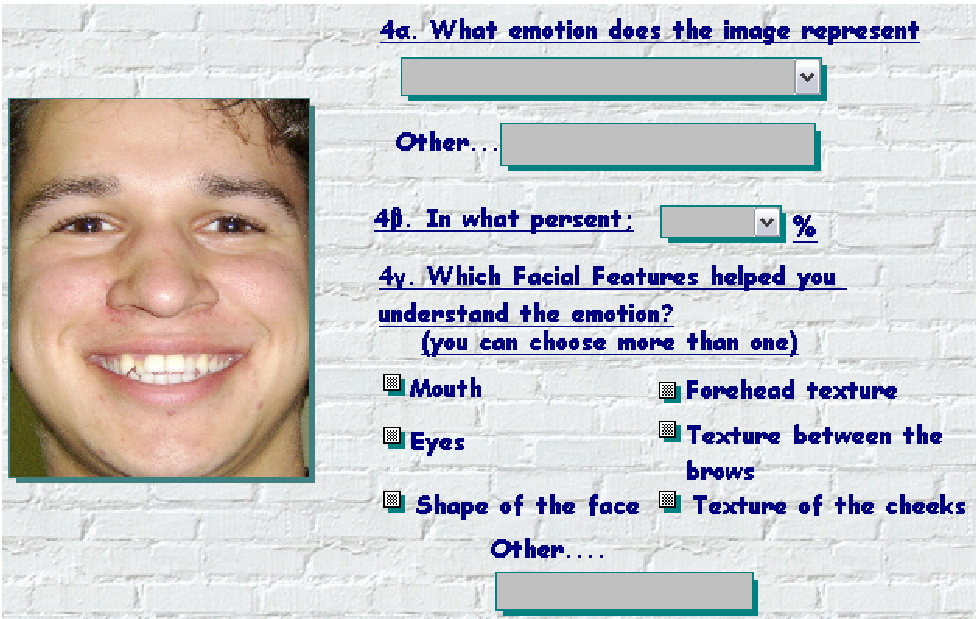 Figure 1: Typical questionnaire layout used to test human certainty and feature reliance.
Experiments & Results: The Power of the "Part"
The results yielded a surprising insight: Less is often more.
- Error Reduction: For "Happiness," the error rate dropped dramatically from 31.06% (full face) to 3.79% (isolated parts). Similar trends were seen for "Sadness" and "Boredom."
- Exceptions: "Anger" and "Disgust" proved more difficult when isolated, suggesting these emotions rely on a more complex, holistic interaction of facial features (e.g., the specific texture between the brows combined with the mouth shape).
- Feature Importance: The "Eyes" and "Mouth" were consistently ranked as the most helpful features across all categories.
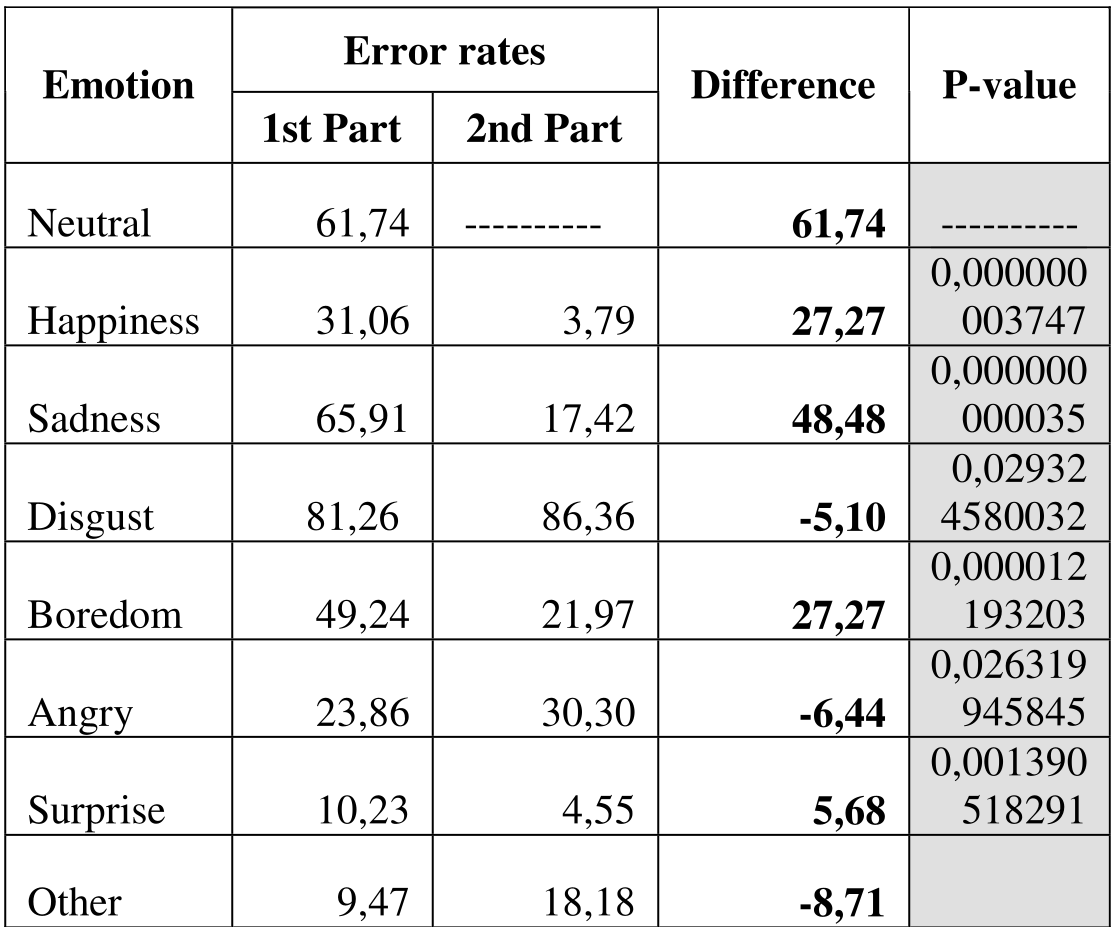 Table: Comparison of human error rates between full-face and part-based recognition.
Critical Analysis & Conclusion
Takeaway
The paper successfully quantifies the human recognition baseline, providing a target for the NEU-FACES system. The most significant contribution is the validation of local feature extraction. By focusing on the "parts" that humans find most informative (eyes/mouth), researchers can reduce the dimensionality of the input data for neural networks, making the models more efficient and robust.
Limitations & Future Work
One limitation is the cultural homogeneity of the study (all participants were Greek); emotional expression can vary across cultures. The authors acknowledge this and plan to:
- Apply multi-criteria decision theory to improve classification.
- Expand the database to include video sequences (temporal data), as static images may lose the "flow" of an emotion.
- Explore image quality enhancement to make the system work in low-resolution environments.
Final Thought
As we move toward "Affective Computing," studies like this remind us that the best AI architectures are often inspired by a deep understanding of human psychology and the specific markers we use to read one another.