
Deciphering the Digital Soul: The Evolution of Deep Learning in Personality Detection
Recent trends in deep learning based personality detection
This paper provides a comprehensive survey of deep learning-based personality detection, focusing on the transition from shallow linguistic analysis to multimodal deep learning. It categorizes methodologies across text, audio, and visual modalities, highlighting state-of-the-art achievements in "First Impressions" and Big-Five trait prediction using architectures like Deep Residual Networks (DRN) and Descriptor Aggregation Networks (DAN).
Executive Summary
TL;DR: This survey illuminates how Artificial Intelligence is moving beyond simple sentiment analysis toward understanding the core of human character: Personality. By synthesizing research across text, audio, and video, the paper demonstrates that deep multimodal architectures (CNNs + LSTMs + Residual Nets) are now capable of predicting personality traits with accuracy levels approaching human perception.
Context: Positioned at the intersection of Affective Computing and Computer Vision, this work marks the transition point (circa 2018) where "Black Box" deep learning began outperforming traditional psychological feature-engineering (like LIWC) in identifying the Big-Five traits (Extraversion, Neuroticism, Agreeableness, Conscientiousness, and Openness).
Problem & Motivation: Beyond the Questionnaire
For decades, identifying personality required tedious questionnaires like MBTI or the Big-Five. In the computational realm, early "closed-vocabulary" methods (e.g., counting how many times someone says "I" vs. "we") were brittle and ignored the rich context of human expression.
The authors argue that true personality is multimodal. A person's character isn't just in what they write; it's in the pitch of their voice, the micro-movements of their eyebrows (Action Units), and even the aesthetic choices of their profile pictures. The challenge lies in "fusing" these diverse signals—social media snippets, vocal jitters, and video frames—into a coherent psychometric profile.
Methodology: The Multimodal Architecture
The survey highlights a shift from manual feature extraction to end-to-end deep learning.
1. The Textual Stream
While traditional methods used LIWC, modern approaches like Majumder et al. use 1D Convolutions to extract n-gram features from stream-of-consciousness essays, concatenating them with Mairesse features for a hybrid "Linguistic + Neural" representation.
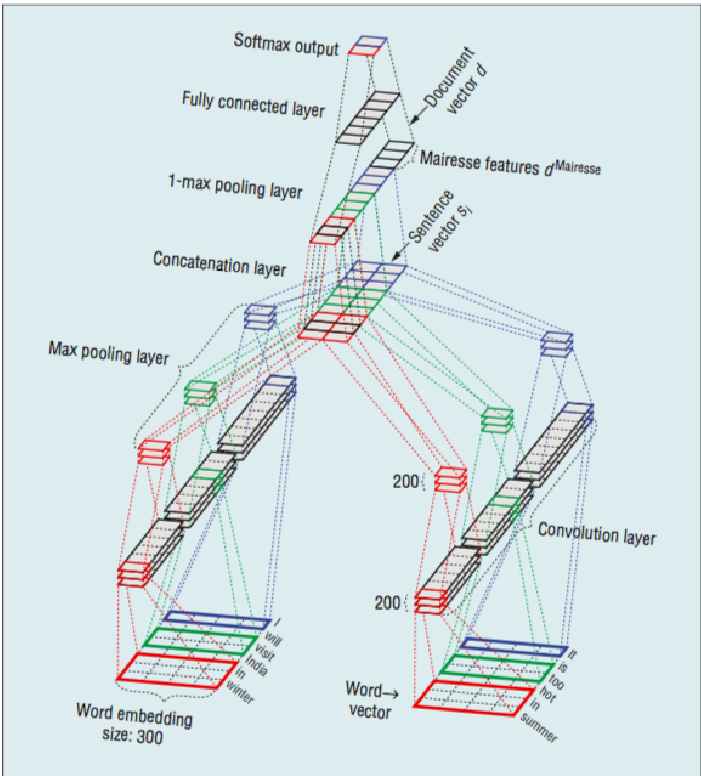 Fig 1: CNN architecture for extracting monogram, bigram, and trigram features from text.
2. The Visual & Audio Streams (Bimodal Regression)
The gold standard in this field involves Deep Bimodal Regression (DBR). This typically uses:
- Visual: Modified Deep Residual Networks (DRN) to scan facial regions.
- Audio: Log-filterbank features fed into linear or recurrent regressors.
- Fusion: Late fusion (averaging scores) is often most effective for "Apparent Personality" (how others perceive you).
Insights from Occlusion Analysis
One of the most fascinating technical insights mentioned is Segment-level Occlusion Analysis. By blocking out parts of a video (the background, the eyes, the mouth), researchers can see which parts of the "image" a CNN actually uses to determine a trait.
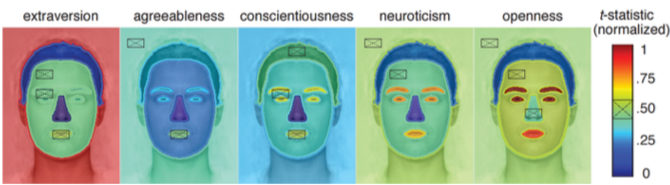 Fig 2: Segment-level occlusion analysis showing how specific regions (Eyes vs. Mouth) influence the prediction of different traits.
Key Discovery: The neural network focuses heavily on the eyes and mouth to discriminate personality. For example, occluding the mouth region significantly increases the predicted "Neuroticism" score, suggesting the model looks for specific lip tensions or "smiles" to gauge emotional stability.
Experiments & Results: The Rise of Multimodal SOTA
The survey provides a comparative look at performance across datasets like ChaLearn First Impressions and Pennebaker's Essays.
| Modality | Best Method/Paper | Dataset | Mean Accuracy |
|---|---|---|---|
| Text | Hernandez et al. (LSTM) | MBTI Kaggle | 67.77% |
| Visual | Gurpinar et al. (ELM) | ChaLearn | 90.94% |
| Multimodal | Gucluturk et al. (DRN) | ChaLearn | 91.70% |
The results confirm that visual features (facial expressions) typically provide the strongest unimodal signal, but the highest reliability is only reached when audio and visual streams are harmonized.
Critical Analysis & Future Outlook
Takeaways
- Perception vs. Reality: The field is moving from "True Personality" (questionnaire-based) to "Apparent Personality" (how the world sees you), which is highly relevant for job screening and personal assistants.
- Feature Evolution: Deep learning (CNN/RNN) has officially replaced shallow models (SVM/Naïve Bayes) as the SOTA backbone.
Limitations & Ethics
The authors do not shy away from the "Cambridge Analytica" shadow. They explicitly discuss the ethical dilemma of Algorithmic Impact Assessments (AIAs). If a machine decides you are "low on Conscientiousness" based on your YouTube vlogs, should you be denied a job? The "Black Box" nature of CNNs makes this a high-stakes concern for fairness and cultural bias.
Future Work
The next frontier is Trimodal Fusion (Text + Audio + Video) and the development of larger, more diverse datasets that move beyond the Big-Five to more complex psychological models.