
Beyond Machine Learning: Using SAT Solvers to Crack the Reciprocal Payer Problem in Banking
Reciprocal payers identification in banking logs using SAT solvers
This paper introduces a novel proof-of-concept application of Boolean Satisfiability (SAT) solvers to identify "reciprocal payers" (cliques) within banking transaction logs. By modeling financial interactions as propositional logic formulas in Conjunctive Normal Form (CNF), the authors successfully detect groups of bank clients who issue mutual payments to one another, a key indicator for money laundering and fraud.
Executive Summary
TL;DR: This paper explores an unconventional but powerful weapon in the fight against financial fraud: SAT Solvers. While the industry typically leans on Machine Learning (ML) or Expert Systems, the authors demonstrate that finding "reciprocal payers"—groups of clients who mutually pay each other—is essentially a Clique Problem that can be solved with extreme efficiency using propositional logic and modern satisfiability testing algorithms.
Positioning: This work serves as a "re-discovery" of SAT solvers for data analysis. It bridges the gap between hardware verification (where SAT solvers matured) and financial forensics (where they are desperately needed but underutilized).
The Problem: The Combinatorial Nightmare of Banking Logs
In the financial world, "reciprocal payers" are often involved in structuring or smurfing—techniques used in money laundering to move funds in cycles to evade detection.
The technical challenge is that finding these groups is a version of the Clique Problem in graph theory. As the number of accounts and transactions grows, the number of possible combinations explodes. Conventional ML often fails here because:
- Strict Logic Needed: Fraud investigators need to find exact loops, not just "clusters" of similar behavior.
- Computational Complexity: For most modern software, searching through millions of transactions to find a clique of 100 people is an NP-complete nightmare.
Methodology: The Logic of Money Flows
The authors propose a shift from "learning patterns" to "solving constraints." They treat bank transactions as propositional variables:
1. From Transactions to Propositional Logic
If account A pays account B, this is a variable. To find a reciprocal relationship, the solver looks for the satisfying assignment where both and are true.
2. Handling Multiple Accounts
Real-world fraud involves one person using multiple accounts. The authors extend their logic by introducing a "Client ID" mapping. The relationship becomes a disjunction:
3. The CNF Workflow
The process follows a clean pipeline:
- Encoding: Convert the transaction table (Table 1) into Conjunctive Normal Form (CNF).
- Solving: Feed the
.cnffile into a SAT solver (like those based on the DPLL algorithm). - Decoding: The resulting "Satisfying Assignment" directly points to the members of the fraud clique.
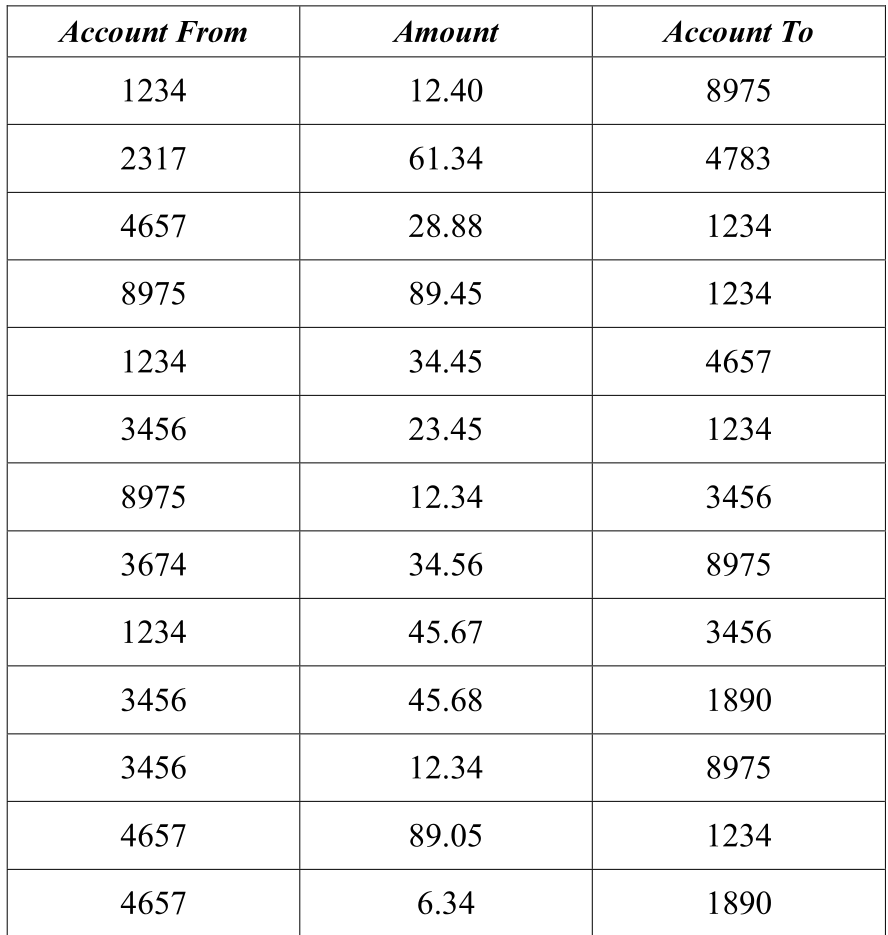 Figure 1: Sample transaction log used to construct the logic clauses.
Experiments & Results: The Power of SAT
By utilizing the formalized .cnf format, the authors show that tasks previously considered "unfeasible" in the 1970s are now solvable in milliseconds.
Key Insights:
- Incomplete Solvers: For general business intelligence, "incomplete" solvers (which are faster but might miss some assignments) can act as a high-speed filter for potential fraud.
- Complete Solvers: For critical regulatory compliance (where failure to find a loop is not an option), "complete" solvers provide a mathematical guarantee of detection that Machine Learning cannot offer.
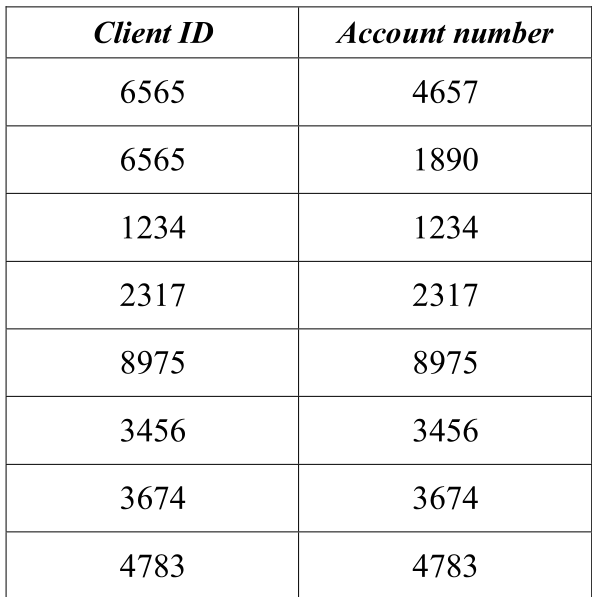 Figure 2: The mapping of accounts to Client IDs, crucial for solving disjunctive SAT clauses in complex laundering schemes.
Critical Analysis & Conclusion
Takeaway
Logic-based solvers are making a comeback. As SAT solvers have evolved through the "SAT Competitions" in the hardware industry, they have become capable of handling millions of variables. This paper proves that if you can define a fraud pattern as a logical constraint, a SAT solver is likely the most robust way to find it.
Limitations
- Encoding Effort: As the authors note, it often takes more time to encode the banking data into SAT format than it does for the solver to actually find the answer.
- Scalability to Billion-Scale: While the proof-of-concept is strong, the memory overhead of CNF files for billions of global transactions remains a hurdle for real-time systems.
Future Outlook
The next frontier is likely SMT (Satisfiability Modulo Theories), which would allow investigators to include "Amount" and "Time" constraints directly into the logic (e.g., "Find a loop where the total amount > $10,000 and occurs within 48 hours"), further narrowing the search for financial crime.