
Beyond Following: The Structural Evolution of Reciprocity in Social Networks
Reciprocal versus parasocial relationships in online social networks
This paper investigates the dynamics of reciprocal versus parasocial edges in directed online social networks using Google+ and Flickr datasets. The authors propose a novel approach by modeling reciprocal edge prediction as an outlier detection problem rather than traditional supervised learning, achieving superior F1 scores.
TL;DR
Not all social media "follows" are created equal. This paper dives into the distinction between parasocial edges (one-way follows) and reciprocal edges (mutual follows). By analyzing Google+ and Flickr, the authors reveal that mutual followers are structurally different from one-way followers and demonstrate that predicting who will "follow back" is best handled as an outlier detection problem rather than standard classification.
Background: The Taxonomy of a "Follow"
In directed networks like Twitter or Google+, relationships exist in two states:
- Parasocial: User A follows User B, but B has not (yet) followed A back. This is common between fans and celebrities.
- Reciprocal: User A and User B follow each other.
Most researchers treat these as simple directed links. However, this paper argues that the transition from a parasocial "request" to a reciprocal "acceptance" is the heartbeat of social network evolution.
The Problem: The Flaw in Classical Prediction
Existing methods for predicting reciprocity usually sample current one-way edges (parasocial) and label them as "negative" examples for training.
The Intuition Gap: If you are trying to predict who will follow back, labeling someone who hasn't followed back yet as a "negative" example is fundamentally flawed. They might follow back tomorrow! This leads to a model that matures poorly as the network grows.
Methodology: Outlier Detection to the Rescue
To solve the labeling dilemma, the authors pivot to One-Class SVM (OC-SVM).
- The Logic: Instead of telling the model what a "negative" relationship looks like, they only show it what "positive" (already reciprocal) relationships look like. Anything that deviates significantly from these established mutual bonds is treated as an outlier.
Key Features for Prediction
The authors identified several high-signal predictors:
- Local Reciprocity: If a user has a high historical "acceptance rate," they are more likely to reciprocate in the future.
- Node Attributes: Sharing a school triples the likelihood of a follow-back in Google+, whereas sharing a city only increases it by 33%.
- Edge Age: The older a one-way follow gets without reciprocation, the less likely it is to ever become mutual (as seen in the "linking-back probability" curve).
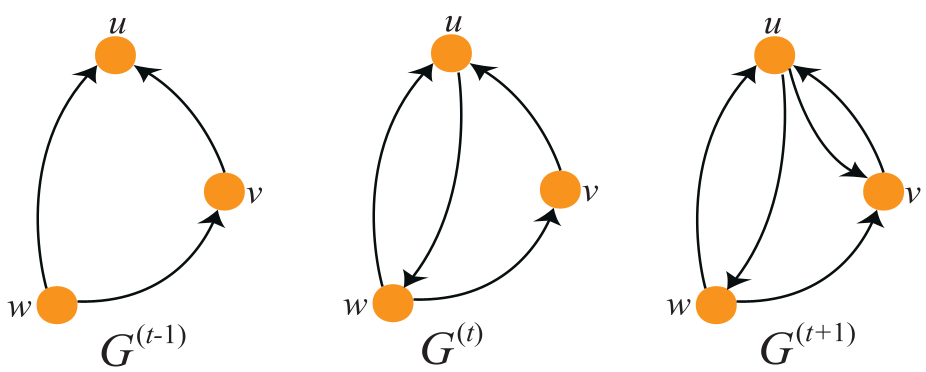 Figure 1: Comparison between friend requests, acceptances, and the resulting reciprocal vs. parasocial states.
Experiments and Results
The authors tested their hypothesis on a massive Google+ dataset (29M nodes) and a Flickr dataset (2.3M nodes).
Structural Insights
- Assortativity: Reciprocal edges connect users of similar "social status" (degree). Conversely, parasocial edges are the bridges between the "ordinary" and the "popular."
- Clustering: Parasocial neighbors are actually connected more tightly to each other than reciprocal neighbors, suggesting that one-way follows often happen within tight interest-based clusters.
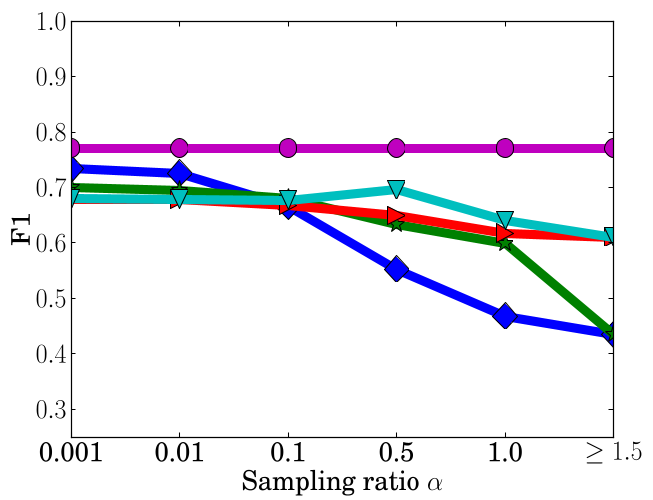 Figure 2: Precision-recall metrics show OC-SVM (outlier detection) consistently outperforming supervised SVM and TriFG across different sampling ratios.
The "Winning" Metric
In Google+, the OC-SVM achieved a precision of 0.8. The authors found that random negative sampling (the old way) consistently degraded model performance because it accidentally included "future positives" as "training negatives."
Critical Analysis & Conclusion
Takeaway
The paper successfully proves that reciprocal relationships are not just "directed links with a return arrow"; they are qualitatively different structural units. Modeling their formation as an outlier detection task is a significant methodological shift that solves the temporal inconsistency of social network datasets.
Limitations
A major limitation is the reliance on public profile data. In Google+, 78% of users had no available attributes. While the authors filtered these for the attribute study, a truly robust model would need to account for the "dark matter" of private users who still influence network reciprocity.
Future Outlook
This work sets the stage for more realistic network growth models. Future AI-driven social platforms could use these insights to suggest "highly likely to reciprocate" friends, moving away from showing users random celebrities and toward building sustainable, mutual social circles.