
Reciprocity vs. Content: Deciphering the ROI of Social Capital in the Blogosphere
The role of reciprocation in social network formation, with an application to LiveJournal ଝ
This study investigates the dynamics of social network formation on LiveJournal by adapting a capital investment model to analyze the role of reciprocation. Utilizing a panel of over 1,300 bloggers followed for a year, the authors distinguish between the "social networking" (interaction-based) and "media" (content-based) aspects of blogging, finding that while reciprocation initiates growth, long-term audience size is driven primarily by active engagement and content production.
TL;DR
Is your online influence a product of what you say or how you interact? This paper deep-dives into a year’s worth of data from LiveJournal to quantify the "economy of friendship." By treating social networks as a form of capital investment, the researchers discovered that while "friending" others gets you noticed, the real long-term growth (higher SOTA in social capital) comes from active commenting and engagement, rather than just broadcasting content.
The Motivation: Aristotle Meets Big Data
The authors open with a provocative quote from Aristotle: "In all friendships implying inequality, the love also should be proportional." In modern terms: why do some bloggers have thousands of readers while others remain in digital obscurity?
Traditional models often look at networks as static graphs. However, the authors argue that social capital is dynamic. The pain point in existing literature is the "reflection problem"—it's hard to tell if you are popular because you work hard, or if you work hard because you are popular. This paper aims to disentangle these variables by looking at reciprocation.
Methodology: The Capital Investment Model
The core of the paper is an adaptation of the Glaeser et al. (2002) model. It treats your "Number of Readers" () as an asset that evolves:
Where is your investment (activity) and is the depreciation rate (lost interest).
The Reciprocation Loop
The authors split growth into two flows:
- Direct Outreach: You add a friend (), and they follow you back (ratio ).
- Organic Attraction: Someone follows you (), and you follow them back (ratio ).
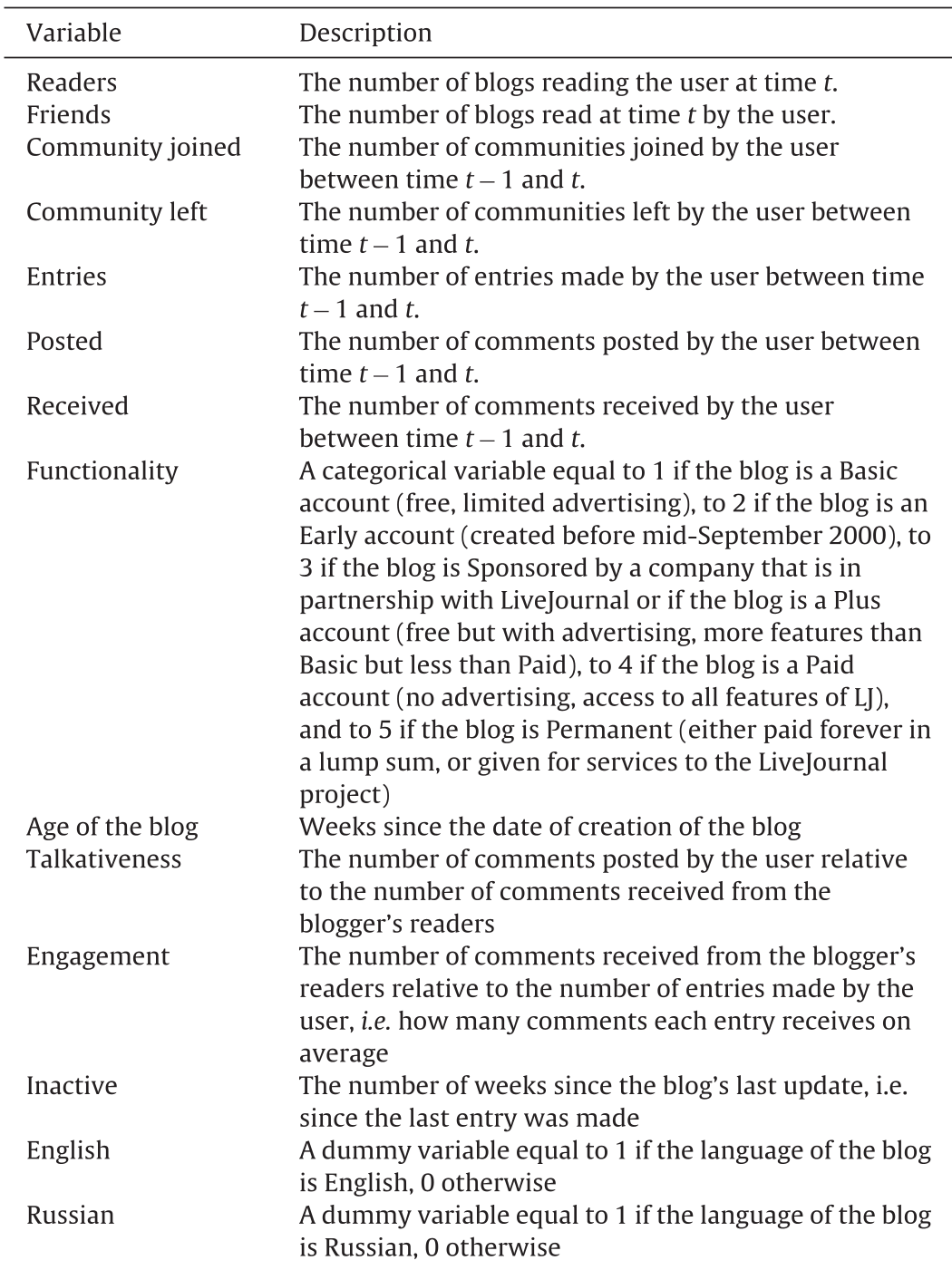
To handle the "messy" reality of this data, they use System-GMM, a sophisticated econometric tool used to handle "dynamic panel bias" and endogenous variables.
Key Findings: The "Social Multiplier" Effect
The study reveals several profound insights into how digital influence is actually manufactured:
1. The Reciprocation Ratios
The study finds that bloggers are far more "giving" than their audience. While you might reciprocate about 43-49% of people who follow you, only 16-25% of the people you follow will follow you back. This "unbalanced" love is a hallmark of the transition from a social group to a media platform.
2. Commenting > Posting
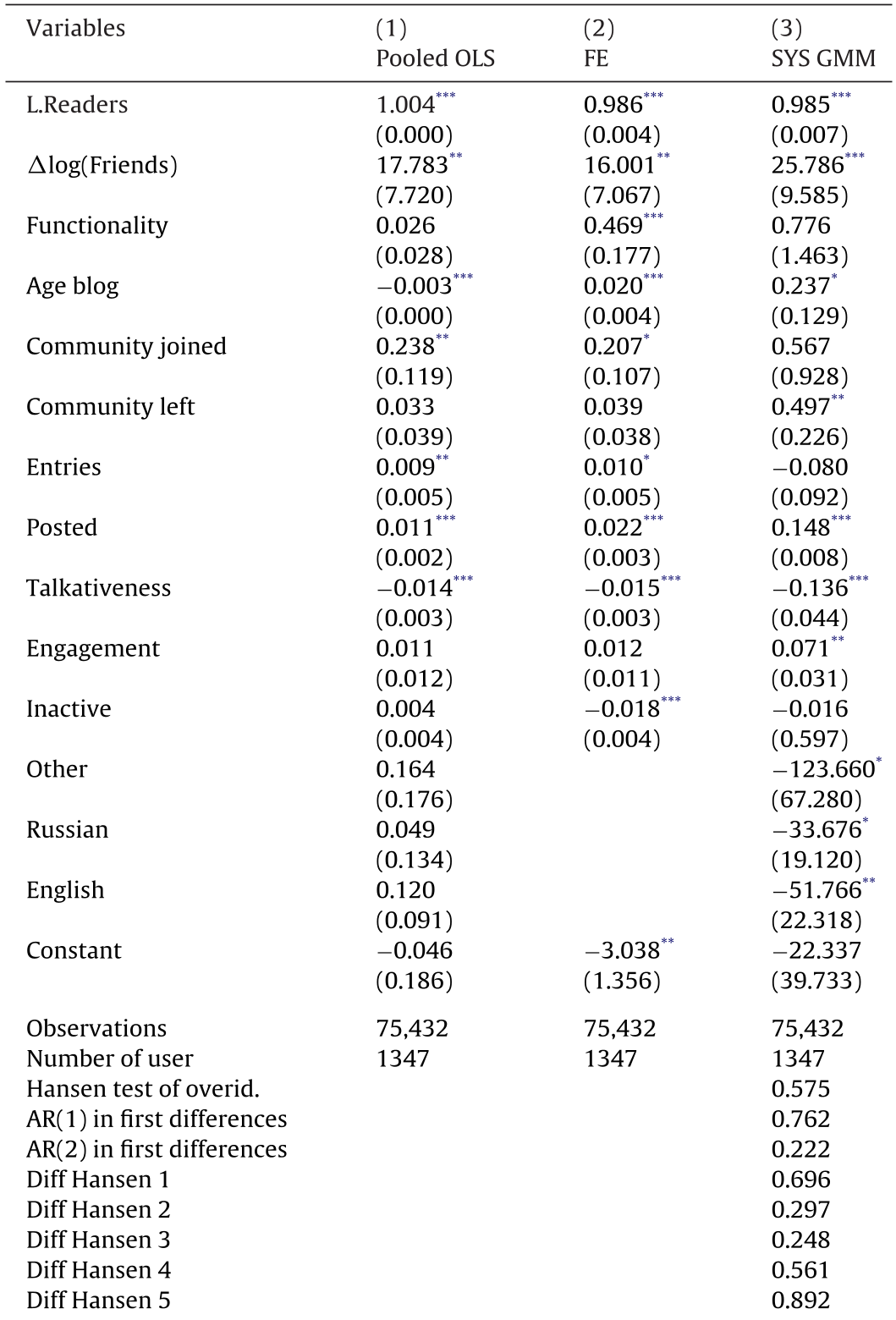
Surprisingly, simply writing more blog entries does not correlate strongly with gaining readers. However, the number of comments posted on others' blogs is a significant driver. In the long run, being a "talkative" participant yields a massive return on investment.
3. The Power of "Big Blogs"
Large blogs ( readers) behave differently. They actually derive more of their growth from reciprocating incoming interest rather than seeking out new friends. The authors suggest that for "famous" bloggers, staying popular is about "repaying" the attention they receive—proving that popular blogs are not just "more loved," but "more loving."
Deep Insight: Multipliers of Influence
One of the most valuable parts of the paper is the analysis of Long-Run Multipliers.
- Functionality Matters: Upgrading to a "Paid" account has a long-run multiplier of 51.7, meaning a small increase in status or toolset today pays off 50x in the future.
- A Week of Silence: Inactivity has a very slow "depreciation" rate. Readers are lazy; they won't unfollow you immediately if you stop posting, but the "friends" you follow are much quicker to drop you.
Critical Analysis & Conclusion
The takeaway is clear: Social media is a long-term investment. The "social multiplier" effect is slow to build but powerful once established.
Limitations: The study focuses on LiveJournal, a platform that sits at the crossroads of a personal diary and a professional blog. On hyper-media sites like Twitter (X), the "media" aspect likely outweighs the "social" aspect even further.
The Verdict: If you want to grow your social capital, stop shouting into the void and start commenting on the community. Influence is built one interaction at a time.