
Social Capital in the Wiki Era: How Network Positioning Dictates Your Status in Open Communities
Investigating recognition-based performance in an open content community: A social capital perspective
This study investigates how social capital within an open content community (Wikipedia) influences participants' recognition-based performance, specifically their attainment of administrative status. Using social network analysis on 465 active users, the authors demonstrate that network closure and structural holes significantly predict formal status.
TL;DR
Why do some Wikipedia editors become powerful "Bureaucrats" while others remain anonymous contributors? This paper explores the "Social Capital" behind open-source success. By analyzing nearly 500 active Wikipedians, the authors found that your formal status isn't just about what you know or how many edits you make—it’s about how you are connected. High performance is driven by a combination of strong local ties (Network Closure) and the ability to bridge different groups (Structural Holes).
Problem & Motivation: The Puzzle of Free Labor
The open-source movement is an economic anomaly: why do people work for free? While "altruism" is a common answer, the real driver is often recognition-based performance. In Wikipedia, this means climbing the ladder from a regular editor to an Administrator, Bureaucrat, or Steward.
The authors argue that this status isn't handed out randomly. It is a form of social reward for participants who leverage their "Social Capital"—the resources embedded in their social relationships. The core question is: which type of connection matters more? Is it "who you know" (direct ties) or "where you sit" (bridging gaps)?
Methodology: Mapping the Wikipedian Social Fabric
The researchers extracted 30 GB of MySQL data from Wikipedia, focusing on 465 participants who were active in the "Requests for Adminship" process.
The Two Pillars of Social Capital
- Network Closure: This view (championed by James Coleman) suggests that dense, cohesive networks build trust and norms. In Wikipedia, this is measured by direct and indirect ties—who discusses things with whom on "Talk Pages."
- Structural Holes: This view (championed by Ronald Burt) suggests that value comes from "bridging" disconnected groups. By occupying a "hole" between two clusters, you gain access to diverse information.
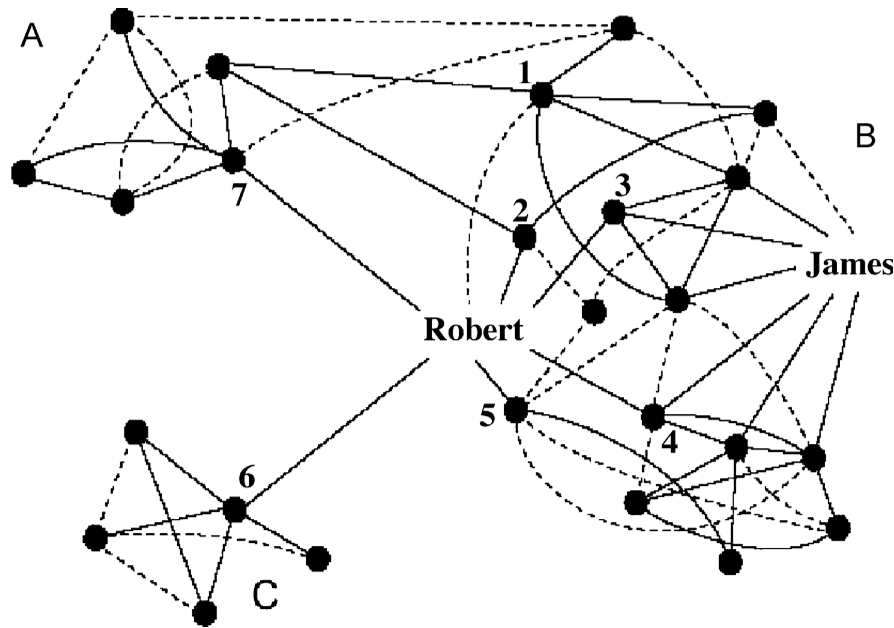 Figure 1: Comparison between Network Closure (James) and Structural Holes (Robert).
Methodology Details
The study used Talk Page interactions as the basis for the social network. If two users commented on the same talk page, a "tie" was recorded. Performance was measured on an ordinal scale:
- 0: Regular Wikipedian
- 1: Simple Administrator
- 2: Super-administrator (Bureaucrat/Steward)
Results: The Balanced Way to Power
The results confirm that social structure is a powerful predictor of status, even when controlling for the total number of edits and length of membership.
1. The Strength of Closure
Both direct and indirect ties had a massive positive effect (p < 0.001). This suggests that to be trusted with "police powers" (deletion/blocking), you must be deeply embedded in the community's discussion culture.
2. The Mixed Blessing of Structural Holes
While larger network size (an indicator of structural holes) helped users gain status, high density actually hindered promotion to the highest ranks. If you only talk to a small, insular group (even if very frequently), you suffer from "cognitive lock-in," and the broader community may view you as narrow or "cliquey."
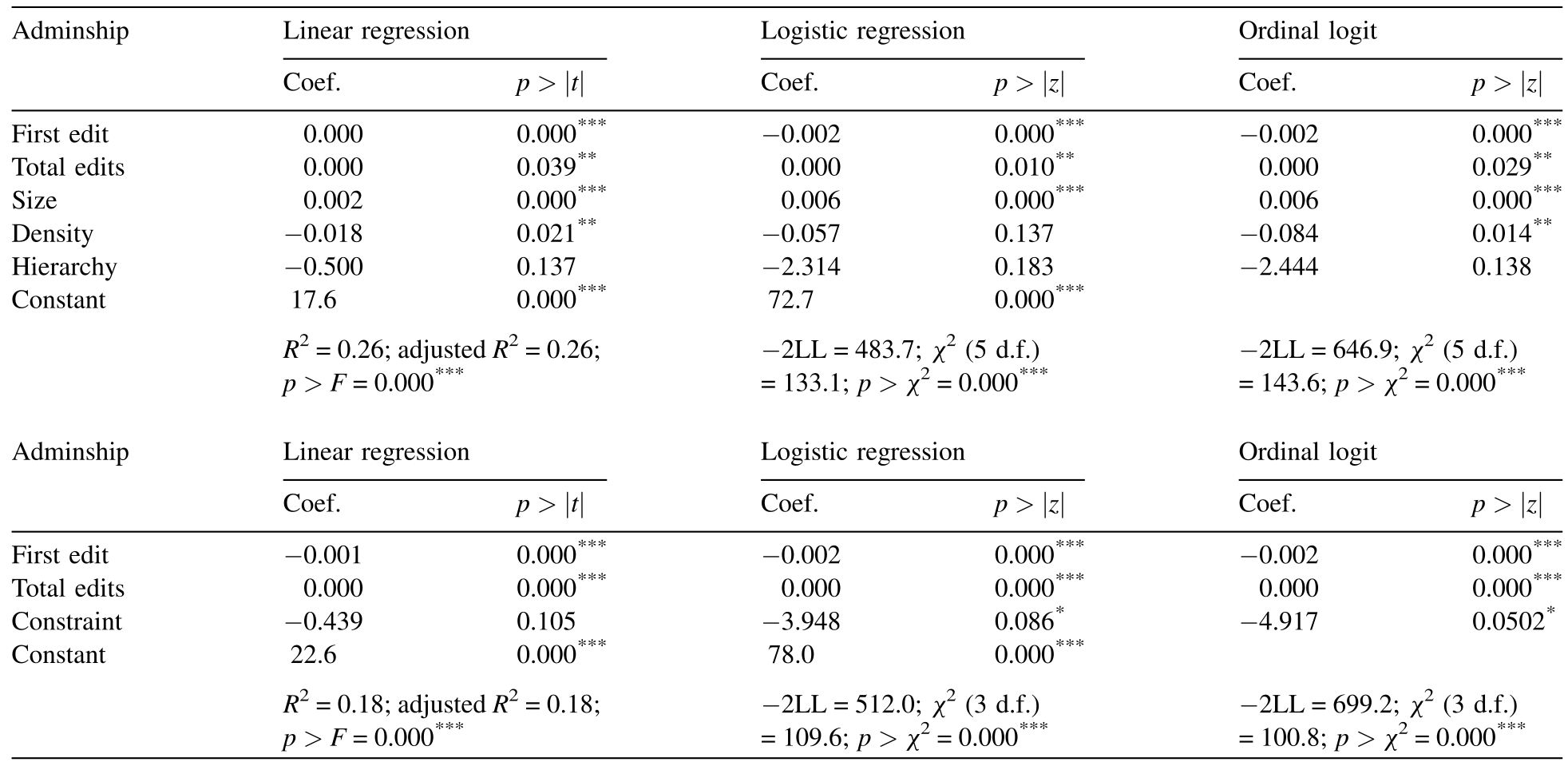 Table: Linear and Logistic Regression results showing the influence of Size, Density, and Hierarchy.
Critical Insight: The "Hierarchy" Paradox
Interestingly, Network Hierarchy (the degree to which connections are concentrated in one person) had no significant effect. In traditional corporations, "knowing the boss" is everything. In Wikipedia's democratic, low-power-distance culture, a "central" user's support only counts as one vote. Status is earned through horizontal peer recognition, not vertical patronage.
Conclusion & Application
For the individual contributor, the lesson is clear: diversify or stagnate. To move from a junior admin to a "Bureaucrat," you must venture out of your favorite topic area and interact with the wider community to exploit structural holes.
For organizations, this research proves that "Wiki-style" collaboration can be managed by understanding social networks. If a company wants to foster internal knowledge sharing, it must encourage a mix of "dense" project teams for trust and "brokerage" roles to ensure new ideas flow between departments.
Limitations: The study is based on 2004-2006 data. Modern Wikipedia is far more bureaucratic, and the "barrier to entry" for adminship has likely shifted from social capital to strict policy compliance.