
Decoding the Law: Automated Identification of Facts and Principles in Legal Precedents
Recognizing cited facts and principles in legal judgements
The paper presents a supervised machine learning approach to automatically identify and classify sentences in legal judgments as "cited facts," "legal principles," or "neither." Using a Bayesian Multinomial Classifier and a rich set of linguistic features, the authors achieve an overall Kappa of 0.72 and classification accuracy of 85% on common law reports.
TL;DR
Researchers have developed a machine learning framework capable of automatically distinguishing between cited facts and legal principles within court judgments. By leveraging linguistic features and dependency parsing, the system achieves 85% accuracy, matching the performance of trained human annotators and paving the way for advanced legal AI tools.
Background: The Burden of Stare Decisis
In common law systems, today's decisions are built on yesterday's foundations. The doctrine of stare decisis ("to stand by decided cases") requires lawyers to find precedents with similar material facts to argue for similar legal outcomes. However, modern legal databases are overwhelming; a single case might have thousands of citing references. Currently, legal professionals must manually sift through long, complex PDFs to find the ratio decidendi—the legal "reason for the decision."
The Problem: Beyond Simple Citations
Traditional citators (like LexisNexis or WestLaw) tell you that a case was cited, but they rarely tell you why or what specific principle was extracted. Existing NLP tools often focus on "sentiment" (whether a case was overruled) rather than the granular content of the citation. This paper addresses the gap: How can we automatically extract the specific facts and principles that give a citation its weight?
Methodology: Linguistics as a Legal Proxy
The authors hypothesized that legal principles and facts have distinct "linguistic signatures." They developed a classification system based on:
- Modality: Principles often use deontic modals (must, shall, may) to express obligation or permission.
- Tense: Facts are typically anchored in the past tense (was, occurred, performed), while principles are often stated in the universal present.
- Dependency Structures: Using the Stanford Parser, the team looked for specific grammatical relationships between words rather than just "bag-of-words" frequency.
 Figure 1: The conceptual framework relies on the textual manifestation of legal reasoning patterns.
Experimental Results: Machines vs. Humans
The study involved a manual annotation phase where legal experts and non-experts labeled sentences. The agreement was surprisingly high (j=0.65), proving that these categories are distinct enough for computational modeling.
When the Bayesian Multinomial Classifier was applied:
- Accuracy: 85% overall.
- Precision/Recall: Highly balanced across categories (approx. 0.82 for principles).
- Feature Efficacy: Dependency features outperformed simple word counts, proving that the structure of legal language is as important as the vocabulary.
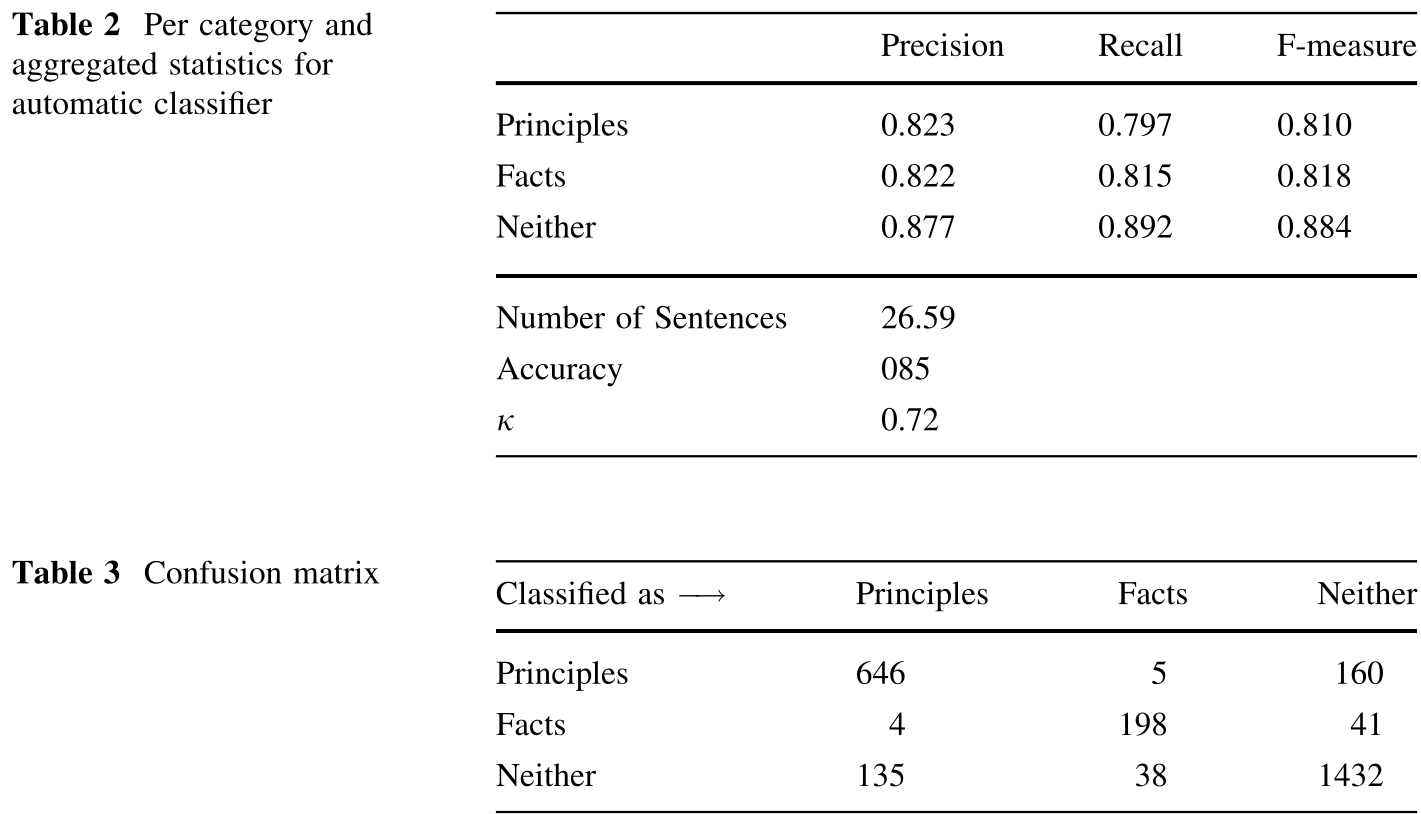 Figure 2: The confusion matrix shows that the model successfully distinguishes between facts and principles, with most errors occurring in the "neutral" category.
Critical Insight: Why Does This Work?
The effectiveness of this approach lies in the "professionalized" nature of legal writing. Judges follow specific rhetorical conventions. By identifying that "Facts" correlate with proper names and past tense, while "Principles" correlate with indefinite articles (e.g., "A contract...") and modals, the model captures the structural logic of legal argumentation without needing a deep semantic "understanding" of the law itself.
Future Outlook and Limitations
While the results are strong, the authors note a challenge: distinguishing between a principle cited from a previous case and a principle being formulated by the current judge. Future iterations will likely require "Context Encoding" to track the provenance of legal statements more accurately.
This work is a vital step toward a "Google for Law" that doesn't just return documents, but returns specific, actionable legal rules and factual scenarios tailored to a lawyer's specific case needs.