
Multimodal Mastery: Deciphering Human Emotions In the Wild
10042_Recognizing Emotion in the Wild using Multimodal Data.
This paper presents a comprehensive multimodal framework for the 8th Emotion Recognition in the Wild (EmotiW 2020) challenge, covering four distinct tasks: Group Emotion Recognition, Driver Gaze Prediction, Engagement Prediction, and Physiological Signal-based Emotion Recognition. Utilizing a combination of deep learning (Xception, InceptionV3), GAN-based discriminators, and ensemble techniques, the authors achieve competitive performance across all tracks, highlighting the robustness of facial and physiological features in "in the wild" scenarios.
TL;DR
Researchers from the University of South Florida tackled the EmotiW 2020 Challenge by developing a robust multimodal pipeline for four complex tasks: group emotions, driver gaze, student engagement, and physiological signals. By fusing deep learning architectures like Xception and InceptionV3 with traditional Random Forests and a novel GAN-based discriminator ensemble, they demonstrated how facial and bodily cues can be generalized across diverse real-world environment.
Problem & Motivation: The "Wild" Challenge
Traditional emotion recognition often relies on "studio-quality" data—centered faces, perfect lighting, and clean signals. The "Wild" setting breaks these assumptions. Whether it's a crowded party (Group Emotion), a driver checking a side mirror (Driver Gaze), or a student distracted in a park (Engagement), the data is messy.
The authors identified two major roadblocks:
- Generalization Gap: Features that work for one task (like facial landmarks) are often ignored for others.
- Signal Noise: Physiological signals in the wild have high variance, making it nearly impossible to distinguish between a "Happy" heart rate and a "Surprise" one without sophisticated filtering.
Methodology: The Core Architectures
1. Group Emotion: Converting Motion to Vision
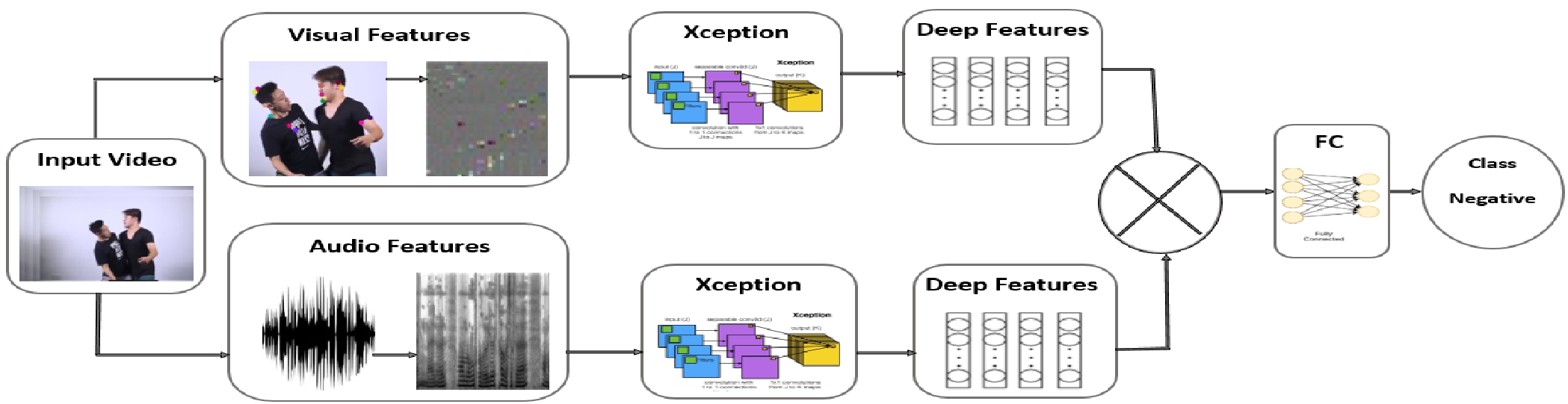
Instead of feeding raw frames, the team transformed Optical Flow (motion) and Mel Spectrograms (audio) into 256x256 RGB images. This allowed them to use Xception networks, typically reserved for static image classification, to learn temporal and acoustic patterns simultaneously.
2. Driver Gaze & Engagement: The Ensemble Power
For Driver Gaze, the authors didn't rely on just one model. They used an ensemble where:
- Pixel-space features (cropped eye/face) were processed by InceptionV3.
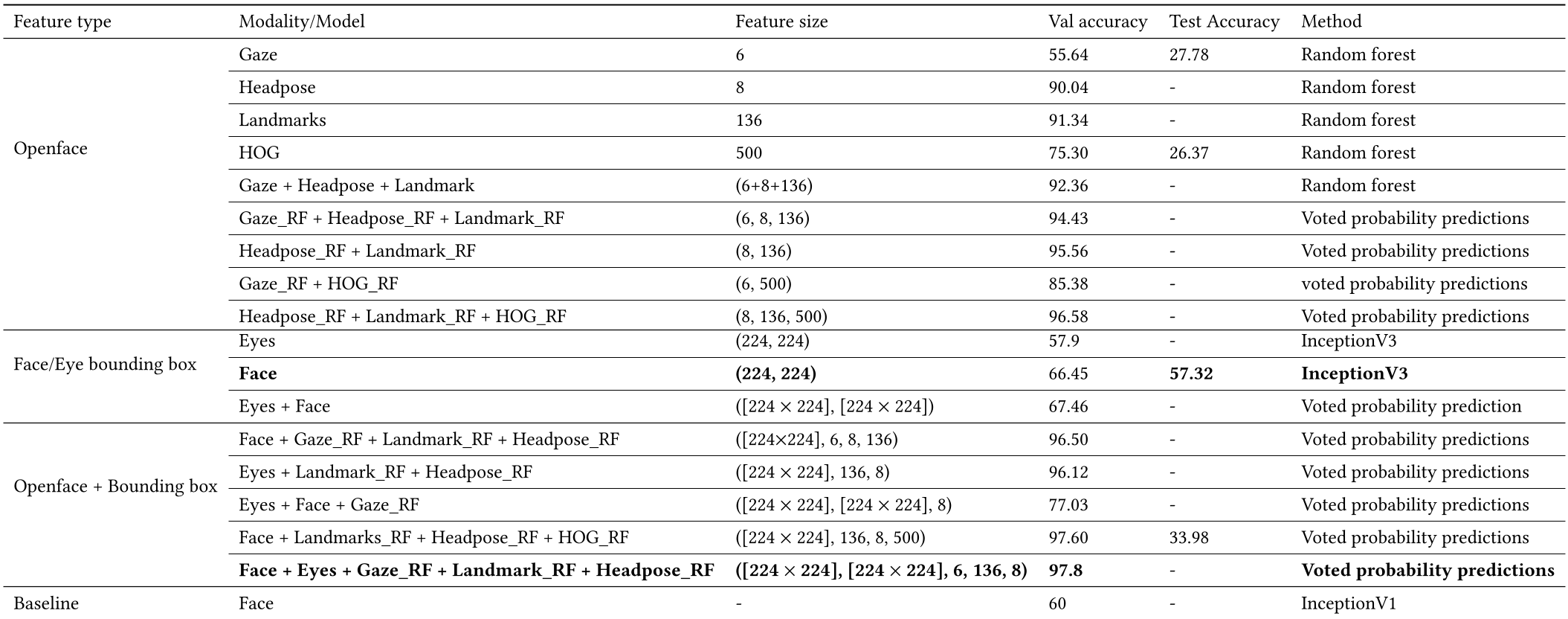
- Non-pixel features (HOG, Gaze vectors, Head Pose) were processed by Random Forests. A weighted sum of probability predictions determined the final gaze zone (e.g., windshield vs. radio).
3. Physiological Signals: GANs as Classifiers
Perhaps the most "out of the box" idea was the GAN-based Discriminator Ensemble. Instead of using GANs to generate data, they trained 7 separate GANs (one per emotion). Each discriminator was tasked with identifying its specific target emotion as "real" and everything else (noise or other emotions) as "fake."
Experiments & Results
The team's results validated the "strength in numbers" approach of multimodal fusion:
- Engagement Prediction: Their weighted ensemble achieved 3rd place in the challenge with an MSE of 0.0659.
- Feature Synergy: In the Driver Gaze task, combining Headpose and Landmarks boosted validation accuracy to over 95%, proving that geometric relationships are often more reliable than raw pixels in low-light driving conditions.
Deep Insight & Conclusion
The research highlights a critical lesson for AI practitioners: Feature Generalization. The same facial Action Units (AUs) and Gaze vectors used to predict if a driver is looking at the mirrors can be effectively repurposed to predict if a student is engaged with a lecture.
Limitations: The "Wild" still bites back—group emotion accuracy suffered (35%) because the feature trackers couldn't handle the extreme occlusions in 28% of the training videos. Future work must focus on occlusion-robust tracking and domain adaptation to ensure high validation performance translates successfully to blind test sets.
Takeaway: Multimodal ensembles are the standard for real-world reliability. When one modality fails (e.g., lighting ruins the pixel data), geometric features or audio can bridge the gap.