
Decoding the Sound of Emotion: High-Accuracy Recognition via Heart Rate Nonlinear Dynamics
Recognizing Emotions Induced by Affective Sounds through Heart Rate Variability
This paper presents a robust emotion recognition system that identifies emotional states elicited by affective sounds using Heart Rate Variability (HRV) exclusively. By combining standard time/frequency domain features with nonlinear analysis (Lagged Poincaré Plots), the authors achieved a state-of-the-art recognition accuracy of approximately 84.72% for valence and 84.26% for arousal using a Quadratic Discriminant Classifier (QDC).
TL;DR
Researchers have developed a system capable of "hearing" how you feel by analyzing the rhythm of your heart. Using only Heart Rate Variability (HRV) derived from an ECG, the study achieves over 84% accuracy in identifying both the intensity (arousal) and the positivity (valence) of emotions triggered by affective sounds. The secret sauce? A blend of nonlinear mathematics and a clever normalization technique that accounts for your "resting" heart state.
Background: Why Audio and the Heart?
While most affective computing research focuses on facial expressions or brainwaves (EEG), sounds are a powerful, primal trigger for the Autonomic Nervous System (ANS). Whether it's a soothing melody or a jarring scream, our heart reacts instantly. This study positions itself at the intersection of psychology and signal processing, aiming to create a system that works with minimal hardware—potentially just a smartwatch or a chest strap.
The Pain Point: The Complexity of the Human Heart
The human heart doesn't beat like a metronome. It is a complex, nonlinear system influenced by a tug-of-war between the sympathetic ("fight or flight") and parasympathetic ("rest and digest") nervous systems. Previous works often looked at simple averages (like mean heart rate), but these "linear" views miss the subtle signatures of emotion. Furthermore, every individual has a different baseline; what looks like "excitement" in one person's heart might be another person's "relaxed" state.
Methodology: Beyond the Average Beat
The authors employed a sophisticated processing chain to extract the "hidden" signals of emotion:
- Standard Features: Time-domain (RMSSD, SDNN) and Frequency-domain (LF/HF ratio) analysis.
- Nonlinear Dynamics: This is the core contribution. They used Lagged Poincaré Plots (LPP), which map current heart intervals against previous ones to visualize the "geometry" of the heart's rhythm.
- Normalization: The researchers used a "Neutral-Arousal" sandwich protocol. By subtracting the data of a 1-minute neutral sound session from the subsequent emotional session, they isolated the specific changes caused by the stimulus.
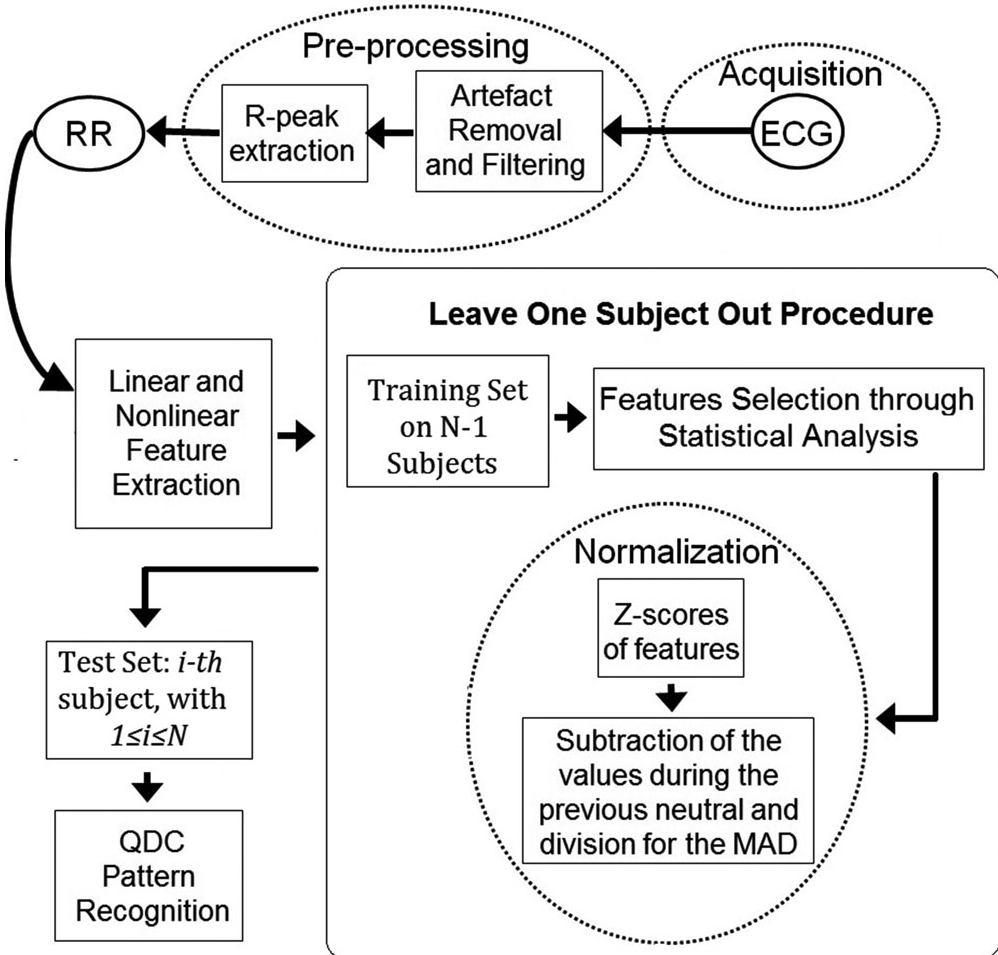 Figure: The experimental protocol used to alternate between neutral and arousing sound sessions.
The Geometry of Emotion
The study highlights how the shape of a Poincaré Plot changes. During neutral states, the plot might look more circular or dispersed, but under high arousal, it shifts into an elliptical shape, signaling a change in the heart's beat-to-beat predictability.
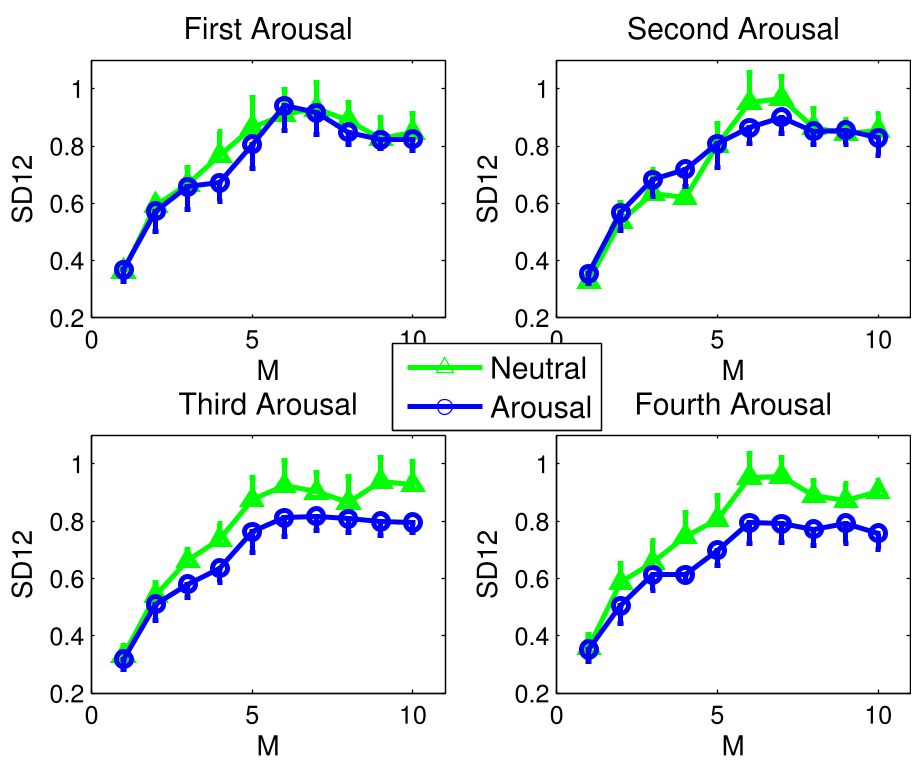 Figure: Lagged Poincaré Plots showing the separation between neutral and high-arousal states.
Experimental Results: Precision in Prediction
Using a Quadratic Discriminant Classifier (QDC) and a Leave-One-Subject-Out (LOSO) validation method (meaning the AI was tested on people it had never seen before), the results were impressive:
- Valence (Pleasant vs. Unpleasant): 84.72% Accuracy.
- Arousal (4 Levels of Intensity): 84.26% Accuracy.
Crucially, if the researchers skipped the normalization step, the accuracy fell to roughly 20%. This proves that context is everything; you cannot understand an emotional heart without first knowing a calm heart.
 Table: The confusion matrix for valence classification, showing high diagonal accuracy.
Critical Insight & Future Impact
The true value of this work is its hardware agnosticism. Because it only requires ECG-derived RR intervals, it can be implemented in "smart textiles" or wearable Holter monitors.
Limitations: The study was conducted on 27 healthy young adults (ages 25-35) in a controlled room. Whether these nonlinear signatures hold up in a noisy, real-world environment (like walking down a busy street) remains to be seen.
Conclusion: By looking at the heart as a nonlinear dynamical system rather than a simple pump, we can unlock a high-fidelity window into the human emotional experience. This research suggests that our "gut feelings" about sounds are written clearly in the subtle variations of our pulse.