
Sensing ASD: Wireless Accelerometers and the Quest for Real-Time Behavior Recognition
Recognizing Stereotypical Motor Movements in the Laboratory and Classroom: A Case Study with Children on the Autism Spectrum
This paper presents a ubiquitous computing approach to automatically recognize Stereotypical Motor Movements (SMM), specifically hand flapping and body rocking, in children with Autism Spectrum Disorders (ASD). Using three wireless tri-axial accelerometers and a C4.5 decision tree classifier, the system achieves an overall recognition accuracy of 88.6% in naturalistic classroom settings.
TL;DR
Researchers from MIT have developed a wearable system capable of detecting stereotypical motor movements (SMM) like hand flapping and body rocking in children with Autism Spectrum Disorder (ASD). By deploying wireless sensors in both clinical labs and chaotic classrooms, they proved that machine learning—specifically Decision Trees—can identify these behaviors with ~89% accuracy, paving the way for real-time intervention tools.
Context: The Invisible Barrier in Autism Research
Stereotypical Motor Movements (SMM) are a hallmark of ASD, yet they remain under-studied because they are notoriously difficult to measure. Until now, clinicians relied on "self-reports" or "manual video coding"—methods that are either subjective or incredibly tedious. The authors argue that if we can't measure it accurately in the wild, we can't understand what triggers it or how to treat it.
The Technical Insight: Why Wearables?
The study moves beyond "mimicked" data (where actors pretend to be autistic) to real-world data from six children with ASD.
The Setup
- Hardware: Three wireless tri-axial accelerometers (left wrist, right wrist, and chest).
- Sampling: 60Hz transmission via 2.4GHz radio.
- The Feature Set: Rather than raw data, the researchers extracted 5 critical "Physiologically Motivated" features:
- Axis Mean Distance: Captures posture and orientation.
- Variance: Measures movement intensity.
- Correlation Coefficients: Detects simultaneous limb/torso motion.
- Entropy: Differentiates rhythmic SMM from random activity.
- FFT Peaks: Pinpoints the frequency-domain "signature" of repetitive rocking or flapping.
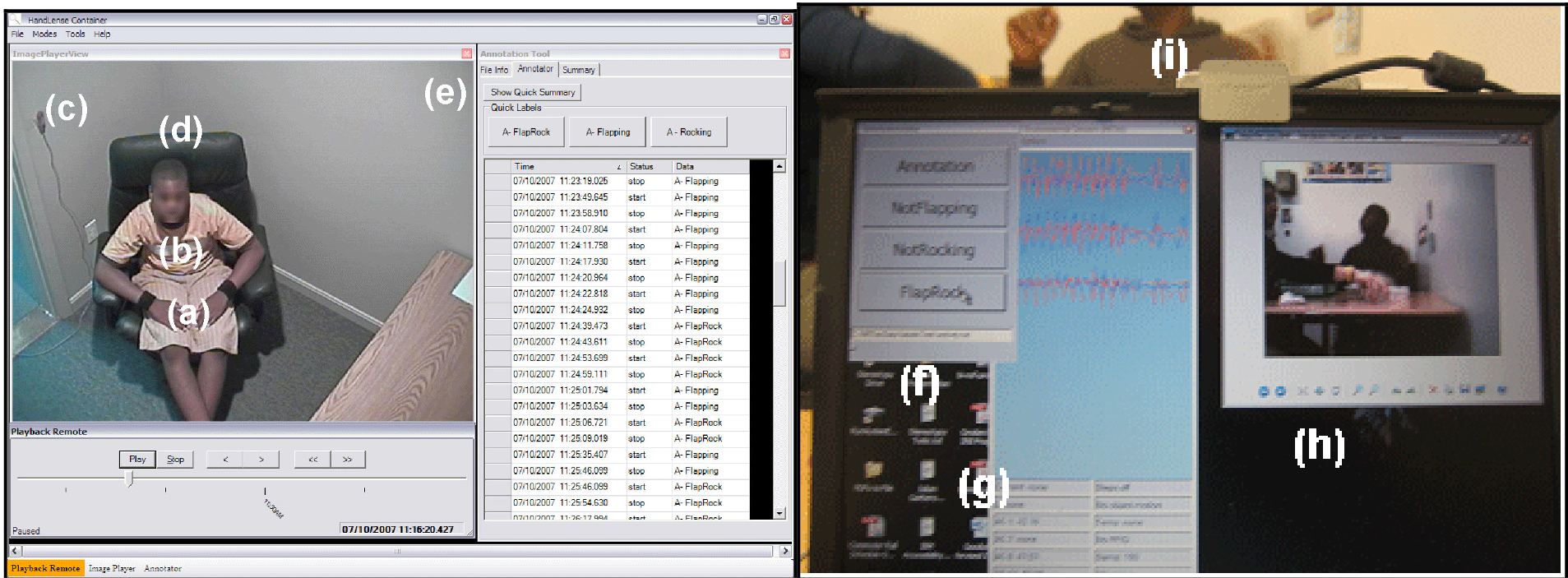 Figure 1: The sensor placement and the real-time annotation interface used to train the models.
Challenges in the "Classroom" vs. the "Lab"
The research highlights a critical hurdle in activity recognition: Annotation Noise. In a quiet lab, a teacher can easily mark when a child starts rocking. In a classroom full of distractions, the "boundaries" (the exact start/stop time) of a movement become blurry.
The team discovered a fascinating trade-off: Offline coding (reviewing video frame-by-frame) is more precise but includes "transitive" movements (the messy start/end of a gesture) that actually confuse the classifier. Real-time coding misses some short events but provides "cleaner" prototypical examples.
Key Results: SOTA Performance in the Wild
The system achieved a Mean Accuracy of 88.6% in the classroom. However, performance was highly "Participant Dependent."
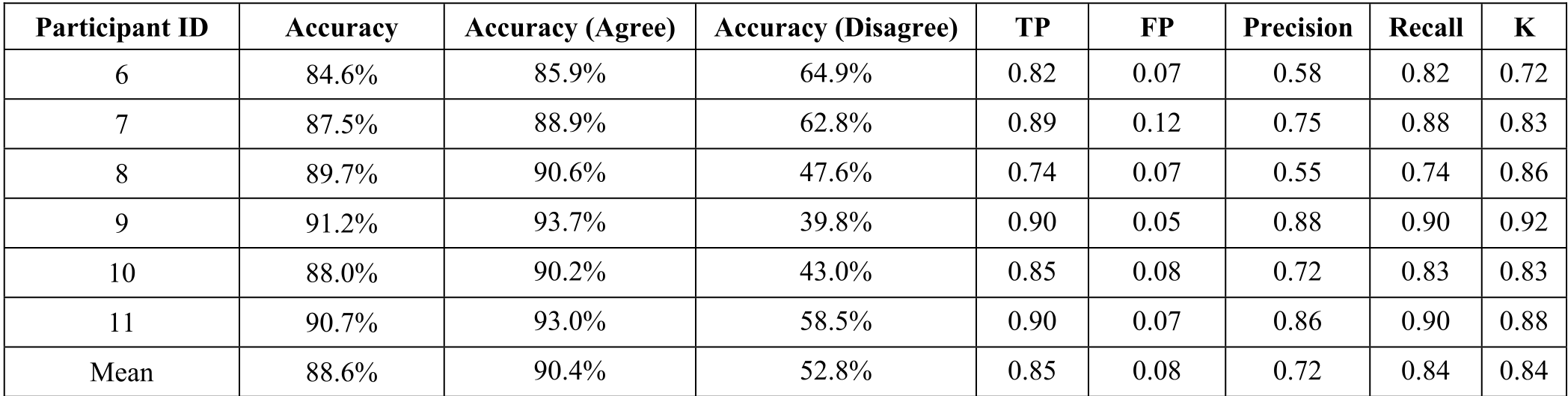 Table 1: Recognition results in the naturalistic classroom setting. Note the high True Positive (TP) rates for most participants.
The "Consistency" Factor
Children who performed behaviors "consistently" (very high topographies of movement) yielded higher True Positive rates (up to 0.91). Conversely, "inconsistent" movements (Participant 6) led to lower precision, highlighting that ASD behaviors are not a monolith; they require personalized algorithmic training.
Critical Analysis & The Future
Why this matters
The study proves that we can move SMM monitoring out of the lab. Imagine a smartwatch that alerts a caregiver before a child's hand-flapping escalates into self-injury, or a system that tracks how a new medication affects behavior frequency across an entire school week.
The Limitations
- Participant Dependency: A "Universal ASD Classifier" didn't work well (Accuracy dropped significantly in participant-independent tests). The system currently requires 10-30 minutes of labeled data per child to work effectively.
- False Positives: A 7-8% FP rate is still high for some medical applications. If an intervention (like a vibration) is triggered incorrectly 8% of the time, it could become an annoying stimulus for the child.
Conclusion
This work marks a shift from "Ubiquitous Computing as a concept" to "Ubiquitous Computing as a clinical tool." By leveraging simple decision trees and well-engineered features, the authors have provided a roadmap for building real-time, wearable assistants for the ASD community.