Beyond the Like: Decoding Learner Behavior through Correlation and Co-occurrence
A recommendation approach based on correlation and co‐occurrence within social learning network
This paper introduces a hybrid social recommendation approach targeting e-learning environments by integrating Spearman correlation and co-occurrence metrics. The method leverages learners' implicit actions (likes, shares, comments) within Social Learning Networks (SLNs) to generate more context-aware pedagogical resource recommendations.
TL;DR
Social learning is no longer just about content; it's about the complex web of interactions learners weave. This paper proposes a hybrid recommendation approach that moves beyond simple content filtering by analyzing the mathematical relationships—Correlation and Co-occurrence—between various learner actions like posting, liking, and sharing within social learning networks.
Background Positioning
In the landscape of Educational Technology (EdTech), recommendation systems are the compass. While many systems use Collaborative Filtering, this work identifies a gap: the failure to account for how different types of actions influence each other. It sits at the intersection of Social Network Analysis (SNA) and Implicit Feedback Recommendation.
Problem & Motivation: The "Passive Learner" Fallacy
Most existing systems rely on explicit data (like ratings) or simple similarity. However:
- Learners are Dynamic: Their interests shift rapidly in social environments.
- Action Dependency: Does a "comment" imply a stronger interest than a "like"? High-frequency actions might be correlated but might not always occur simultaneously.
The authors argue that a system failing to distinguish between the frequency of two actions (Correlation) and the simultaneous probability of those actions (Co-occurrence) loses the nuance of the social learning context.
Methodology: The Power of Dual Matrices
The core of the approach is the breakdown of learner history into two distinct mathematical lenses.
1. Structural Logic
The workflow begins with unstructured data collection, moving toward structured "Event Vectors" (). The system differentiates between "Primary Actions" (the goal, e.g., a page to recommend) and "Secondary Actions" (supportive signals, e.g., reactions).
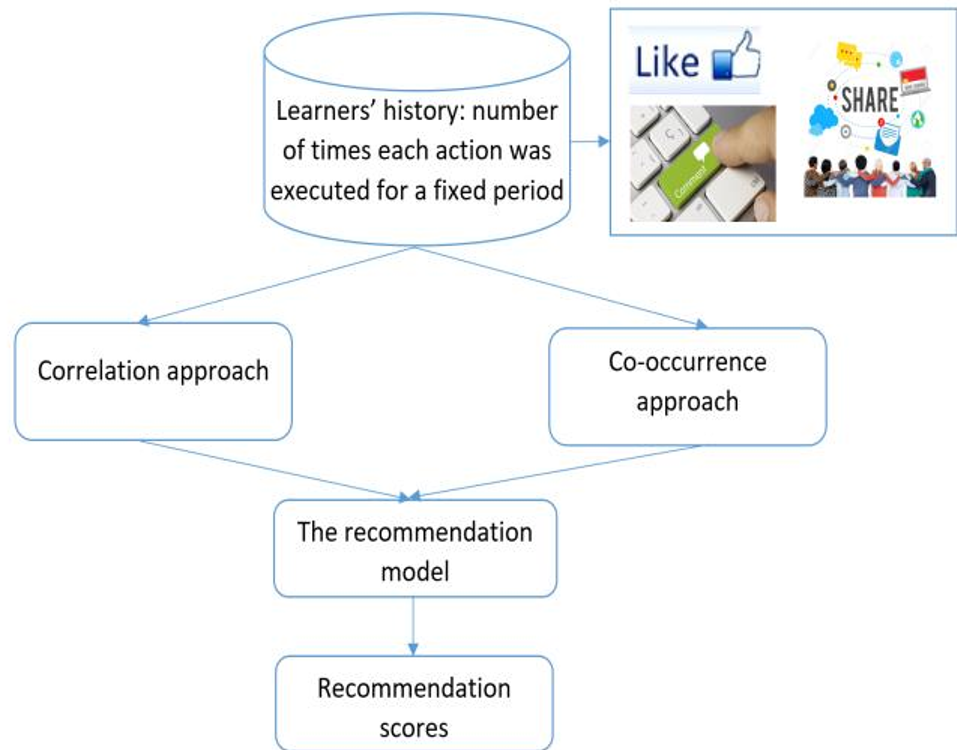 Figure 1: The proposed recommendation strategy showing the flow from data collection to the hybrid calculation.
2. The Mathematical Engine
- Spearman Correlation (): Chosen over Pearson because learner data often follows a non-normal distribution. It measures the strength of the relationship between the ranks of two actions.
- Co-occurrence (): This captures the "Togetherness." By converting history into a binary matrix (action vs. no action), the dot product reveals how often two distinct items were interacted with by the same set of users.
The final recommendation score is a weighted sum that accounts for both the correlation matrix () and the learner's specific history ().
Discussion: Why Hybrid Wins
By combining these two, the system gains "Specificity" and "Variety":
- Correlation finds items that behave similarly over time.
- Co-occurrence identifies "packaged" behaviors (e.g., learners who read Article A almost always share Resource B).
The paper emphasizes the use of Implicit Data. In e-learning, learners are often too busy to rate content. By mining "likes" and "shares" silently, the system provides support without increasing the cognitive load on the student.
Critical Analysis & Future Outlook
Strengths:
- Rigorous distinction between correlation and co-occurrence.
- Effective use of non-parametric statistics (Spearman) suited for sparse, "long-tail" educational data.
Limitations:
- The current paper is primarily architectural/theoretical. Empirical validation on a large-scale dataset (e.g., Coursera or EdX logs) is needed to prove the "Precision" and "Recall" benefits.
- The computational cost of maintaining large matrices in real-time could be a bottleneck as the user base grows.
Future Directions: The authors plan to integrate Community Detection as a pre-processing step. Clustering learners into groups with similar pedagogical goals before running the correlation matrices could significantly reduce noise and improve the "Social" aspect of the social learning network.
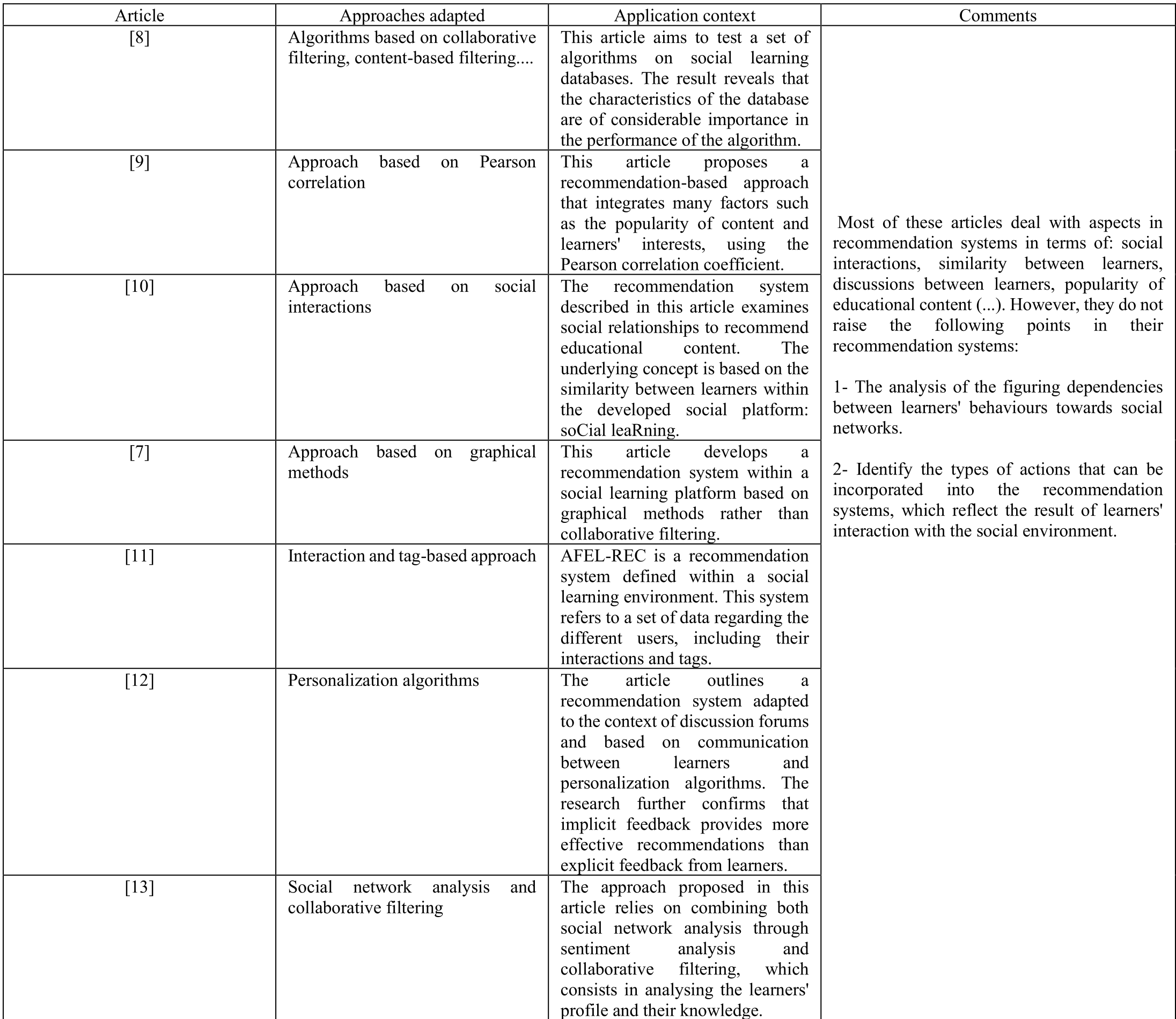
Main Reference Table for Existing Works: