
Recommendation Diffusion: Why Your Friends' Choices Aren't Enough
Recommendation information diffusion in social networks considering user influence and semantics
The paper introduces a hybrid Recommendation Information Diffusion algorithm for social networks that combines Collaborative Filtering (CF) with Quality of Service (QoS) attributes and semantic analysis. By integrating user influence levels with product characteristics like price and reliability, it optimizes advertisement propagation to achieve a 6.8/10 user satisfaction rating.
TL;DR
Social networks influence 74% of buying decisions, yet most recommenders fail by assuming your best friend influences you on everything. This paper proposes a hybrid algorithm that filters social influence through a "Quality of Service" (QoS) lens—ensuring that if a friend buys a $500 camera, you only get an ad if it fits your specific budget and reliability preferences.
The "Loud Friend" Problem: Motivation
We all have that one friend who is a tech guru but has terrible fashion sense. Traditional Collaborative Filtering (CF) often struggles because it treats social ties as monolithic. If Alice and Bob are close friends, CF might suggest Bob's high-end DSLR to Alice, even if Alice only buys entry-level gadgets. The authors identify three major gaps in prior work:
- Domain-Specific Influence: Influence is not global; it varies by item category.
- Qualitative Constraints: Users have "buying habits" (Price/Reliability ranges) that social influence cannot override.
- Semantic Gaps: Items need to be compared based on functional similarity, not just IDs.
Methodology: The Hybrid Engine
The core of the algorithm is the User Interest Probability (UIP), a weighted sum of two distinct scores:
1. The CF Score (Social Influence)
Identifies the top N=8 influencers for a specific category (e.g., "Smartphones") based on past communication and successful recommendation acceptance. It uses semantic similarity to find the "best match" between what an influencer bought and the new item being promoted.
2. The QoS Score (Budget & Reliability Fit)
This acts as a "sanity check." It calculates:
- Price Vicinity: How close the item's price is to the user’s average spending in that category.
- Reliability Vicinity: Ensuring the item meets or exceeds the user's expected quality threshold.

The Semantic Bridge
To handle disparate products, the authors use a semantic similarity metric based on RDF descriptions: This ensures that a smartphone and a digital camera are recognized as having "partially overlapping" functionalities (e.g., camera resolution), allowing for smarter cross-category diffusion.
Experiments and Breakthroughs
The team tested the algorithm using both synthetic (Berlin SPARQL Benchmark) and real-world (Amazon) datasets with 85 participants.
Finding the Golden Ratio
- Convergence at N=8: Adding more than 8 influencers per category yielded diminishing returns, allowing the system to remain computationally efficient.
- The 0.4 Threshold: By analyzing the Precision/Recall trade-off (F-measure/EM), they discovered that a UIP threshold of 0.4 is the "sweet spot" for information diffusion.
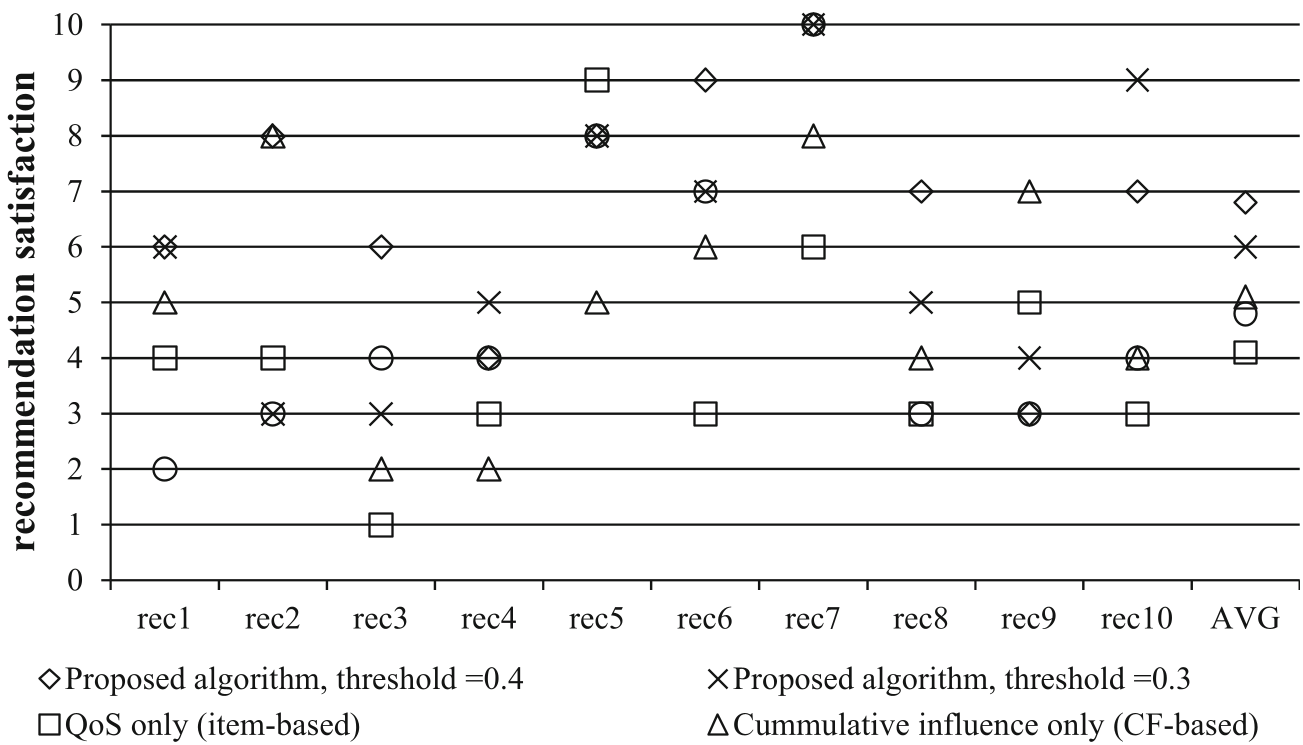
Key Result: User Satisfaction
As seen in the chart above, the proposed algorithm (Threshold=0.4) strictly outperformed:
- Plain CF: Proving that social ties without price-checks lead to irrelevant ads.
- Plain QoS: Proving that budget-matching without social trust lacks "discovery" value.
- Global Influencers: Proving that your "Smartphone Expert" friend shouldn't be the one recommending your "Shoes."
Critical Insight: The "Why"
Why does this work? It respects the Inductive Bias of social commerce: we trust our friends to filter what is good, but we rely on our wallets to decide what is feasible. By treating the recommendation space as a limited resource, this algorithm maximizes "Online Advertisement Efficiency" by only diffusing information that bridges the gap between social desire and personal habit.
Conclusion
This paper provides a robust framework for targeted information propagation. While it relies on an 8-day update cycle for influencer weights—which might be slow for viral trends—its ability to ground social influence in qualitative reality makes it a precursor to modern context-aware recommender systems.
Future Directions: Integrating real-time sentiment analysis and expanding serendipity (so users aren't trapped in a "budget bubble") are the next logical steps for this architecture.