
Hybrid SimRank: Revolutionizing Online Dating with Social Connections and Demographic Insights
A Recommendation Method for Online Dating Networks Based on Social Relations and Demographic Information
This paper proposes a social recommendation framework for online dating networks that combines user clustering with structural similarity measures. By integrating profile attributes, personal preferences, and social link behavior (SimRank), the method achieves a success rate of 36.01%, nearly tripling the baseline system's performance.
TL;DR
Matching in online dating is fundamentally different from recommending movies. It requires two-way mutual interest and must navigate high data sparsity. This paper introduces a framework that clusters millions of users by their demographic profiles and uses an Adapted SimRank algorithm to find "behavioral twins." By recommending partners who successfully interacted with these twins, the system boosts matching success rates from 13.9% to 36.01%.
Problem & Motivation: The Dating Recommendation Paradox
In traditional E-commerce, if a user likes a book, the book doesn't need to "like" the user back. In online dating, the "item" is another human being with their own preferences. Existing systems often face the following hurdles:
- Dataset Sparsity: With millions of users, any single person only interacts with a tiny fraction of the population.
- One-Sided Logic: Many systems only look at what a user says they want, ignoring their actual behavioral social links.
- Scale: Calculating similarity between all pairs in a million-member network is computationally impossible ().
The authors' insight was simple: Users who contact similar types of people are likely similar themselves. By grouping these users together, we can "borrow" success stories from one user to help another.
Methodology: The Three-Pillar Architecture
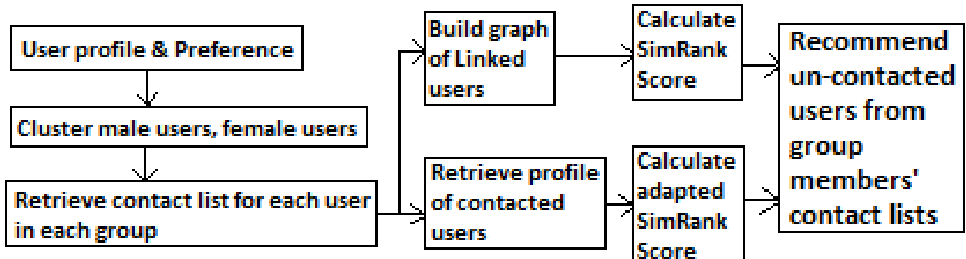
The proposed framework moves away from global calculations, focusing instead on localized "clusters" of similar individuals.
1. Strategic Clustering
The system first divides users by gender. Then, it uses a k-way bisection algorithm to create groups based on a combination of:
- Profile Attributes: (e.g., Age, Job, Education) - "Who I am."
- Preferences: (e.g., What I am looking for) - "What I want."
2. Adapted SimRank: Finding Behavioral Similarity
While standard SimRank looks at common neighbors in a graph, the authors' Adapted SimRank evaluates the similarity of the profiles of the people a user has contacted.
The formula defines similarity between two users ( and ) as the average profile similarity () of their respective contact lists ( and ):

3. Recommendation Logic
Instead of just recommending anyone their neighbor talked to, the system focuses on Top-n successful matches—users who actually replied positively to the neighbor.
Experiments & Results: Double the Success
The researchers tested their method on a real-world dataset of 87,304 active male users and over 1.3 million messages.
Key Performance Hits:
- Success Rate (SR): The best variation (CDAS - Combined Distance Adapted SimRank) reached a 36.01% success rate, compared to just 13.9% in the current live system.
- Comparison vs. SOTA: The method outperformed traditional Collaborative Filtering (CF) and the Adamic/Adar link prediction model across almost all metrics.
| Method | Success Rate (Top-1) |
|---|---|
| CDAS (Proposed) | 36.01% |
| Adamic/Adar | 16.8% |
| Baseline System | 13.9% |
| Collaborative Filtering | 12.8% |
Deep Insights: Profile vs. Preference
An interesting ablation study revealed that using Profile + Preference combined yielded better results than using either alone. This suggests that in the dating world, social compatibility is a complex mix of "who you are" and "the type you seek."
Critical Analysis & Conclusion
Takeaway
This research proves that social network structures (who-contacts-whom) are more predictive of successful outcomes in dating than static profile matching alone. By "adapting" SimRank to look at the features of contacts rather than just the IDs of contacts, the authors solved the cold-start problem for users who might not have common neighbors but approach similar "types."
Limitations & Future Work
- Recall vs. Precision: While the Success Rate (Precision) is high, the Recall remains low (under 1% for some methods). This means the system is very accurate but only finds a small portion of all possible matches.
- The "New User" Problem: The current method relies on at least some contact history. Future work needs to integrate more robust cold-start mechanisms for brand-new registrants.
Overall, this work provides a scalable, mathematically sound blueprint for the next generation of social matching engines.