
Recommendation over a Heterogeneous Social Network: Beyond Homogeneous Ranking
Recommendation over a Heterogeneous Social Network
This paper proposes a recommendation framework for heterogeneous social networks (comprising users, resources, categories, and tags) using a learning-based ranking approach. It introduces a random walk model across multiple object types and a pair-wise learning algorithm to automatically determine relationship weights, achieving superior performance on real-world datasets like Arnetminer and Powazi.
Executive Summary
TL;DR: This research tackles the complexity of modern social platforms (like academic portals or content sharing sites) by treating recommendation as a ranking problem on a heterogeneous graph. By combining Language Models for relevance and a Learned Random Walk for global importance, the authors provide a system that can recommend users, tags, resources, and categories simultaneously.
Positioning: This work serves as a pivotal bridge between early link-analysis algorithms (like PageRank) and modern Heterogeneous Information Network (HIN) mining. It shifts the focus from "what is popular" to "what is important within a specific structural context."
The Problem: The "Flat Network" Fallacy
Most classical recommendation engines operate on a bipartite graph (User-Item). However, real-world data is a "messy" web: a User creates a Resource, assigns a Tag, which belongs to a Category.
Previous graph-based methods (like PageRank) often treat all edges as equal. This is the "Flat Network" fallacy. In reality, a link between a User and a Category is fundamentally different from a link between a User and a Tag. Manually tuning these weights () is a nightmare for developers.
Methodology: Ranking with Intelligence
The authors propose a three-step pipeline: Global Importance Relevance Estimation Strategy Combination.
1. The Heterogeneous Random Walk
The core innovation is the transition matrix for a graph containing four node types .
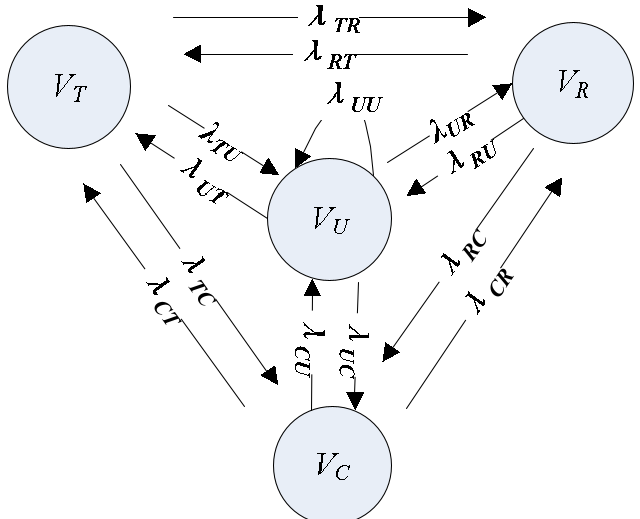 Figure 1: The formalized heterogeneous graph structure.
Instead of arbitrary weights, they use a Pair-wise Learning Algorithm. By providing pairs of nodes where one is known to be more important than the other, the system automatically optimizes the values (e.g., for User-to-Resource).
2. Strategy for Two Scenarios
- Browsing: When a user looks at a specific object, the system "understands" the context by extracting key terms to calculate a relevance score .
- Searching: When a user inputs a query, the system identifies relevant "seeds" and then uses the learned importance scores to find associated objects of different types.
Experimental Proof
The model was validated on Powazi (internal sharing) and Arnetminer (academic).
Performance Boost
The "LM+RW" strategy (language model + learned random walk) consistently beat the baselines. Specifically, when comparing against standard PageRank (which uses uniform weights), the learned weights provided a significant accuracy gain.
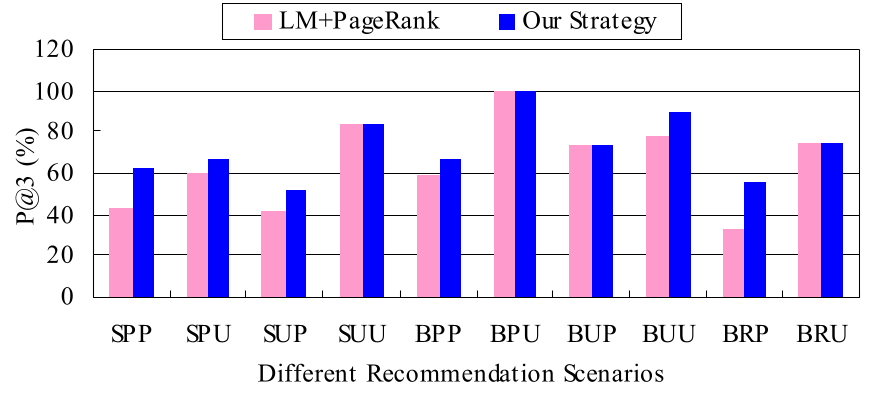 Figure 2: The performance gap between uniform weights (LM+PageRank) and learned weights (LM+RW).
As shown in the table below, the Importance Scores for different relations vary wildly after learning, proving that relationship weights are not equal.
| Relationship | Learned Weight () |
|---|---|
| User Resource | 0.75 |
| User Tag | 0.10 |
| Resource Project | 0.69 |
Critical Insight & Conclusion
Takeaway
The genius of this work lies in its simultaneous multi-type recommendation. While a search engine typically gives you a list of one type (e.g., just papers), this model returns a holistic ecosystem: the top experts, the seminal papers, and the most relevant conferences all at once.
Limitations
The primary bottleneck is the Pair-wise Training Data. Ground truth for "importance" is difficult to collect at scale without implicit feedback loops (like click-through data). Furthermore, as the network scales to millions of nodes, the iterative random walk calculation requires significant optimization (potentially using sparse matrix acceleration or local graph partitioning).
Future Impact
This approach lays the groundwork for personalized structural ranking. By substituting global importance with user-specific preference profiles in the random walk, this framework can easily evolve into a highly personalized discovery engine for any complex social graph.