
RankMF: Decoding Social Context in Implicit Feedback Recommendation
Learning to recommend with social contextual information from implicit feedback
The paper introduces rankMF, a unified ranking framework for social recommendation using implicit feedback. It integrates social contextual information (interaction behaviors) and common social relations into a Bayesian Personalized Ranking (BPR) model, achieving SOTA performance on the Tencent Weibo dataset.
TL;DR
The paper "Learning to recommend with social contextual information from implicit feedback" introduces rankMF, a ranking-based matrix factorization framework. It moves beyond simple user-item pairs by injecting "Social Context"—how your friends' collective behavior influences your choices—into a Bayesian Personalized Ranking (BPR) structure. It effectively cracks the code of recommending items when only "implicit" signal (like following/clicking) is available.
Problem & Motivation: The Gap in Social Signals
Most recommendation research historically relied on explicit ratings (1-5 stars). However, real-world platforms like Twitter or Facebook operate on implicit feedback—you follow someone or click a link, but you rarely "rate" it.
The authors identified two major misses in prior SOTA:
- Context Ignorance: Your interest in an item often depends on whether your "followees" also follow it.
- Implicit Ambiguity: In implicit data, we only see "positive" signals. We don't know if a non-interaction is a "dislike" or just "missing information."
The core Insight of this paper is that social context (peer behavior) provides the missing "anchor" to interpret these implicit signals accurately.
Methodology: The RankMF Architecture
The authors propose a dual-layer enhancement to the standard Matrix Factorization (MF) approach.
1. Social Contextual Expansion
Instead of a static user latent vector , they represent the user as a combination of their inherent traits plus their social context:
- User Side Context: Influenced by what their friends have followed.
- Item Side Context: Influenced by how the target item relates to other items the user already interacted with.
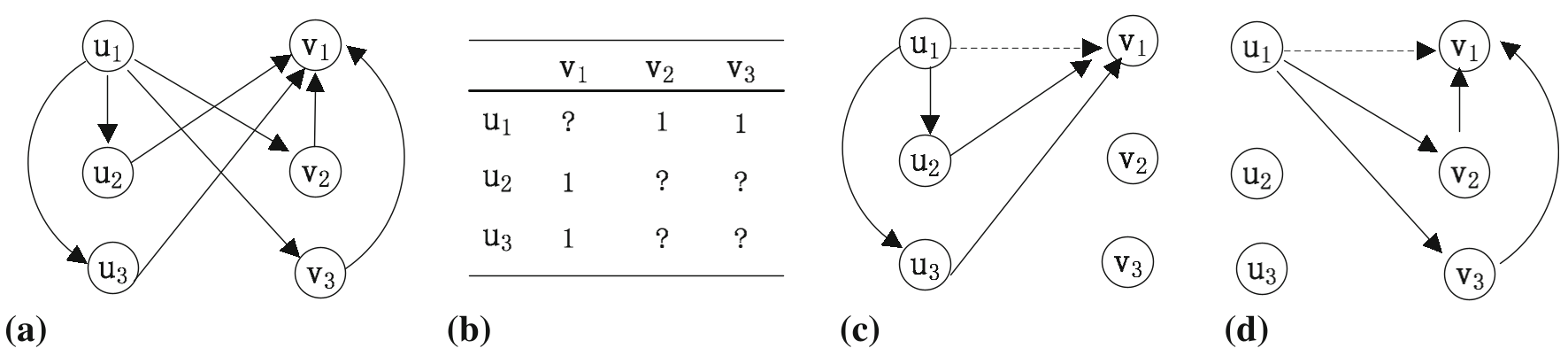
2. Tri-Factor Social Regularization
To refine the latent space, the authors introduce three specific factorization terms:
- User-User (Common Friends): Users sharing many friends should have similar latent vectors.
- User-Item (Common Connections): Users are drawn to items that reside within their existing social circle.
- Item-Item (Common Social Relations): Items followed by similar groups should be clustered together.
The final objective function integrates these as regularization terms within a BPR framework, which optimizes for the relative ranking of items rather than absolute score prediction.
Experiments & Results
The model was tested on the Tencent Weibo dataset (KDD Cup 2012), a massive real-world graph with over 1.2 million ratings.
SOTA Comparison
As shown in the table below, rankMF consistently outperforms the standard BPRMF and popularity-based baselines:
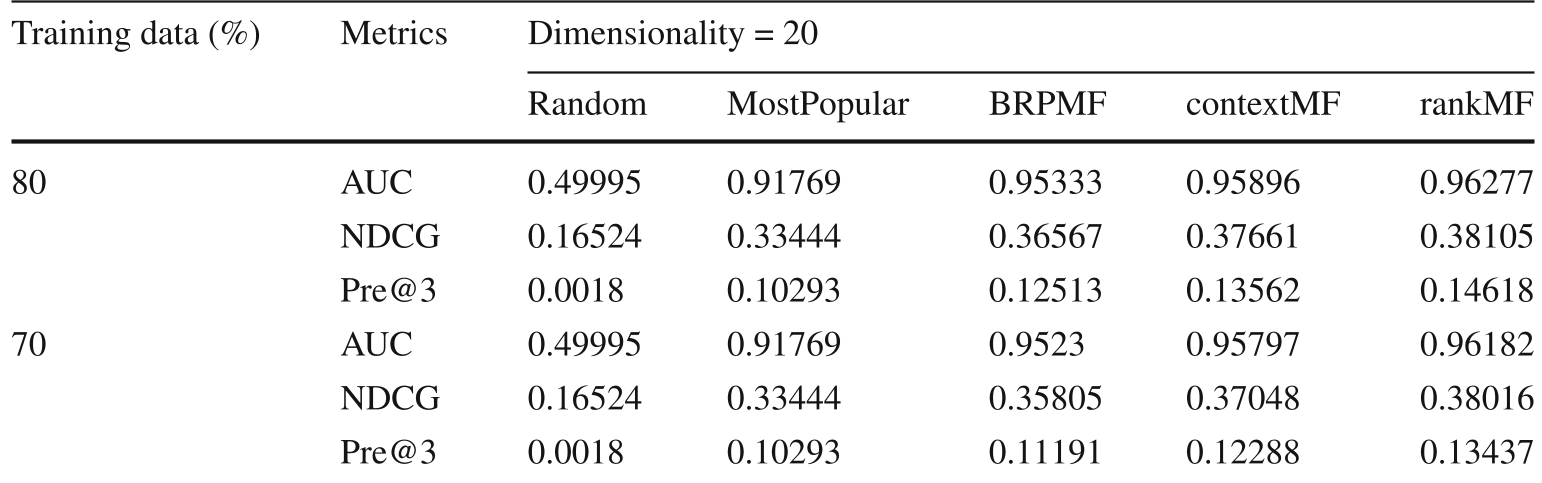
- AUC Improvement: rankMF achieved 0.962+ AUC, proving its superior capability in ranking relevant items higher.
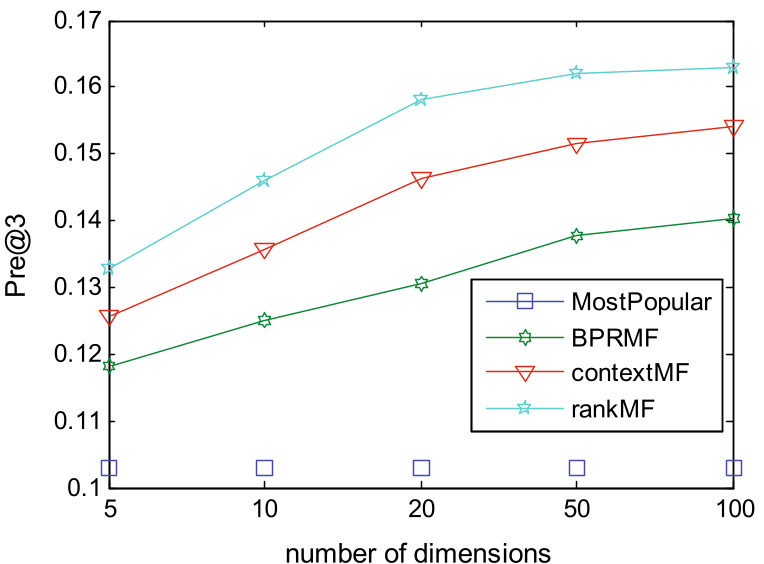
- Impact of Dimensions: The model remains robust as latent factor dimensions () increase, showing steady gains in NDCG and Precision up to .
Critical Analysis & Conclusion
Takeaway
The genius of this paper lies in its transition from individualistic MF to context-aware Ranking. By mathematically formalizing the intuition that "we follow what our friends follow," the authors provided a scalable way to handle the extreme sparsity of social graphs.
Limitations & Future Work
- Dynamic Context: The current model uses a simplified 0/1 function for social context interaction. Replacing this with a weighted temporal function (how long ago did a friend follow an item?) could further increase accuracy.
- Feature Integration: The study focuses purely on structural graph data. Integrating content features (NLP on microblogs) remains a promising future direction.
In summary, rankMF stands as a foundational work in the "implicit social recommendation" lineage, proving that social structural data is a powerful surrogate for missing explicit ratings.