
SoRel: Mastering Cold-Start Recommendations through Weighted Social-Item Fusion
Recommendation based on weighted social trusts and item relationships
The paper introduces SoRel, a novel recommender system framework that extends Probabilistic Matrix Factorization (PMF). It integrates weighted social trusts and item relationships to improve prediction accuracy, achieving SOTA results over baseline PMF and existing social-based models on the Epinions dataset.
TL;DR
Recommendations often fail when data is sparse—a classic "Cold Start" dilemma. This paper introduces SoRel, a framework that enhances Probabilistic Matrix Factorization (PMF) by injecting two vital signals: Weighted Social Trusts and Item Relationships. By recognizing that not all friends are equally influential and that items belong to intrinsic similarity clusters, SoRel outperforms traditional social-based algorithms, especially for users who have barely rated any items.
Problem & Motivation: The Limits of "Blind" Trust
In the era of information overload, Collaborative Filtering (CF) is the gold standard. However, most Matrix Factorization techniques hit a wall with cold-start users.
Previous attempts to fix this using social networks made a naive assumption: Uniform Influence. They treated a best friend and a causal acquaintance as equally important. Furthermore, they largely ignored the "Item-to-Item" side of the equation. If a user likes Twilight, they are likely to enjoy Underworld due to thematic similarities (vampires), regardless of what their social circle says. The authors argue that a truly robust system must blend personal taste, social validation, and item characteristics.
Methodology: The SoRel Architecture
The core innovation lies in the triplet-fusion of latent factors. The model doesn't just look at the rating matrix ; it optimizes a combined probability density function.
1. Weighted Social Trusts (The User Side)
Instead of binary trust, the authors use the Pearson Correlation Coefficient (PCC) to weight a user's friends. If your friend has a similar rating history to yours, their influence on your latent factor is amplified.
2. Weighted Item Relationships (The Item Side)
The model assumes that an item's latent factor should be similar to its neighbors. They use Adjusted Cosine Similarity to build an item-influence matrix, ensuring that even if an item is new, its features can be inferred from its "kin."
3. Model Combination
The authors utilize a linear combination controlled by three hyper-parameters:
- : Personal Taste / Global Characteristics.
- : Social Influence.
- : Item-Relationship Influence.
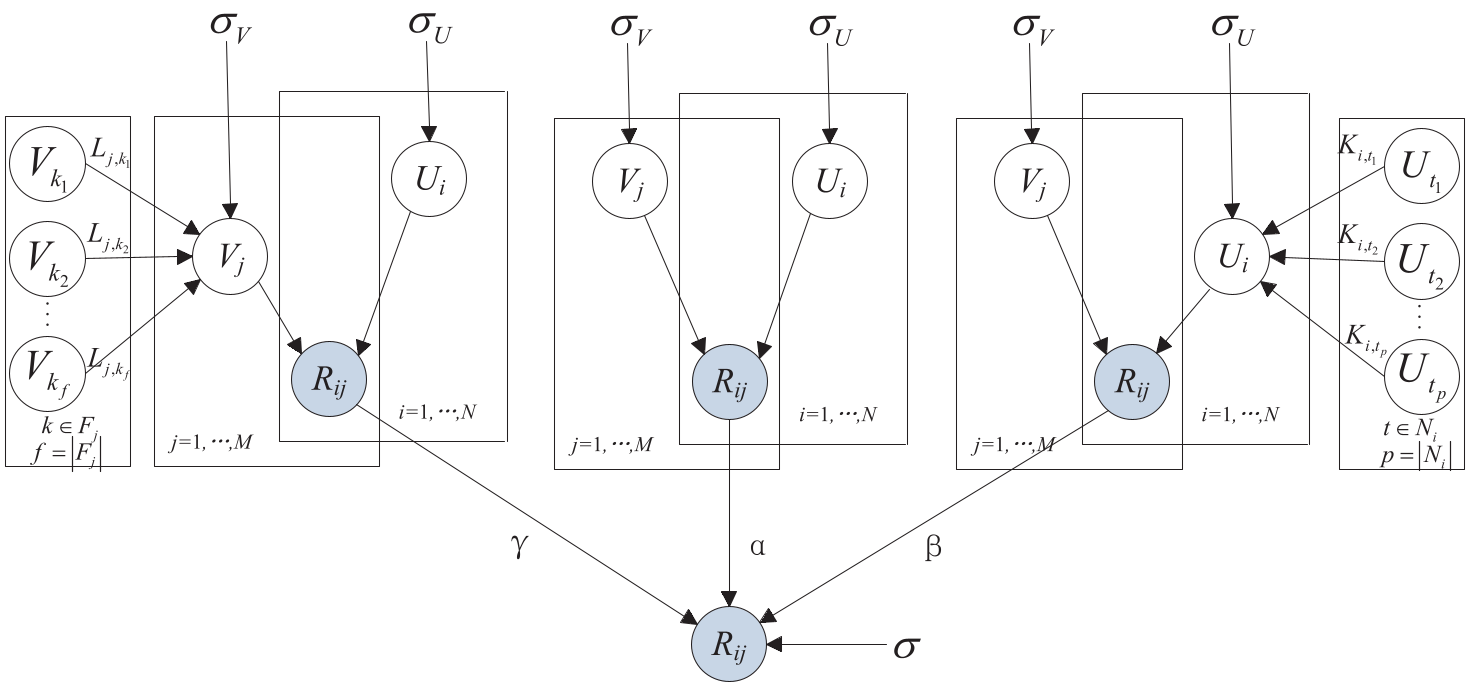 Figure 1: The Graphical Model representing the fusion of user latent factors, item latent factors, and their respective relational influences.
Experiments & Results: Winning the Cold War
The researchers tested SoRel on the Epinions dataset—a benchmark notorious for its social complexity.
Performance Benchmarks
SoRel consistently showed the lowest MAE (Mean Absolute Error) across all tests.
- Significant Gain: Compared to standard PMF, SoRel reduced error by approx 5.3%.
- Ablation Insight: The version using only Item Relationships (SoRel2) outperformed the version using only Social Trusts (SoRel1), proving that item-side signals are often more stable than social ones.
| Method | MAE (D=10, 90% Training) |
|---|---|
| PMF | 0.8526 |
| SocialMF | 0.8329 |
| SoRel (Proposed) | 0.8077 |
Solving for Cold Start
When looking at users with only 1-10 ratings, the performance gap between SoRel and other methods widened significantly. Because cold-start users also tend to have fewer social "trust" links, the inclusion of item relationships acts as a safety net, allowing the system to recommend based on the inherent properties of the few items the user has interacted with.
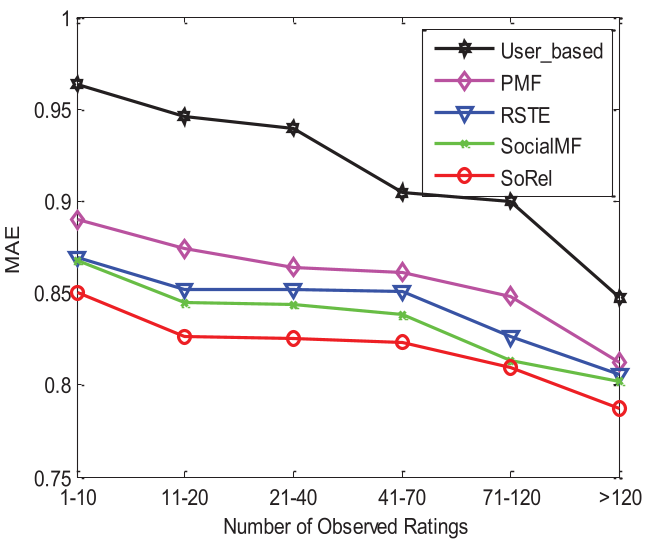 Figure 2: Accuracy comparison highlighting how SoRel maintains high performance even as the number of available user ratings decreases.
Critical Analysis & Conclusion
The study provides a profound insight: Social trust is not the silver bullet. While social data is helpful, item-to-item relationships often provide a denser, more reliable signal for latent factor learning.
Limitations:
- The item similarity is still calculated based on rating overlaps (adjusted cosine). Future work could improve this by using NLP/Computer Vision to extract semantic features from the items themselves.
- The linear combination of is static. A more advanced version might learn these weights dynamically per user (e.g., some people are more "socially influenced" than others).
Final Takeaway: For developers building recommendation engines in sparse environments, don't just "add social." Invest in high-quality item similarity matrices—they are the key to cracking the cold-start code.