
HST: Revolutionizing Spatio-Temporal Recommendations with Heterogeneous Graphs
Recommendations based on a heterogeneous spatio-temporal social network
The paper introduces a Heterogeneous Spatio-Temporal (HST) graph framework for friend and location recommendations in Location-Based Social Networks (LBSNs). It utilizes a hybrid tripartite structure (Users, Locations, Sessions) and a customized Random Walk with Restart (RWR-HST) algorithm to capture time-varying user preferences, achieving a significant F1 performance improvement of up to 30% over state-of-the-art methods like GTAG-BPP.
TL;DR
Static recommendation systems are becoming obsolete in the dynamic world of Location-Based Social Networks (LBSNs). This paper presents HST (Heterogeneous Spatio-Temporal) graph, a framework that integrates users, locations, and time-specific "sessions" into a unified hybrid tripartite network. By applying a specialized Random Walk with Restart (RWR-HST), the authors achieve up to a 30% boost in recommendation accuracy by effectively mining the hidden correlation between who you are and where (and when) you hang out.
The "Static" Trap in LBSNs
Most elder-generation recommenders treat your check-ins as a static list. If you visited a gym three years ago, a static model might still recommend gyms even if your current routine has shifted to cafes. Prior attempts to fix this, such as STG (Session-based Temporal Graph) and GTAG, introduced "session nodes" but made a fatal structural error: they disconnected users from locations, forcing the algorithm to travel through sessions. When session data is sparse (e.g., unique check-in times), these models collapse.
Methodology: The HST Architecture
The core innovation lies in the HST Graph Structure. Unlike previous models, HST adopts a Star-Schema where the User node is the central hub, maintaining direct edges to both locations and sessions.
1. The 7-Edge Hybrid Network
The HST graph isn't just a tripartite set; it's a "hybrid" because it acknowledges that nodes of the same set interact. It incorporates:
- Unipartite edges: User-User (Friendship), Location-Location (Geographic proximity), and Session-Session (Temporal proximity).
- Bipartite edges: User-Location, User-Session, and their inverses.
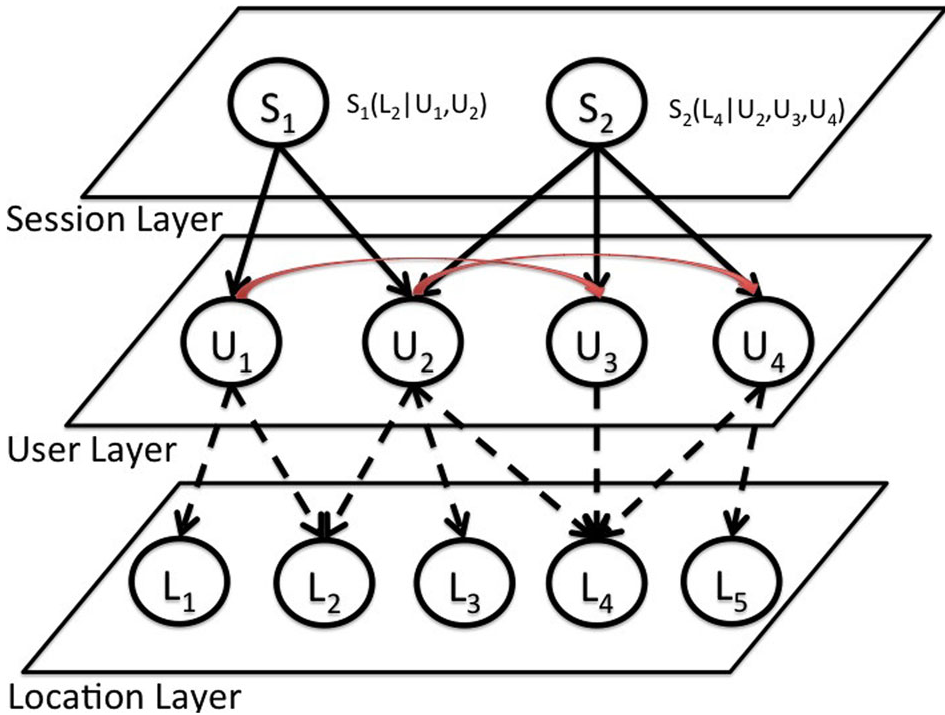 Figure 1: The HST Graph showing user-centric connections and unipartite relations.
2. Session Node Extraction
The authors define a "Session Node" as a co-location event where multiple users visit the same place within a specific time window (e.g., a 3-hour bin). This captures the "Rock Band" effect: if two strangers always check into the same dive bar on Friday nights, they likely share latent preferences even if they aren't explicit friends.
3. RWR-HST: Navigating the Graph
The Random Walk with Restart (RWR) algorithm is modified to handle the heterogeneous nature of the graph. The transition matrix is partitioned into sub-matrices where trade-off parameters () control how much the walker "trusts" each sub-network.
Experimental Breakthroughs
The researchers tested HST against GTAG-BPP, Fast-Katz, and standard RWR using massive datasets from Foursquare and Gowalla.
Performance Gains
The results were conclusive: the HST model dominated across all metrics. For friend recommendation, it achieved an average improvement of 12-23% over GTAG-BPP. For location recommendation, the gain was 9-21%.
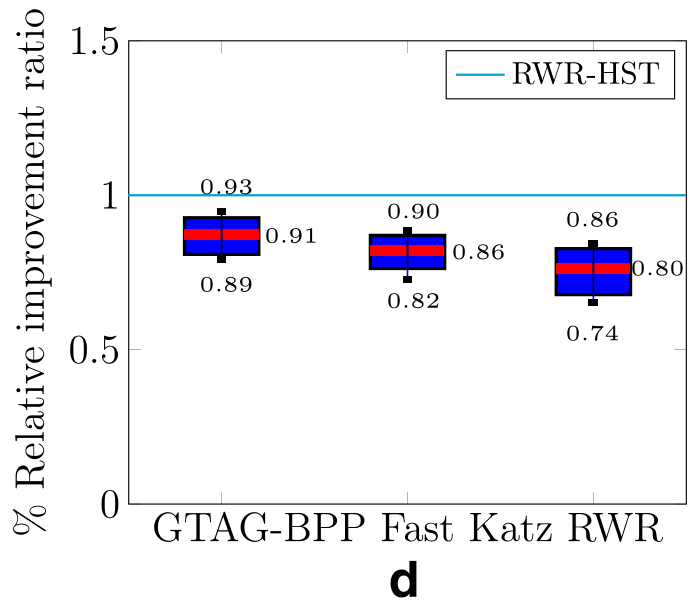 Figure 2: Relative F1 improvement of RWR-HST vs. competitors.
Why does it work?
- Sparsity Resilience: Because users are connected to both locations and sessions, the random walker always has an alternative path even if session data is missing.
- Temporal Precision: Sensitivity analysis showed that smaller time windows (e.g., 3 hours) yielded higher precision than 24-hour windows, proving that "near-simultaneous" behavior is a stronger indicator of similarity than general daily patterns.
Deep Insight & Conclusion
The HST framework proves that in the era of Big Data, more connections are better than complex chain-like structures. By essentially "over-connecting" the graph with unipartite and bipartite edges, the authors created a system where social influence and spatial behavior mutually reinforce each other.
Limitations: While powerful, the model relies on manual tuning of 5 trade-off parameters. Future work involving Graph Neural Networks (GNNs) could potentially learn these weights automatically, further optimizing the system's adaptability across different urban densities.
Takeaway: If you want to know what a user wants next, don't just look at where they went—look at who else was there at the exact same time.