
LGTR: Why Your Friends' Opinions Matter More Than the Crowd in Social Recommendations
Providing recommendations in social networks by integrating local and global reputation
The paper introduces the LGTR (Local and Global Trust-based Recommendation) framework, an unsupervised approach for Online Social Networks that integrates personal ego-networks with community-wide feedback. It effectively predicts user trustworthiness and item preferences by dynamically weighting local and global reputation scores.
TL;DR
The paper "Providing recommendations in social networks by integrating local and global reputation" introduces a robust, unsupervised framework that challenges the status quo of social trust. By mathematically balancing local ego-network signals with global community feedback, the authors achieve SOTA results on the CIAO dataset, reducing recommendation error (MAE) by up to 14% without the need for complex model training.
Problem & Motivation: The "Tyranny of the Majority"
In Online Social Networks (OSNs), trust is everything. However, current recommender systems face two major hurdles:
- Global Reputation Fragility: Relying on an "average" community score is prone to manipulation. A few malicious actors can easily skew a global rating.
- Model Rigidity: Supervised models (like SoRec or SoReg) require constant retraining on huge datasets, which is computationally expensive and slow to adapt to new social connections.
The authors' Research Intuition was simple: As a user's local network (ego-network) grows, the "global" score becomes increasingly irrelevant. For a seasoned user, the direct and indirect experiences of their immediate circle are far more statistically significant than the white noise of 10,000 strangers.
Methodology: The Local-Global Balance
The LGTR (Local and Global Trust-based Recommendation) framework operates on a dual-indicator system.
1. Local Reputation ()
Instead of just looking at immediate friends, the model explores the user's Ego-Network. It uses an exponential decay function: where is the path length. This encodes a physical intuition: trust evaporates quickly as the distance between two users increases in the social graph.
2. Global Reputation ()
This serves as the "anchor" for newcomers. It aggregates all community feedback to provide a baseline when the ego-network is too sparse to be reliable.
3. The Linear Hybrid Component
The framework merges these into a synthetic trust score (): The magic happens in determining the optimal . The authors use an L1-norm loss function to minimize the difference between predicted trust and actual ratings during a lightweight optimization phase.
 Figure 1: Conceptual overview of how local and global perspectives are synthesized.
Experiments & Results: Local Wins for Vets, Global for Rookies
Tested on the CIAO dataset (7,252 users, 183,749 ratings), the results were telling:
- The "Newcomer" Effect: For users with small local dimensions (), merging global and local data was essential.
- The "Power User" Effect: For users with high (large ego-networks), setting (ignoring global data entirely) actually yielded the lowest error.
- Unsupervised Superiority: Despite being unsupervised, LGTR outperformed supervised heavyweights like LOCALBAL and Bayesian Probabilistic Matrix Factorization (MF).
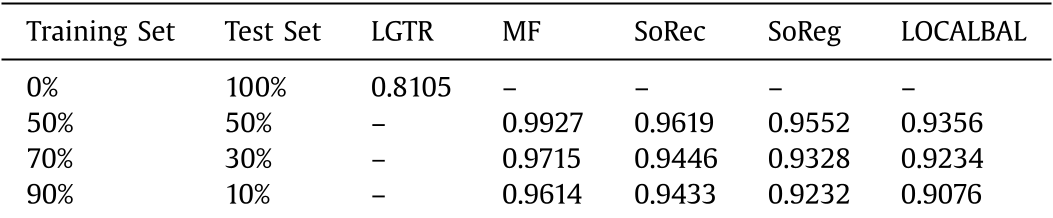 Table 1: LGTR (MAE 0.81) significantly outperforms MF (MAE 0.96) and SoRec (MAE 0.94).
Critical Insight & Perspective
The industry value of this work lies in its scalability. By moving away from supervised matrix factorization, platforms can implement real-time trust updates.
Limitations: The model assumes that trust is transitive and follows an exponential decay. In highly polarized or "echo chamber" environments, this could lead to narrow recommendations (Filter Bubbles).
Future Outlook: Transitioning this framework to Graph Neural Networks (GNNs) could automate the feature extraction of the ego-network, potentially making the parameter dynamic for every individual interaction rather than a static optimization.
Conclusion
The study confirms a fundamental social truth: Local expertise trumps global popularity. For architects of modern social platforms, the takeaway is clear—stop obsessing over global averages and start empowering the user's immediate social graph.