
Maximizing the Echo: Recommending Connections to Boost Content Spread
Recommendations to boost content spread in social networks
The paper introduces a novel approach to "people recommendation" in social networks like Twitter and Google+, prioritizing content spread over traditional profile similarity. It proposes the Restricted Maximum Probability Path (RMPP) model and a continuous greedy approximation algorithm to maximize content dissemination while adhering to local per-node connectivity constraints.
TL;DR
Most social networks recommend friends based on who you already know (Friend-of-Friend). This paper argues that's a missed opportunity. By using a sophisticated Continuous Greedy algorithm and a new propagation model called RMPP, the authors show we can recommend links that increase how far information travels by up to 90x, all while keeping recommendations relevant and limited to a reasonable number per user.
The Motivation: Reach Beyond Similarity
Social networks are content engines. Whether it's a viral tweet or a shared photo, the value of the network is tied to how effectively content reaches interested eyes. However, current recommendation engines (like "People You May Know") are "selfish"—they look for local similarity (shared friends, similar profiles) but ignore the global health of information flow.
The authors identified a critical gap: if we treat recommendation as an optimization problem to maximize Content Spread, the network becomes significantly more vibrant. But this is a hard math problem. Adding edges changes the very structure of the graph, making the spread function "non-submodular" (where the benefit of an edge doesn't necessarily diminish as you add more—it might actually explode, which makes optimization NP-hard).
Methodology: Solving the Unsolvable
To bridge the gap between theoretical complexity and practical deployment, the paper introduces two major innovations:
1. The RMPP Model (Restricted Maximum Probability Path)
The standard way to model influence is the Independent Cascade (IC) model, but it's #P-hard to compute. A common shortcut is the Maximum Probability Path (MPP). However, MPP isn't submodular when you add edges.
The authors propose RMPP, which mandates that a piece of content can only traverse one newly recommended edge on its way to a destination. While this sounds restrictive, the authors prove that in real-world "small-world" networks, most content reaches its destination through very few hops anyway. This restriction makes the math "well-behaved" (submodular).
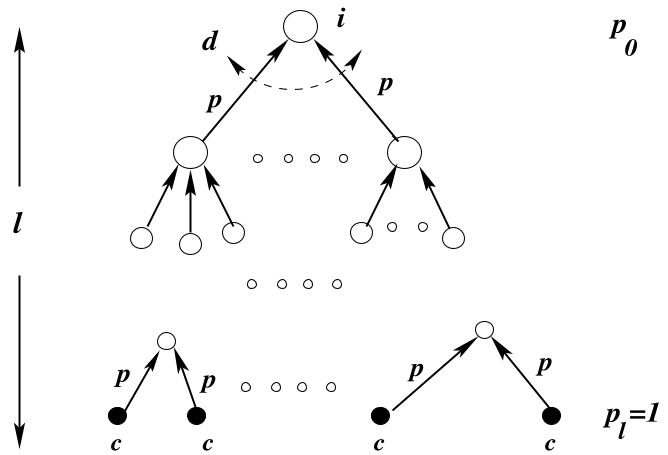 Figure: The propagation tree illustrating how content flows from seed nodes to a target user.
2. The Continuous Greedy Algorithm
Unlike influence maximization (which picks nodes), link recommendation requires picking edges per node. This creates a massive web of local constraints.
- Fractional Relaxation: Instead of picking an edge (0 or 1), the algorithm assigns a probability to each potential link.
- Graph Matching: In each step, it uses a matching algorithm to find a set of edges that satisfies everyone's "budget" while maximizing the gain in content spread.
- Randomized Rounding: Finally, it converts these probabilities back into real recommendations.
Performance: 90x Better than Heuristics
The results across Twitter and Flickr datasets are staggering. Traditional heuristics like Friend-of-Friend (FoF) or Degree-based selection perform poorly because they create "echo chambers" or focus on nodes that are already saturated.
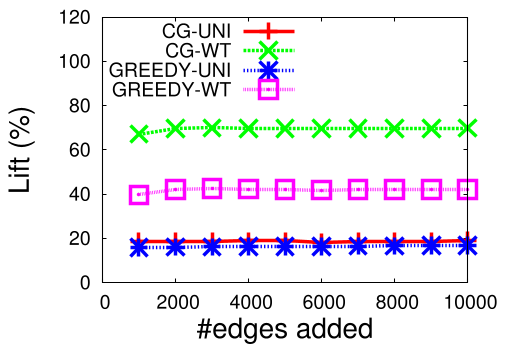 Figure: Comparison showing the massive "Lift" in content spread achieved by the Continuous Greedy (CG) approach compared to Degree and FoF heuristics.
Key findings include:
- Lift: In many cases, the proposed approach showed a 1.75x to 4x improvement over simple Greedy methods and nearly two orders of magnitude improvement over FoF.
- Topology Insight: In "Uniform" settings, the algorithm favors connecting high-priority hubs. In "Weighted" settings (where influencers are harder to move), it finds high-value low-degree nodes to bridge gaps.
Critical Analysis & Future Outlook
The beauty of this work lies in its Inductive Bias: it assumes that the network's value is derived from information flow. By shifting the objective from "Who do I know?" to "Who helps me discover?", the authors provide a blueprint for a more engaging social experience.
Limitations:
- Computation: Even with the approximation, the O(m³) matching steps are expensive for billion-edge graphs (though the authors suggest Map-Reduce for scalability).
- User Intent: The model assumes users will accept the recommendation. If the "relevance" (similarity) is too low, the link won't form, and the spread won't happen.
Conclusion: This paper moves the field of social recommendation from simple pattern matching to sophisticated network engineering. It proves that with the right mathematical relaxations, we can optimize the very fabric of social connectivity to ensure the best content finds the widest audience.