
Recommender Systems from Personal Social Networks: Beyond the Popularity Trap
Recommender System from Personal Social Networks
The paper proposes a novel recommendation method utilizing personal social networks to deliver personalized media content (movies/TV). It constructs a hierarchical "social tree" for each user and employs an attenuation-based ranking algorithm to aggregate feedback from friends across multiple layers of connection.
TL;DR
This research shifts the recommendation paradigm from "what is globally popular" to "what your friends and their friends trust." By constructing a Personal Social Network and applying a distance-based attenuation model, the authors achieve higher ranking precision (R-measure) than standard popularity metrics, specifically for media like movies and TV shows.
The Core Challenge: The Limits of Crowdsourcing
Most recommendation engines today rely on Collaborative Filtering (CF) or Content-Based (CB) filtering. While effective, they face two major hurdles:
- The Cold Start Problem: New users with no history get poor results.
- The Trust Gap: We often value a recommendation from a friend more than a high average score from 10,000 strangers.
The authors argue that social networks provide a natural "trust proxy." If you trust a friend, you are likely to share their tastes. But how do you scale this to "friends of friends" without losing the signal in the noise?
Methodology: The Personal Social Tree
The authors propose a systematic way to transform a global social graph into a user-centric power structure.
1. Building the Tree
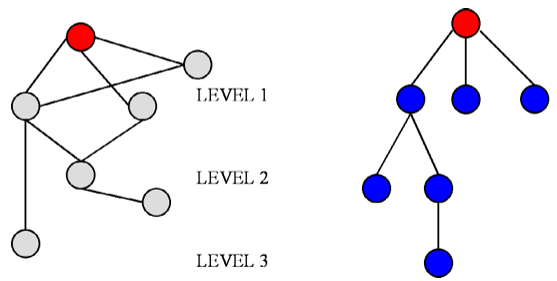
Using a Breadth-First Search (BFS) algorithm, the system builds a "social tree" for each user up to six levels deep. Each node is a user, and each edge represents an accepted friendship (trust = 1).
2. The Attenuation Ranking Formula
The heart of the system is the ranking formula, which balances distance and feedback:
- : The rating (1 for like, -1 for dislike).
- : The distance between users.
- : The Attenuation Coefficient.
If , a direct friend's "like" is worth twice as much as a "friend-of-a-friend's" like. This prevents the influence of distant, unknown users from overwhelming the preferences of a user's inner circle.
Experiments and Insights
The study was conducted at Ben-Gurion University with 50 participants rating 108 movies from IMDB. The researchers compared their Social Network (SN) method against a Popularity baseline.
Key Findings:
- Superior Ranking: The SN method achieved an R-measure of 119.73, outperforming Popularity (111.97). This indicates that the SN method is better at putting the movies a user actually likes at the very top of the list.
- High Recall: Both methods reached over 90% recall when suggesting 60 items, but the SN method provided a more personalized "vibe" than just listing blockbusters.

Critical Analysis & Conclusion
The beauty of this approach lies in its interpretability. Unlike black-box neural networks, a user can understand why a movie was recommended: "Your friend Alice and her friend Bob both liked this."
Limitations:
- The study uses a small, homogeneous sample (50 students). In a massive, heterogeneous network (like Facebook or X), the "noise" at level 6 might be too high.
- The value of is currently static. The authors suggest that Personalized values—tuning how much an individual trusts distant connections—could significantly boost performance.
Future Outlook: This work lays the groundwork for "Social-Aware" AI. As we move toward decentralized platforms, using our immediate social graph to filter the overwhelming sea of data will be essential for maintaining relevance and trust.