
CSR: Beyond Uniform Influence in Social Recommender Systems
Recommender Systems with Characterized Social Regularization
The paper introduces Characterized Social Regularization (CSR), a novel social recommendation model that treats social influence as context-dependent rather than uniform. By utilizing product-sharing logs as item-specific social constraints within a Matrix Factorization framework, CSR achieves state-of-the-art performance on e-commerce datasets.
TL;DR
Social recommendation has long relied on the "homophily" assumption—that friends share similar tastes. However, traditional models treat this influence as a static value. Characterized Social Regularization (CSR) breaks this mold by introducing item-specific influence, acknowledging that you might trust one friend's taste in movies but another's in electronics. By weighting social similarity with item features, CSR improves NDCG@5 by over 16%.
Problem & Motivation: The Fallacy of Uniform Influence
Traditional Social Recommendation (SR) models like SocialBPR or Sorec treat social links as global constraints. If User A and User B are friends, the model forces their latent vectors to be similar across the entire embedding space.
The Reality Check:
- You share book tastes with work colleagues.
- You share food tastes with family.
- You share gadget tastes with tech-savvy friends.
Existing methods suffer from an inductive bias that ignores this "Characterized" nature of relationships. When a model forces two users to be similar on items they actually disagree on, it introduces noise and reduces recommendation accuracy.
Methodology: Characterizing the Social Link
The core innovation of CSR is the move from simple Euclidean distance to a Dimension-weighted Distance.
1. The Mathematical Intuition
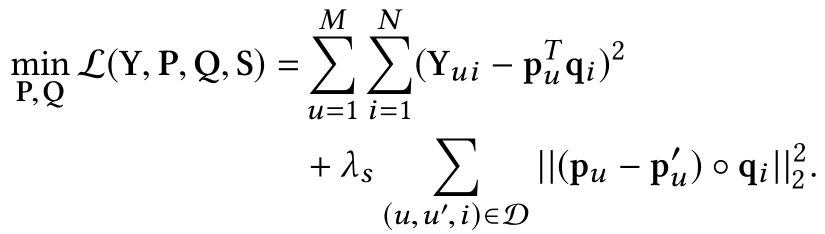
In Matrix Factorization, the latent vector represents user interests, and represents item attributes. CSR proposes that if user and interact with item , their similarity should be constrained primarily on the dimensions relevant to item .
The proposed regularization term is:
By using the Hadamard product () with the item vector , the model dynamically scales the social constraint. If a specific dimension in is zero (meaning that feature is irrelevant to the item), the difference between users in that dimension is ignored.
2. Architecture and Data Flow
The model utilizes "Product-sharing logs" as the bridge. When a user shares a specific product with a friend, it provides the triplet necessary to ground the social tie to a specific context.
Experiments & Results
The researchers evaluated CSR on a dataset from Beibei, a large Chinese e-commerce platform.
SOTA Comparison
CSR was compared against baseline Matrix Factorization (BPR) and several social-aware models (SocialBPR, UGPMF, SBPR).
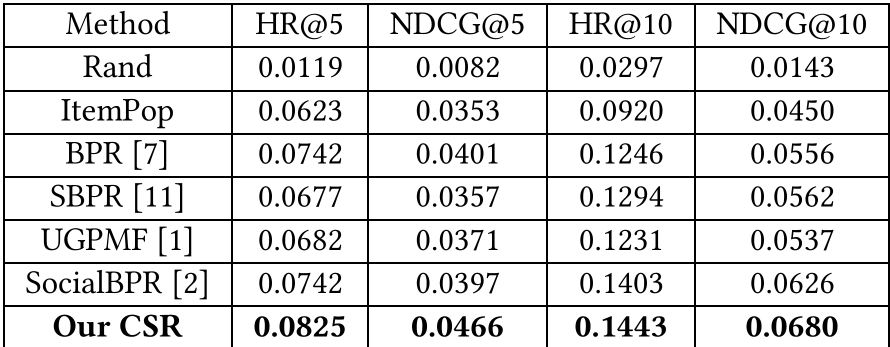
- Key Result: CSR achieved a 16.21% improvement in NDCG@5 over the best-performing baseline.
- Sparsity Handling: One of the most significant findings was CSR's performance on users with very few social relations. By learning better item-contextualized embeddings, it provided superior recommendations even for "cold-start" social users.
Hyper-parameter Sensitivity
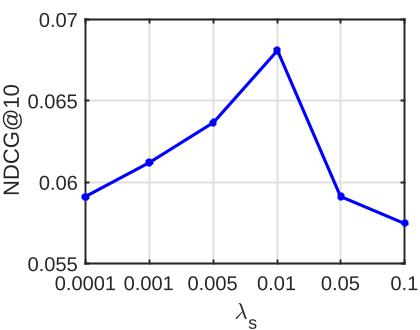
The study of the weight and dimensionality shows that while social info is vital, setting too high can lead to the social term dominating the interaction data, which harms performance. An optimal balance (around 0.01) was found to be best for the Beibei dataset.
Critical Analysis & Conclusion
Takeaway
The shift from Global Social Regularization to Characterized Social Regularization is a vital step toward more human-centric AI. CSR proves that social influence is a function of the item being discussed, not a fixed property of a friendship.
Limitations & Future Work
- Data Dependency: CSR relies heavily on "product-sharing logs." In platforms where sharing is rare, the model may revert to standard BPR performance.
- Linearity: The model uses the item vector directly as a weight. Future iterations could use a non-linear attention mechanism to learn which "characteristics" of a user-friend pair matter most for different item categories.
Overall, CSR provides a simple yet elegant mathematical framework to make social recommendation systems significantly more expressive and context-aware.