
Recommender Systems in the LLM Era: From Collaborative Filtering to Generative Reasoning
Recommender Systems in the Era of Large Language Models (LLMs)
2024-01-01
Summary
Problem
Method
Results
Takeaways
Abstract
This comprehensive survey explores the integration of Large Language Models (LLMs) into Recommender Systems (RecSys), categorizing methodologies into pre-training, fine-tuning, and prompting paradigms. It highlights how LLMs revolutionize the field by enabling advanced reasoning, natural language interaction, and cross-domain generalization.
## 1. Executive Summary
**TL;DR**: This survey provides a definitive roadmap for the evolution of Recommender Systems (RecSys) under the influence of Large Language Models (LLMs). By moving beyond the limitations of Deep Neural Networks (DNNs), researchers are now leveraging LLMs through three primary paradigms: **Pre-training, Fine-tuning, and Prompting**.
**Background Positioning**: This work acts as a high-level academic "atlas," mapping out how generative AI is transforming recommendation from simple scoring functions into complex, reasoning-driven conversational agents. It transitions the field from task-specific architectures to universal foundation models for recommendation.
## 2. Problem & Motivation: The "Glass Ceiling" of Traditional RecSys
For over a decade, RecSys has been dominated by Matrix Factorization and Graph Neural Networks (GNNs). However, these methods hit a "glass ceiling" in three areas:
1. **Semantic Sparsity**: Discrete IDs (e.g., `User_123`, `Item_456`) carry no inherent meaning. When interaction data is sparse, traditional models fail.
2. **Generalization Gap**: A model trained for movie ratings cannot suddenly explain *why* it made a recommendation or adapt to book suggestions without retraining.
3. **Reasoning Deficit**: Complex tasks like "plan a 3-day budget trip to Tokyo" require sequential decision-making that traditional discriminative models aren't built for.
## 3. Methodology: The Three Pillars of LLM-RecSys
The core of the paper explores how we bridge the gap between "Natural Language" and "Recommendation Logic."
### Paradigm A: Pre-training and Fine-tuning
Instead of training from scratch, we adapt model weights.
- **Full-model Fine-tuning**: Optimizing all parameters (e.g., LaMDA for YouTube).
- **PEFT (LoRA/Adapters)**: Updating only a tiny fraction of weights ($\approx 1\%$), allowing LLMs to learn recommendation patterns (like TALLRec) on consumer-grade hardware.
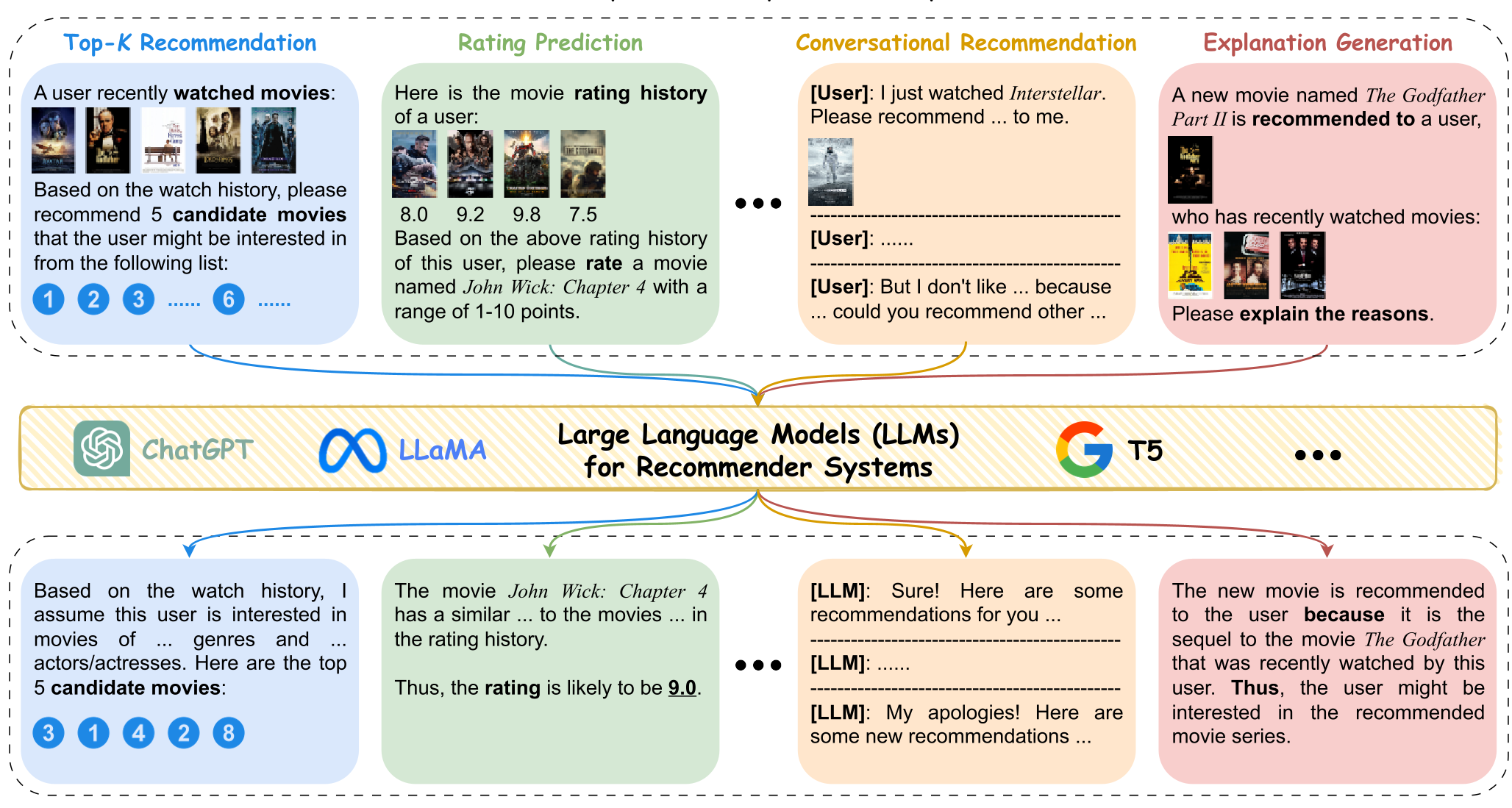
*Figure 1: Examples of LLMs performing diverse tasks: Top-K, Rating Prediction, and Explanation Generation.*
### Paradigm B: Prompting (The Zero-Shot Frontier)
This is the most transformative shift. We keep the LLM frozen and treat recommendation as a "dialogue" or "instruction following" task.
- **In-context Learning (ICL)**: Providing few-shot examples within the prompt.
- **Chain-of-Thought (CoT)**: Guiding the model to "think step-by-step" to infer user intent before suggesting an item.
### Paradigm C: Hybrid Architectures
Methods like **P5** unify all recommendation tasks (sequential, rating, review) into a single text-to-text format using a T5 backbone.
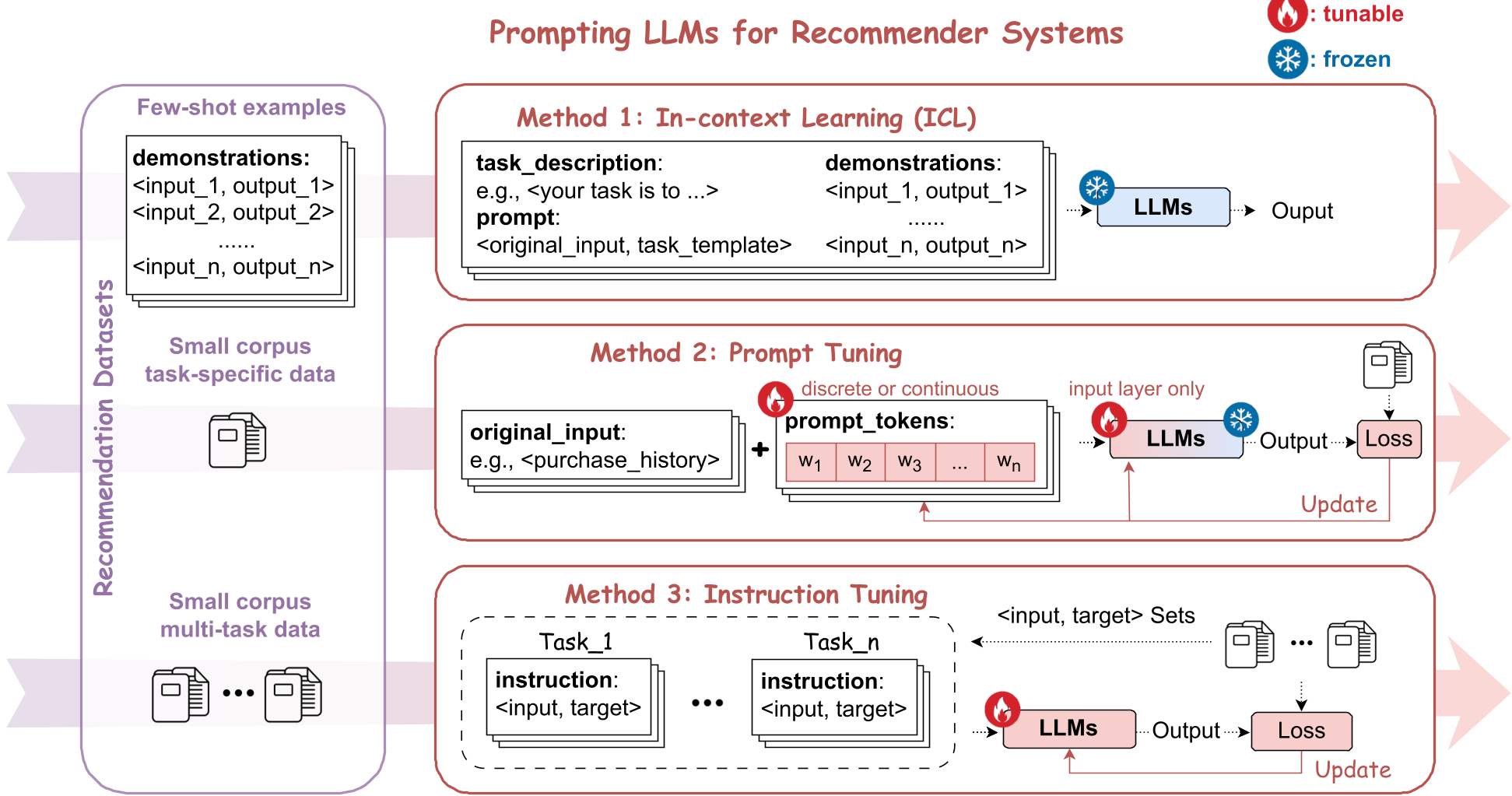
*Figure 2: Comprehensive comparison of prompting techniques, including Instruction Tuning and Soft/Hard Prompting.*
## 4. Experiments: What the Data Shows
The survey aggregates findings illustrating that:
- **LLMs as Rankers**: LLMs often outperform traditional models in cold-start scenarios where textual descriptions are rich but interaction data is scarce.
- **TALLRec Efficiency**: By using LLaMA-7B with LoRA fine-tuning, recommendation accuracy can be significantly improved with very small datasets, proving that LLMs are "efficient learners" for RecSys.
- **Cross-Domain Prowess**: A single LLM (like P5) can maintain high performance across multiple different datasets (e.g., Beauty, Sports, Toys) simultaneously without task-specific heads.
## 5. Critical Analysis & Future Directions
Despite the hype, the authors remain objective about the "Elephant in the Room":
* **Hallucinations**: LLMs might confidently recommend products that don't exist.
* **Efficiency**: Inference costs for a 70B parameter LLM are orders of magnitude higher than a traditional light-weight GNN.
* **Privacy**: How do we prevent LLMs from "memorizing" sensitive user interaction histories?
**Moving Forward**: The future lies in **Vertical Domain-Specific LLMs** (e.g., LawGPT, FinGPT) and **Tool-mediated Agents**, where the LLM acts as the "brain," calling traditional RecSys engines as "tools" to perform high-precision retrieval.
## 6. Takeaway
The era of treating recommendation as a simple matrix math problem is over. The integration of LLMs marks the transition toward **Cognitive Recommender Systems**—systems that don't just find a match, but understand the "why" behind every user click.