
RSboSN: Filtering Social Noise for Precision Recommendation
Recommender Systems Based on Social Networks
The paper introduces RSboSN (Recommender Systems based on Social Networks), a social regularization framework that integrates user friendships and tag information. By utilizing a biclustering algorithm to identify "true" friends with similar preferences, it achieves state-of-the-art accuracy in item recommendation on social datasets like Del.icio.us.
TL;DR
While "who you know" matters in recommendations, "who you share tastes with" matters more. This paper presents RSboSN, a framework that refines social recommendation by using Biclustering to identify "true" friends within social networks. By moving away from the assumption that all friends influence us equally, the authors achieved a massive 39.63% improvement in Recall over traditional social recommendation baselines.
Problem & Motivation: The Heterogeneity of Friendships
Most social-based recommender systems follow a simple logic: if you are friends with someone, your tastes must be similar. However, real-world social networks are heterogeneous. You might follow a colleague for professional updates but have completely opposite tastes in movies.
The authors identified three critical weaknesses in prior work:
- Unilateral Trust: Trust is often treated as a one-way street, ignoring the mutual nature of social relationships.
- Homogeneous Bias: Treating all friends as equally influential regardless of the item category.
- Data Sparsity: The "Cold-start" problem where new users lack enough interaction data to generate quality suggestions.
Methodology: The Power of Biclustering
The core innovation of RSboSN is the transition from global social influence to local, interest-based groups.
1. Biclustering for "True" Friends
Instead of looking at the whole user-item matrix, the authors use a biclustering algorithm based on Coupled Two-Way Clustering (CTWC). This identifies subsets of users who behave similarly across subsets of items. Because these clusters can overlap, the model captures the reality that a user can belong to a "Jazz music group" and a "Tech gadget group" simultaneously.

2. Sophisticated Social Regularization
The model incorporates two specific regularization terms into the Matrix Factorization objective function:
- Friendship Similarity: Weighted more heavily if the friend is in the same bicluster ( parameter).
- User-Item Correlation: Captures "expert influence," where a friend who is particularly knowledgeable about a specific item tag carries more weight for that specific recommendation.
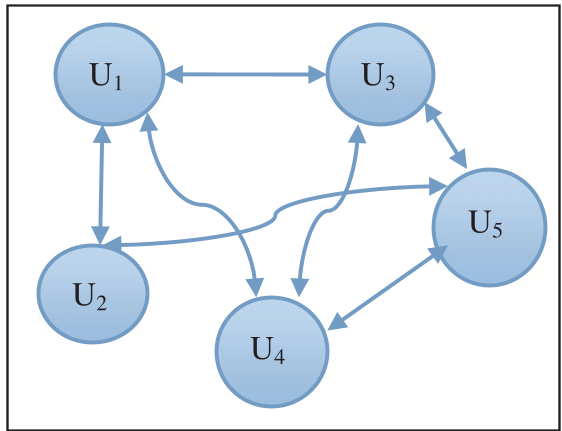 Figure: The network graph illustrates how User 1 might turn to different friends (User 3 vs User 4) depending on the specific item (I4) based on historical tag overlap.
Experiments & Results
The authors tested RSboSN against several baselines, including Popularity-based (Pop), Collaborative Filtering (CF), and the standard Social Recommendation (SoRec) on the Del.icio.us dataset.
Performance Gains
The results were conclusive. RSboSN outperformed SoRec across all metrics:
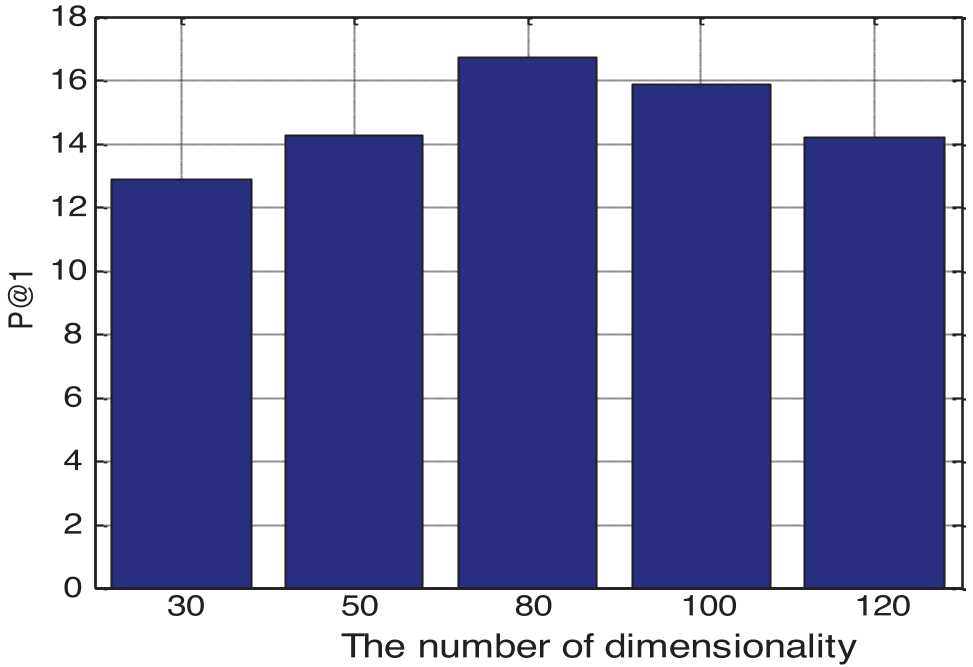
- P@1 (Precision at 1): 16.73% vs 13.29% (+25.88% relative improvement)
- R@5 (Recall at 5): 10.71% vs 7.67% (+39.63% relative improvement)

Sensitivity Analysis
The authors found that the feature dimensionality peaked at 80. Furthermore, the weighting parameter performed best at 0.8, confirming that while pure social tags matter, the "cluster membership" (the identified group of similar friends) is the dominant factor in prediction accuracy.
Critical Insight & Conclusion
RSboSN proves that social information is a "noisy" signal that must be filtered through the lens of shared interests. By using Biclustering to isolate stable sub-patterns of behavior, we can mathematically model the "circle of friends" in a way that aligns with human intuition.
Takeaway: If you are building a recommender for a platform with high social interaction, don't just use the social graph—use the social-interest overlap.
Future Work: The authors suggest that moving beyond immediate friends (one-hop) to multi-hop "friends of friends" and incorporating temporal context (how tastes change over seasons) are the next frontiers for the RSboSN framework.