
Recommending Followees via Content-Weighted Interest Homophily: Beyond "Friends of Friends"
Recommending Followees Based on Content Weighted User Interest Homophily
This paper introduces a followee recommendation system tailored for Content Curation Social Networks (CCSNs) like Pinterest and Huaban. Specifically, it proposes a method based on "Content Weighted User Interest Homophily," which leverages re-pin paths and topical categories to identify and recommend users with highly similar interests.
TL;DR
In Content Curation Social Networks (CCSNs) like Pinterest, users follow others because of what they post, not who they know. This paper shifts followee recommendation from friendship-based models to an Interest Homophily model. By analyzing "re-pin paths" and weighting them with content category data, the authors achieve superior recommendation precision compared to standard popularity-based metrics.
The Shift from Social to Interest-Driven Networks
Most social networks (like Facebook or LinkedIn) rely on the principle of Social Homophily: you are likely to know the friends of your friends. However, on platforms like Huaban or Pinterest, the "Follow" link is driven by niche interests—Interior Design, Travel, or DIY Crafts.
The core challenge is identifying "indirect users" in a re-pin chain (users further up the source of a pin) who the target user doesn't know but likely shares a soul-mate level of interest with.
Methodology: The Anatomy of a Re-Pin Path
The authors define a re-pin path as a sequence of users through which a specific "pin" has traveled. If User A pins an image, User B re-pins it from A, and User C re-pins it from B, a path is formed.
1. Re-pin Path Similarity
The system uses a Weighted Levenshtein Ratio to compare paths. The intuition is that if two pins follow similar user trajectories, they represent shared consumption patterns.
2. Adding Content Weight
Not all re-pins are equal. To refine the "Interest" part of the homophily, the authors introduce a Category Histogram. If two users not only share a re-pin path but also classify their pins into the same categories (e.g., both put a pin under "Scandinavian Design"), the weight of their interest similarity increases.
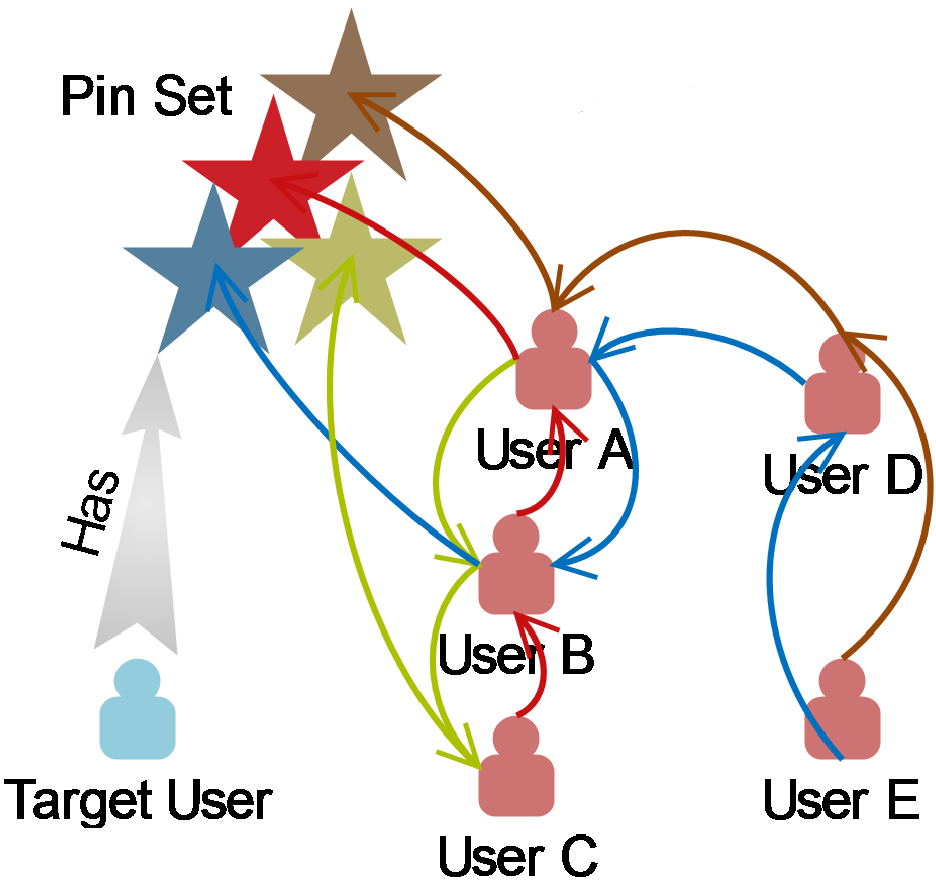 Figure 1: The proposed recommendation framework showing the pipeline from re-pin paths to final ratings.
3. Transferring Similarity to Users
The algorithm distributes the path similarity score across the "shared users" within those paths. A normalization step ensures that users who consistently align with the target user's categorization habits receive higher recommendation scores.
Experimental Validation
Using a crawled dataset from Huaban.com containing over 250k pins, the authors tested their "Interest Homophily" approach against the standard Popularity (POP) method.
- Precision: The Interest Homophily approach yielded significantly higher Average Precision.
- Ranking: The "Average Position" (where the correct followee appears in the list) was lower/better for the proposed model, meaning users find who they want faster.
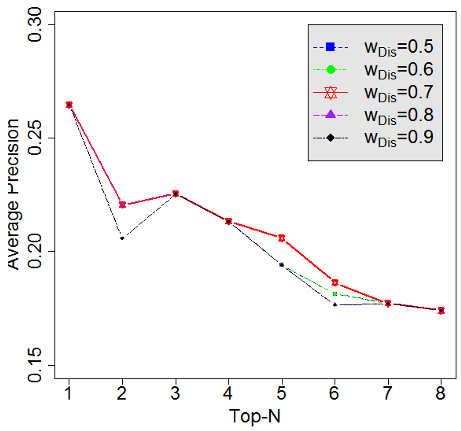 Figure 2: Average Precision and Position comparison showing the clear advantage over Popularity-based methods.
Critical Insight & Future Outlook
The brilliance of this work lies in its realization that on curation sites, content is the proxy for identity. By treating the "re-pin" not just as an action, but as a directed edge in an interest graph, the model captures the nuance of expertise and taste.
Limitations: The study relies on explicit category IDs provided by users. In modern settings, these might be noisy or absent, suggesting that future iterations should incorporate Computer Vision (CV) to automatically extract embeddings from the pin images themselves, further enriching the "Content Weight."
Conclusion
This paper serves as a vital blueprint for building recommendation engines in "Interest-First" social ecosystems. It proves that by mathematically modeling the path of information flow and weighting it with topical relevance, we can connect users more meaningfully than simply following the crowd.