
Social Signals in Virtual Markets: Why Your Interests Matter More Than Your Location
Recommending Sellers to Buyers in Virtual Marketplaces Leveraging Social Information
This paper investigates the efficacy of external social information—such as user interests, group joins, and check-ins—for recommending sellers to buyers in the virtual marketplace of Second Life. By employing a user-based k-nearest neighbor (KNN) collaborative filtering approach, the authors demonstrate that specific social signals can significantly enhance seller recommendations, reaching performance levels comparable to internal marketplace historical data.
TL;DR
Researchers analyzed years of data from the Second Life virtual world to see if social network data (Facebook-like likes, groups, and interests) could predict which sellers a buyer would visit. They found that who you associate with (groups) and what you like (interests) are nearly as predictive of your shopping habits as your actual purchase history. Conversely, "check-ins" are almost useless in a world where you can teleport.
Problem & Motivation: The Missing Social Link
Most recommendation engines are "island" systems—they only know what you do within their own store. If you haven't bought anything yet, the system faces a "cold start." The authors argue that our social persona—the groups we join and the interests we state on social networks—contains latent signals about our commercial preferences.
The challenge lies in quantifying which social signals actually translate to buying behavior. Does "liking" a photo of a virtual car mean you'll buy from a specific virtual car dealer? The authors set out to bridge the gap between social networking and marketplace transactions.
Methodology: KNN Meets Social Graphs
The study utilizes a User-Based K-Nearest Neighbor (KNN) Collaborative Filtering approach. The "secret sauce" isn't the algorithm itself, but the similarity features used to find those "neighbors."
The features were split into two categories:
- Network-based: Analyzing the structure of social connections (e.g., Adamic Adar or Preferential Attachment).
- Homophilic-based: Analyzing shared content (e.g., Jaccard Similarity on joined groups or stated interests).
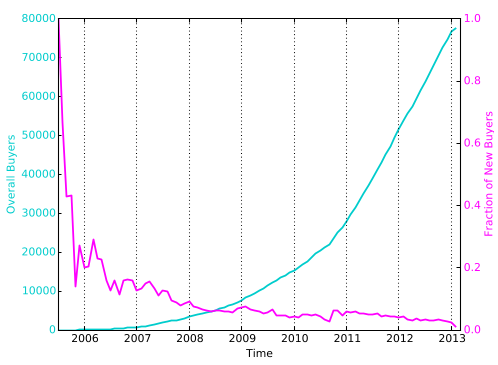 Above: The purchase distribution and the fraction of new sellers over time, illustrating the dynamic nature of the Second Life marketplace.
Experiments & Results: The "Teleportation" Effect
The researchers conducted longitudinal experiments from 2009 to 2013. The results revealed a stark contrast between different types of social data:
- The Winners: Groups Jaccard and Interests Jaccard. These homophilic features performed significantly better than the "Most Popular" baseline and were on par with internal marketplace data like Product Categories.
- The Loser: Check-ins. In many real-world studies, location is a prime predictor. However, in Second Life, players "teleport." This creates a lack of geographic friction, making location-based check-ins poor indicators of commercial intent.
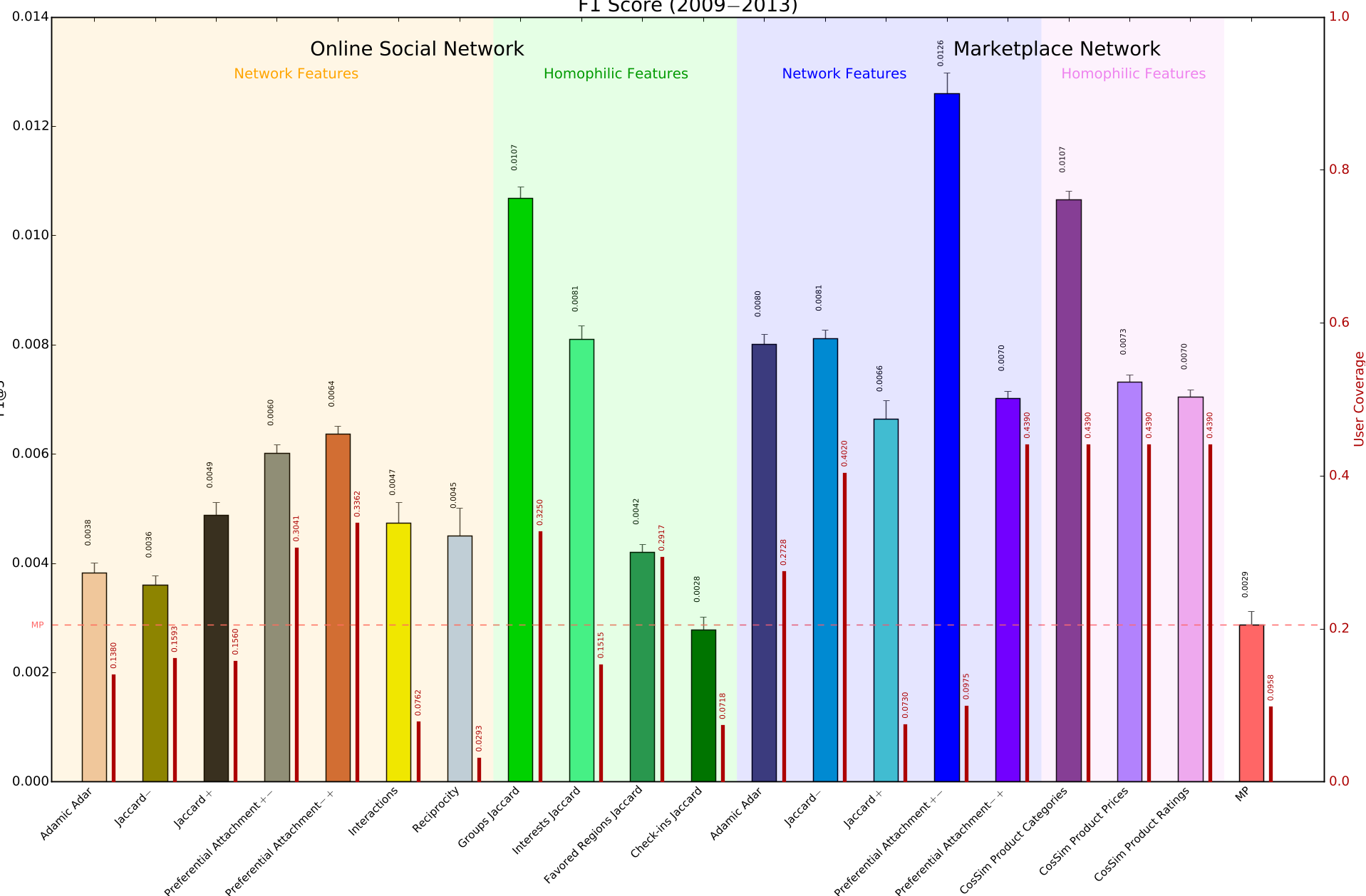 Figure 4: This chart clearly shows that Group-based and Interest-based features (Social Network data) rival the performance of Marketplace-native data (CosSim Product Categories).
Stability Over Time
A unique contribution of this paper is the temporal analysis. As shown in the study's time-series graphs, the predictive power of "Groups" becomes more stable as the social network matures, whereas network structure signals (like Preferential Attachment) tend to oscillate more violently.
Critical Analysis & Conclusion
This work demonstrates that social identity is a robust proxy for commercial interest. For developers building "Metaverse" or virtual marketplaces, the takeaway is clear: focus on user affiliations and declared interests rather than spatial movements.
Limitations: The study is confined to Second Life, a platform with unique social dynamics (no formal "friendship" links in the traditional sense). Furthermore, while KNN is a solid baseline, modern Neural Collaborative Filtering or Self-Attention mechanisms might extract even deeper insights from the sparse "Check-in" data that KNN missed.
Future Outlook: The next frontier is "Learning to Rank" (LTR), where these disparate social signals can be weighted dynamically by a machine learning model rather than being used in isolation. As we move toward a more integrated Web3/Metaverse experience, cross-platform social-to-commerce pipelines will become the standard, not the exception.