
Beyond Average Ratings: Integrating Local and Global Reputation for Trustworthy Recommenders
Recommending Users in Social Networks by Integrating Local and Global Reputation
This paper introduces a hybrid trust prediction model for Online Social Networks (OSNs) by integrating local reputation (derived from a user's ego-network) and global reputation (community-wide feedback). Validated on the CIAO dataset, the approach significantly improves precision in predicting user trustworthiness.
TL;DR
Trust is the currency of Online Social Networks (OSNs), yet most platforms rely on a "Global Reputation" score—essentially a simple average of all user feedback. This paper argues that such an approach is fundamentally flawed. By introducing Local Reputation—trust calculated specifically within a user’s "ego-network"—the authors demonstrate that we can predict trustworthiness with much higher precision, eventually making global scores obsolete as a user's network grows.
Problem & Motivation: The Failure of Global Consensus
In platforms like eBay, Epinions, or Twitter, we often rely on global feedback to judge a stranger. However, global reputation systems face two major hurdles:
- Vulnerability to Manipulation: Malicious actors can easily farm fake positive "helpful" votes to distort their global standing.
- Lack of Context: A user who is highly rated by the general public may not be trustworthy within your specific niche or circle of friends.
The authors' core insight is that proximity matters. A recommendation from a friend of a friend is inherently more valuable than a recommendation from a random stranger on the other side of the network graph.
Methodology: The Hybrid Reputation Model
The proposed model suggests a synthetic score, , which balances two components:
1. Local Reputation ()
This is calculated by looking at the user's Ego-Network. If user wants to evaluate user , the system looks at all paths from to .
- Weighting: A direct link counts as 1. An indirect link via a path of length is weighted by . This exponential decay reflects the intuition that trust "dilutes" as it travels further from the source.
2. Global Reputation ()
This remains the traditional average of all feedbacks provided by the entire community for a user's past actions.
3. The Integration Strategy
The final trust suggestion is determined by: Where is the weight of local importance and is the threshold for a binary "Trust/No Trust" decision.
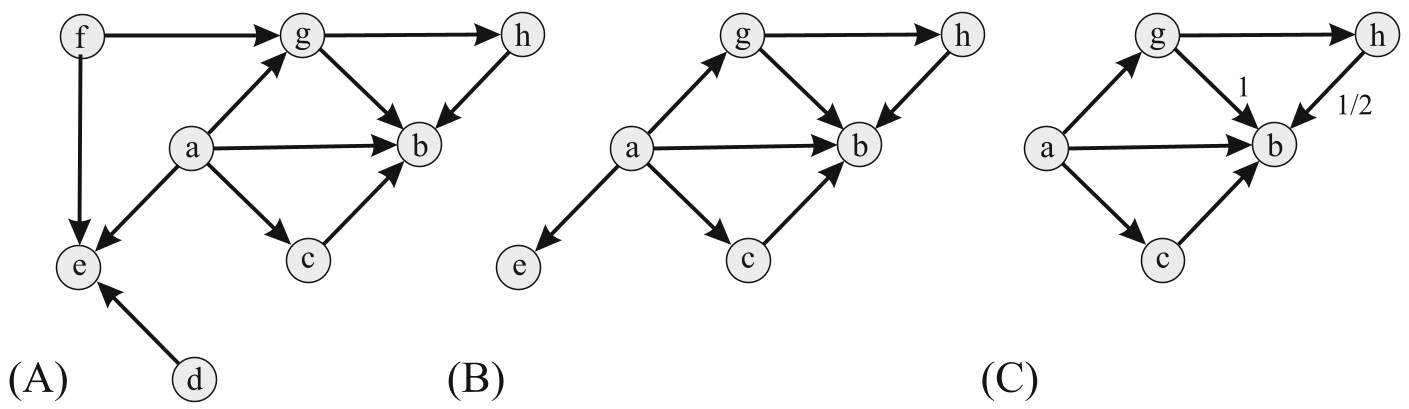 The figure above demonstrates how local contributors are identified within a sub-graph to calculate the value.
Experiments: When Does Local Rep Take Over?
The authors tested their model using real-world data from the CIAO social network. The key variable was , which represents the size of a user's ego-network.
- For Newcomers ( is small): The error is minimized when . Since the user has few connections, the local network doesn't have enough data, and global reputation must "fill the gaps."
- For Veteran Users ( is large): As the ego-network expands, the optimal moves toward 1. In fact, for users with large networks, the global reputation becomes almost irrelevant noises.
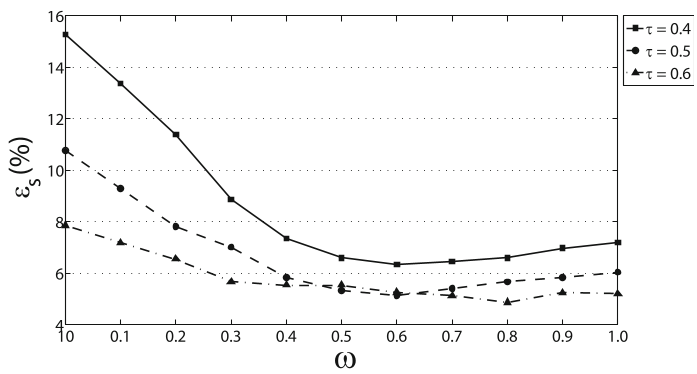 The charts clearly show that as the local dimension rises (Node 339), the reliance on global data decreases.
Critical Analysis & Conclusion
Takeaway
The study proves that local trust is superior to global reputation for established users. This suggests that mature OSNs can actually reduce their computational overhead and increase security by focusing on local ego-network calculations rather than maintaining massive, easily-manipulated global leaderboards.
Limitations
- Cold-Start Sensitivity: New platforms or users with zero connections still depend entirely on global metrics, which remain vulnerable.
- Computational Complexity: Calculating shortest paths for every user pair in a massive graph is significantly more expensive than simple averaging, a trade-off between precision and performance.
Future Outlook
This work paves the way for "Personalized Trust" engines. Future recommender systems might not tell you if a product is "good" globally, but rather if it is "trusted by people you trust," creating a decentralized and more resilient web of confidence.