
MASTER & MASTER+: Solving the Multi-Network Identity Puzzle via Constrained Dual Embedding
Reconciling Multiple Social Networks Effectively and Efficiently: An Embedding Approach
The paper proposes MASTER and MASTER+, two novel frameworks for reconciling multiple social networks by identifying accounts belonging to the same individual. It utilizes a Constrained Dual Embedding (CDE) model to integrate both attribute and structure information into a unified latent space, achieving state-of-the-art accuracy and efficiency across bi-network and multi-network scenarios.
TL;DR
Reconciling identities across social platforms (e.g., matching a Twitter handle to a LinkedIn profile) is notoriously difficult due to data noise and the "multi-network" problem. This paper introduces MASTER and MASTER+, frameworks that use a Constrained Dual Embedding (CDE) model to map multiple networks into one shared latent space. By combining attribute and structural data and utilizing a novel balance-aware fuzzy clustering for parallelization, the authors achieve SOTA accuracy with high scalability.
Context: The Multiplicity and Robustness Gap
In the real world, an individual doesn't just exist on two platforms; they inhabit an ecosystem of networks (Twitter, Facebook, Foursquare, etc.). Traditional "Anchor Link Prediction" methods usually match networks in pairs. This leads to global inconsistency—you might find that Account A on Twitter matches Account B on Facebook, and B matches C on Foursquare, but A and C are incorrectly identified as different people.
Furthermore, social data is "messy." Profile attributes are often empty or faked, and network structures are sparse. A robust solution must look beyond simple surface features.
Methodology: The MASTER Framework
The core of the paper is the Constrained Dual Embedding (CDE). Instead of just matching, it "embeds" nodes into a d-dimensional space where distance represents identity similarity.
1. Uni-Embedding (Capturing the Local)
For each individual network, the model captures:
- Structure Space: Not just who you follow (1st-order), but the similarity of your neighbor circles (2nd-order proximity).
- Attribute Space: Proximity based on profiles and content. These are fused using collaborative matrix factorization.
2. Joint-Embedding (Aligning the Global)
The framework uses known "anchor links" as hard constraints to pull the latent spaces of different networks together. It solves this using an NS-Alternating algorithm, which separates the complex optimization into manageable subproblems (representation matrices and kernel matrices), proving convergence to KKT points.
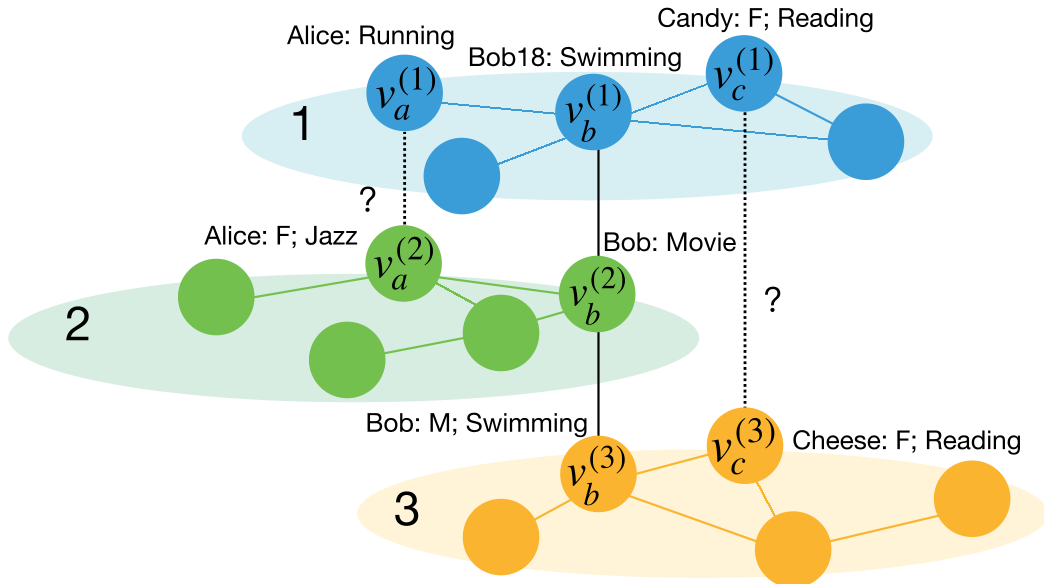 Figure 1: The general concept of reconciling multiple social networks through overlapping identity links.
Scalability via MASTER+
To make MASTER work on millions of users, the authors proposed MASTER+. Its "secret sauce" is the Balance-aware Fuzzy Clustering (BFC).
- Why Fuzzy? Identities shouldn't be strictly partitioned. Soft (fuzzy) clustering allows "marginal" accounts to be checked against multiple candidate groups, increasing accuracy.
- Why Balance-aware? In parallel computing, your speed is limited by the slowest worker. BFC forces clusters to be roughly equal in size, preventing a single massive cluster from becoming a bottleneck.
Experimental Performance
The researchers tested their methods on real-world data from Twitter and Foursquare.
- Accuracy: MASTER consistently beat previous SOTA methods like COSNET and PALE. Notably, it maintained high performance even when 30% of social connections were removed, proving its Robustness.
- Efficiency: MASTER+ showed a "near inverse-square" decrease in runtime as more clusters were added, proving it can scale to massive datasets.
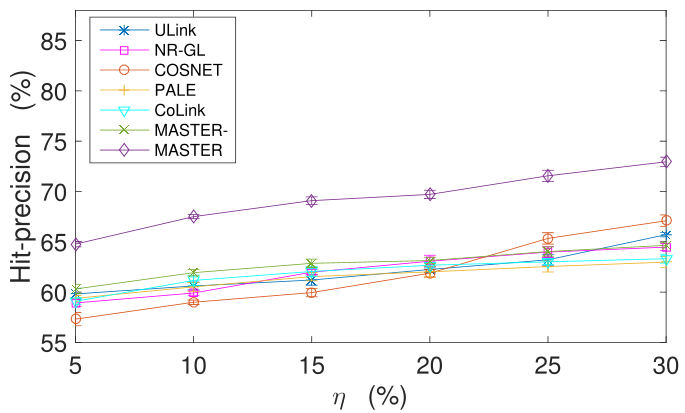 Figure 2: Hit-precision comparison on dense vs. sparse networks. MASTER maintains a clear lead as data becomes noisier.
Critical Insight: Why it Works
The brilliance of this approach lies in the transition from Pairwise Matching to Joint Embedding. By treating the problem as a unified optimization task rather than a series of local comparisons, the model naturally eliminates the contradictions that plague other multi-network alignment tools. The addition of the BFC algorithm in MASTER+ also addresses a common academic pitfall: creating an accurate model that is too computationally expensive to use in production.
Conclusion & Future Outlook
MASTER and MASTER+ represent a significant step forward in social network analysis. For industry practitioners, the use of Balance-aware regularizers in clustering provides a blueprint for scaling other graph-based tasks like fraud detection or recommendation engines. Future work could potentially integrate Deep Learning (GNNs) into the CDE framework to capture even more complex non-linear relationships in social data.