
Reconsidering the Social Web of Things: From Tweeting Toasters to Autonomous Social Agents
Reconsidering the social web of things: position paper
This position paper introduces the Social Web of Things (SWoT), a paradigm shift that integrates pervasive computing, social networking, and multi-agent systems. It proposes a four-layered architectural model—Agency, Social, Organizational, and Application—to transform everyday objects into proactive, autonomous participants in socio-technical networks (STN).
TL;DR
The Social Web of Things (SWoT) isn't just about your fridge having a Twitter account. This paper argues for a transition from passive "connected things" to proactive social agents that operate within human-like organizational structures. By layering Agency, Social, and Organizational models, the authors propose a framework where devices can negotiate, follow rules, and collaborate autonomously to solve real-world problems.
Context: The Evolution of the Web
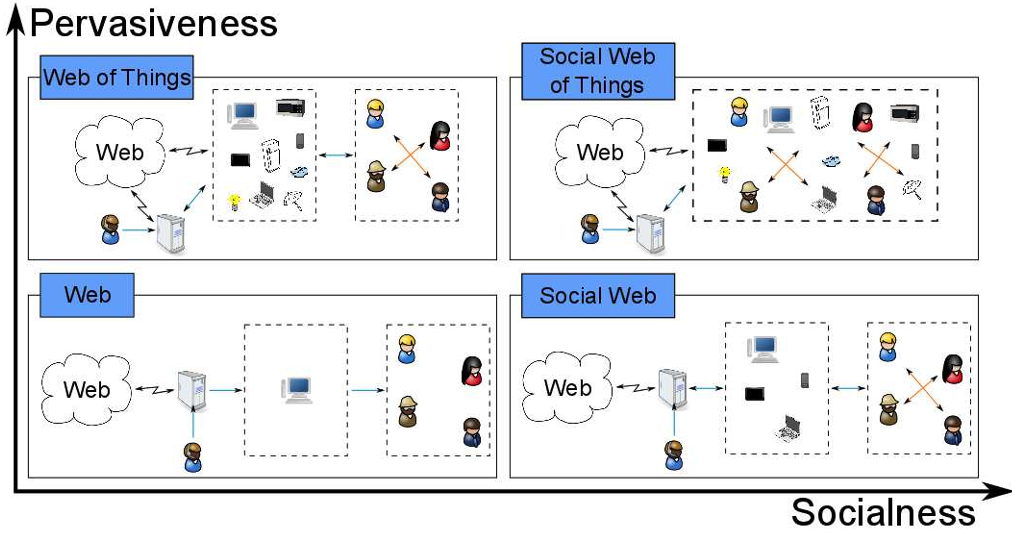
In the early 2010s, we saw the convergence of two massive trends: Socialness (Web 2.0) and Pervasiveness (IoT). However, these worlds often met at a superficial level. A device might "post" a status, but it wouldn't "understand" its social context or the norms of the household it lived in.
The authors argue that a third dimension is missing: Pro-activeness. Without it, we are simply building "Social Silos."
The Core Vision: Socio-Technical Networks (STN)
The paper shifts the focus toward Socio-Technical Networks. In this vision:
- Things are proactive: They are goal-driven and can act without human intervention.
- Things are social: They consume and produce content as regular users do.
- Things are organized: They follow norms, roles, and communication protocols.
The Four-Layered Architecture
To realize this, the authors propose a structured model:
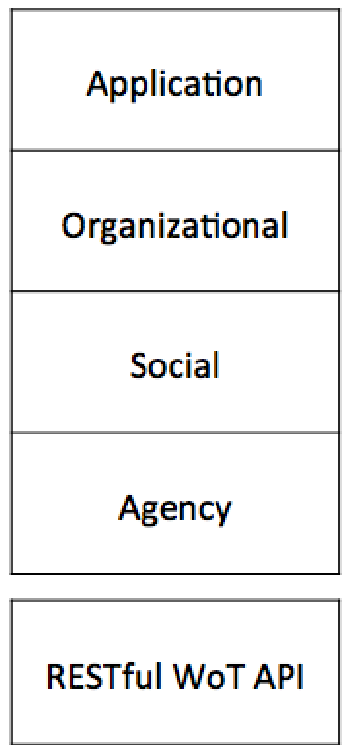
- Agency Layer: Treats every entity (human or thing) as an intelligent agent with specific properties (autonomy, reactivity).
- Social Layer: Manages the "Who Knows Whom" dimension, exposing a uniform API to different social networking services.
- Organizational Layer: The "brain" of the social structure. It uses the MOISE+ model to define roles (e.g., "WashingMachine"), goals (e.g., "Finish Laundry"), and norms.
- Application Layer: The interface where developers build end-user services on top of the established social/agent logic.
Methodology: The Power of Normative Organizations
The technical brilliance of this paper lies in the Organizational Dimension. Instead of hard-coding interactions, they use an organizational model to define:
- Structural Dimension: Roles like "Student," "Administrator," and "Door."
- Functional Dimension: Complex processes like "How to do laundry," broken down into sub-goals.
- Normative Dimension: Rules defining what an agent must or may do (e.g., "The studio door must notify the student when a reservation is made").
Case Study: The Smart Student House
The paper illustrates this with a Student House scenario. Imagine Jane, a student, looking for an available washing machine. In a typical IoT setup, Jane manually checks an app. In the SWoT setup:
- The washing machines are autonomous entities.
- If Jane's floor is busy, a machine on the 6th floor might "negotiate" with Jane's agent to offer a slot.
- The Organizational Rules ensure the machine only communicates with students of that building, preventing spam and protecting privacy.
Critical Insight & Conclusion
The SWoT vision presented here is deeply rooted in Multi-Agent Systems (MAS). By moving the complexity of "social behavior" from the hardware to the "Organizational Layer," the authors provide a scalable way to manage thousands of heterogeneous devices.
Limitations & Future Work
While the organizational model provides excellent governance, the paper observes that:
- Resource Scalability: If every lightbulb becomes a "proactive social agent," current social network APIs would likely collapse under the load.
- Privacy: Creating a "Social Graph" for things invites massive privacy concerns, necessitating a balance between autonomy and data protection.
Final Takeaway: This work acts as a blueprint for the "Humanization of Things." As AI and LLMs (Large Language Models) become the brains of these agents in the 2020s, the organizational structures proposed in this 2013 paper are more relevant than ever for ensuring these agents behave according to human norms.