
Deciphering the Digital Maelstrom: Using 3D Space to Fix Broken Chat Histories
Reconstructing chat history for avatar agents using spatio-temporal features of virtual space
This paper introduces a novel framework for reconstructing chat histories in 3D virtual environments by leveraging the spatial and temporal features of avatars. It utilizes a "Degree of Conversation Strength" (DCS) metric and "Chat Flow Graphs" (CFG) to map social interactions and resolve dialogue ambiguities in real-time.
TL;DR
In a crowded virtual chat room, following a conversation is like trying to read a book where the sentences have been shuffled. Researchers from Pusan National University have developed a way to fix this by treating space as context. By analyzing where avatars are standing and what they can "see," their system reconstructs the logical flow of dialogue (Chat Flow Graphs) and maps out the hidden social networks forming within virtual worlds.
The Problem: The "Turn Rupture" Chaos
If you’ve ever used a fast-paced group chat, you’ve seen it: User A asks a question, User B asks a different one, and then User C says "Yes." Does "Yes" mean it's raining, or that 1+1=2?
In academic terms, this is known as Turn Rupture. In text-only environments, the lack of spatial cues forces users to manually scroll and mentally "link" messages. Traditional 3D chats are often just 2D chat boxes slapped onto a 3D model, failing to use the rich spatial data available in the engine to resolve these ambiguities.
Methodology: Space as a Semantic Filter
The paper’s core innovation is the Degree of Conversation Strength (DCS). Instead of just looking at who typed what, the system looks at the visual intersection of agents.
1. The Geometry of a Conversation
The researchers argue that in a virtual space, a conversation's "strength" is proportional to how well an agent can see another's speech balloon.
- Viewing Frustum: The 3D field of vision for an avatar.
- Clip Area: The portion of the word balloon actually visible to the listener.
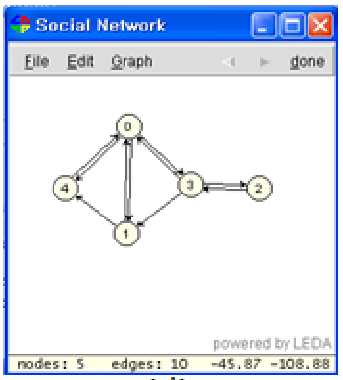 Figure: The DCS calculation based on the visual area of word balloons within the agent's view.
2. The Chat Flow Graph (CFG)
Once the DCS is calculated, the system doesn't just list messages chronologically. It builds a Chat Flow Graph. By applying a recursive Graph-Cut Algorithm (preferring vertical cuts to horizontal ones), the system partitions the chaotic stream of messages into logically coherent "topic blocks."
Experiments: Mapping the Social Fabric
The experiment involved tracking five agents moving across different chat groups. By summing the DCS values over time, the system generated an Edge-Weighted Social Network.
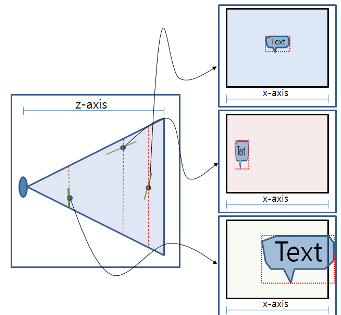 Figure: Clustering of chat units and the resulting social network showing agent relationships.
The results showed that while a standard text log would show a single messy thread, the CFG successfully separated the agents into distinct sub-clusters based on their spatial proximity and interaction frequency. It turned "noise" into a structured map of social interaction.
Deep Insight & Conclusion
The genius of this work lies in its realization that human communication is an embodied act. In the real world, we use our bodies to signal who we are talking to; by bringing these "Physical Constraints" into the digital log, the researchers solved a linguistic problem using geometry.
Limitations & Future Work
While the DCS is a brilliant metric, the paper primarily focuses on visual area. Modern iterations of this research could benefit from:
- Multimodality: Incorporating NLP to verify if the "spatial" link matches the "semantic" content.
- Dynamic Environments: Adapting the DCS when agents are moving rapidly or in non-linear spaces.
Ultimately, this work serves as a foundational step toward Context-Aware Avatar Agents—AI that doesn't just read your text, but understands your digital "body language."