
IVMF: Revolutionizing Crowdsourcing through Context-Aware Viral Marketing
Recruiting the K-most influential prospective workers for crowdsourcing platforms
The paper introduces the Intelligent Viral Marketing Framework (IVMF), a novel system that integrates social community-based crowdsourcing with information diffusion models. It proposes the Content-Based Improved Greedy (CBIG) algorithm to identify the K-most influential workers across multiple contexts while optimizing for marketing budgets.
TL;DR
The Intelligent Viral Marketing Framework (IVMF) is a dual-module system designed to recruit the -most influential workers on social media. By extending the Linear Threshold model to handle multiple topics and introducing the CBIG algorithm, the authors reduced the computational cost of finding influencers by over 80% while maintaining nearly perfect accuracy.
Background: Why Influence Matters in Crowdsourcing
Crowdsourcing platforms usually wait for workers to come to them. However, for viral marketing, the platform must proactively "recruit" the right nodes—those who don't just complete a task but amplify it across their social circles. The challenge is two-fold:
- Complexity: Finding the optimal set of "seed" nodes is an NP-hard problem.
- Context: A user influential in "Sports" might be ignored when posting about "Personal Care."
The Core Innovation: Multi-Context LT Model
The authors argue that every user has a "Threshold Vector" rather than a single value. If a piece of content spreads across "Social" and "Science" contexts, the model evaluates the user's receptivity based on three behavioral patterns:
- Pattern 1 (Conservative): Requires influence to exceed the maximum threshold of the involved contexts.
- Pattern 2 (Balanced): Uses the average threshold.
- Pattern 3 (Aggressive): Uses the minimum threshold.
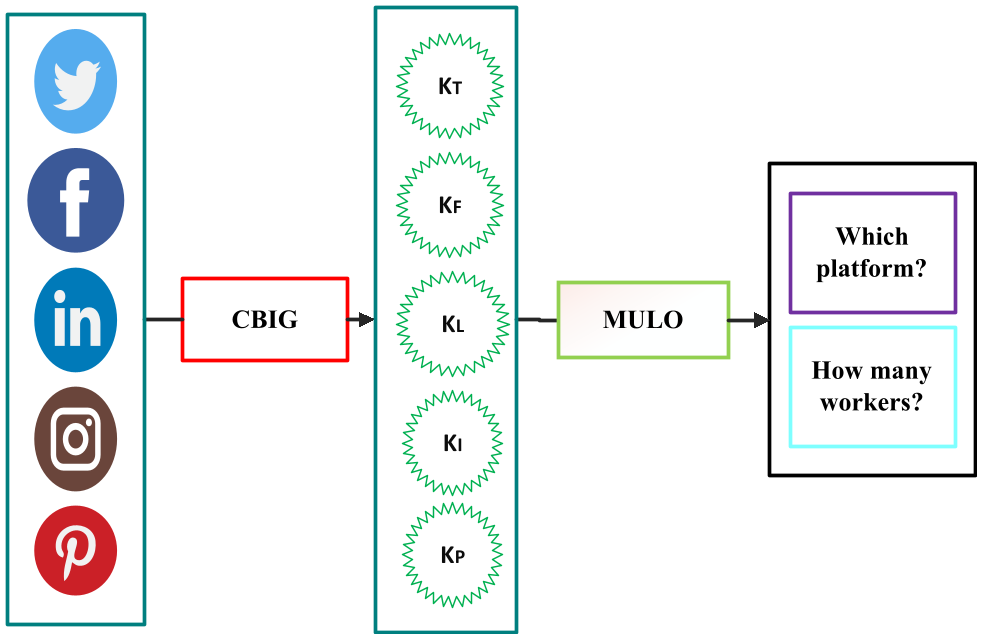 Figure 1: The Intelligent Viral Marketing Framework (IVMF) connecting social networks to crowdsourcing goals.
Methodology: The CBIG Algorithm
The Content-Based Improved Greedy (CBIG) algorithm is the engine of this framework. The "Pain Point" of the classic greedy approach is that it simulates the entire network spread for every single node to see who is best.
CBIG introduces a filtering step:
- Pruning: It calculates , the number of immediate neighbors a node can activate.
- Thresholding: If is below a threshold , the node is discarded immediately.
- Optimization: Influence spread is only calculated for the "survivors."
Experimental Battleground
Testing was conducted on the ParsiYaar dataset (3,054 nodes, 19,602 edges). The framework was tasked with selecting influencers for a personal care brand's viral video campaign.
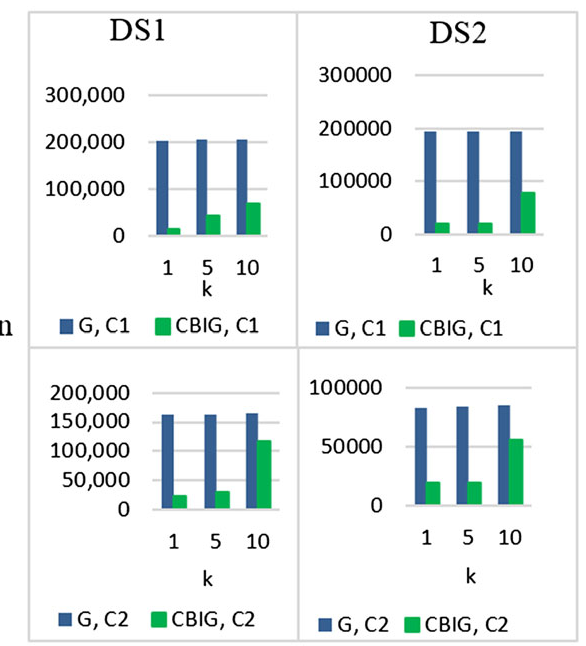 Figure 2: The iteration count of CBIG (varying ) vs. the Basic Greedy Algorithm.
Key findings include:
- Efficiency: Iterations dropped by 82.39%.
- Scalability: In the largest dataset (DS), computation time was slashed by 62.53%.
- Retention: The algorithm still captured 99.27% of the influence set found by the exhaustive greedy method.
Critical Insight & Conclusion
The true value of IVMF lies in its contextual intelligence. By acknowledging that propagation behavior changes with the topic, Businesses can avoid wasting "Social Capital" on users who are technically well-connected but contextually irrelevant.
However, the model relies on a fixed parameter for pruning. Future work could involve dynamic adjustment—where the algorithm learns to prune more aggressively as the recruitment target grows, further optimizing the balance between speed and viral reach.