
RecursiveMAS: Scaling Agent Intelligence via Latent-Space Recursion
Recursive Multi-Agent Systems
RecursiveMAS is a novel multi-agent framework that scales agent collaboration by casting the entire system as a unified latent-space recursive computation. By connecting heterogeneous agents via the lightweight "RecursiveLink" module, it achieves SOTA performance across 9 benchmarks including mathematics, science, and coding, with an average accuracy improvement of 8.3%.
TL;DR
RecursiveMAS transforms Multi-Agent Systems (MAS) from a collection of models talking to each other via text into a unified recursive machine. By replacing slow, discrete text-based interaction with high-speed, continuous latent thoughts, the framework achieves an 8.3% accuracy boost while slashing token costs by up to 75%.
Background: The Problem with Text-Based Collaboration
In the current LLM landscape, "more agents" often means "more latency." Standard MAS setups represent agents as black boxes exchanging text. This approach has three fatal flaws:
- Decoding Bottleneck: Every agent must decode tokens into text and re-encode them, leading to massive overhead.
- Information Loss: Mapping complex internal reasoning (latent states) to discrete tokens causes "semantic narrowing."
- Non-Differentiable Loops: You cannot easily backpropagate through text, making it nearly impossible to optimize the collaborative system as a single entity.
Methodology: The Architecture of a Collective Brain
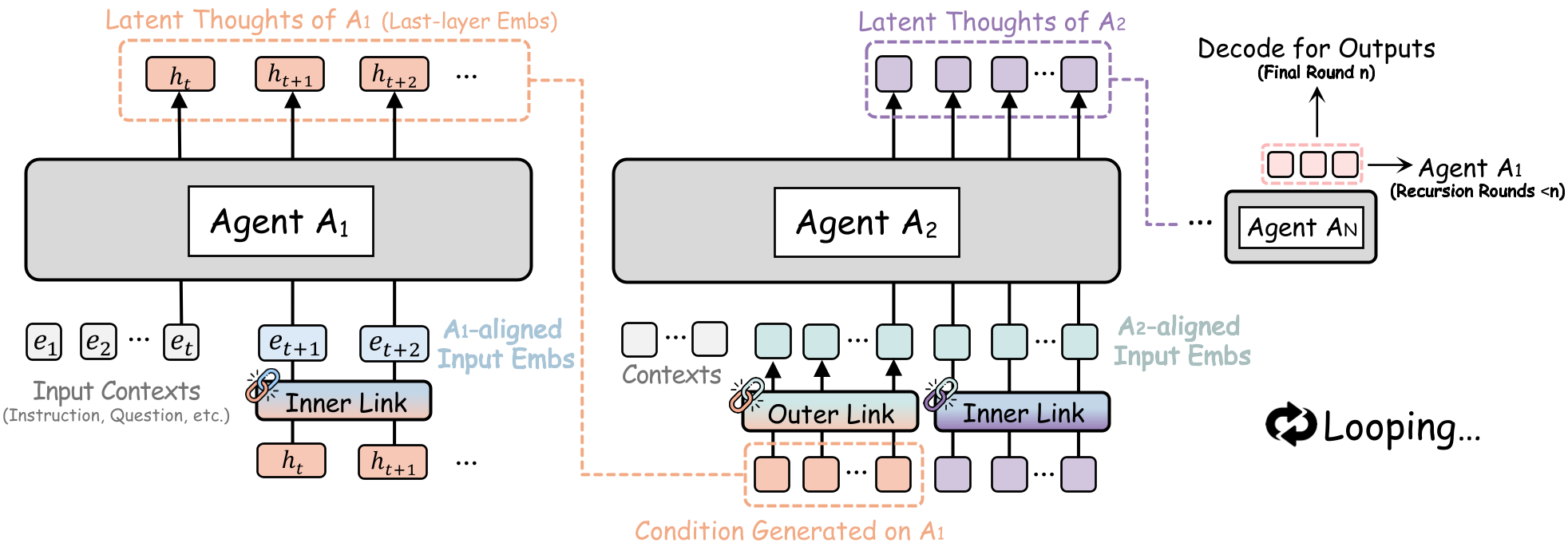
RecursiveMAS treats the entire multi-agent system as a Recursive Language Model (RLM). Instead of layers within one model being reused, different agents act as the functional blocks of a global loop.
1. The RecursiveLink Module
The technical heart of this work is the RecursiveLink. It’s a lightweight two-layer residual projection module:
- Inner Link: Connects a model's output embeddings back to its input for auto-regressive latent reasoning.
- Outer Link: Bridges heterogeneous agents (e.g., Llama to Qwen) by mapping distributional differences between different embedding spaces.
2. Inner-Outer Loop Learning
How do you train such a beast? The authors propose a two-stage strategy:
- Inner Loop: A "warm-start" that teaches each agent to generate semantically meaningful latent thoughts.
- Outer Loop: System-level co-optimization. Gradients are backpropagated through the entire recursive collaboration trace, allowing "credit assignment" across multiple agents.
Experimental Proof: A New Scaling Axis
The researchers tested RecursiveMAS across 4 patterns: Sequential, Mixture-of-Experts, Distillation, and Deliberation.
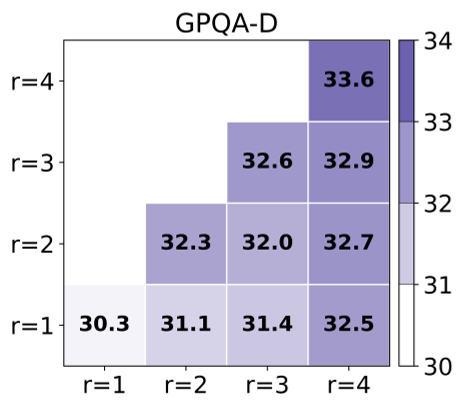
Performance Landscape
The results confirm a "Scaling Law" for recursion: increasing the depth of recursion (r) during inference results in monotonic performance gains, especially when the system is trained for deeper recursion.
Efficiency Gains
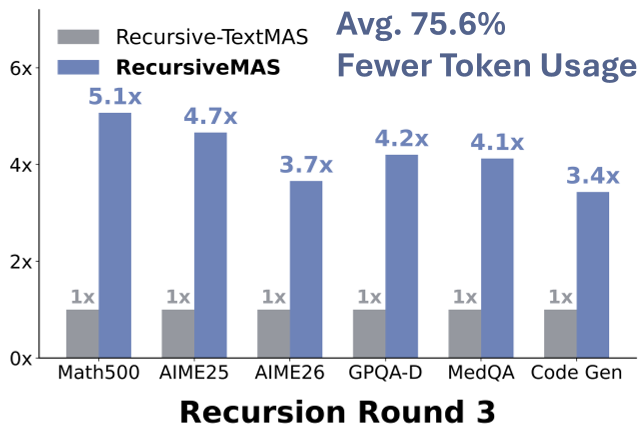
Unlike text-based recursion (Recursive-TextMAS), which gets exponentially slower as rounds increase, RecursiveMAS maintains a much flatter cost curve. By skipping the vocabulary-space projection, it transforms a complexity problem into a one.
Deep Insights: Gradient Stability
A key theoretical contribution is Theorem 4.1. The authors prove that while text-based SFT suffers from gradient vanishing (due to the softmax operator in decoding), the residual connections in RecursiveLink maintain a gradient norm close to 1. This ensures that the system actually learns across long recursive paths.
Critical Analysis & Future Outlook
Takeaway: RecursiveMAS proves that "thinking longer" (recursion) and "working together" (MAS) are more powerful when done in the continuous latent space. It effectively bridges the gap between System 1 (instinctive generation) and System 2 (deliberative reasoning).
Limitations:
- Representational Drift: While the authors show latent states align with ground truth over rounds, training requires high-quality "role-specific" data.
- Memory Overhead: Storing full latent traces for backpropagation across multiple agents is memory-intensive.
Future Work: We expect to see this applied to Multimodal Agents, where latent representations of images and video can be recursively refined without the need for verbose textual descriptions of every frame.