
ReMSA: Navigating the Physics of Trust in Social Networks
A model for recursive propagations of reputations in social networks
The paper introduces ReMSA (Reputation Management for Social Agents), a novel distributed algorithm designed to model the emergence and recursive propagation of reputation in social networks. By leveraging network topology (node degrees), recursive voting, and interaction dynamics (velocity and acceleration), ReMSA achieves a more objective and accurate assessment of node trustworthiness, successfully identifying malicious entities in Autonomous Systems (AS) networks.
TL;DR
ReMSA is a distributed reputation algorithm that treats information propagation like a physical system. By calculating the "velocity" of social interactions and weighting votes based on network topology (node degrees), it creates a more objective and resilient trust map. It outperforms traditional models by accurately identifying malicious nodes in complex Inter-domain routing (BGP) environments.
The Missing Context: Why Degree and Speed Matter
In a social or technical network (like the Internet's Autonomous Systems), not all opinions are equal. A node with many connections (high degree) often possesses more localized information and influence. Existing algorithms (AFRAS, Histos) frequently treat interactions as static events.
The authors identify three fatal flaws in prior work:
- Topological Blindness: Ignoring the influence or "confidence" derived from a node's position in the graph.
- Temporal Stagnation: Failing to distinguish between a node that interacts once a year versus one that interacts ten times a day.
- Subjectivity Bias: The lack of a recursive voting system to balance out individual "grudges" or local errors.
Methodology: The Mechanics of Recursive Reputation
ReMSA solves these by introducing a feedback loop influenced by the "Physics of Interaction."
1. The Recursive Voting Process
When Agent A interacts with Agent B, it doesn't just rely on its own experience. It initiates a recursive "Ask" process among its neighbors. Crucially, the weight of a neighbor's vote is determined by its relative degree ().
 The model facilitates the emergent consensus through intrinsic (direct experience) and extrinsic (neighbor voting) factors.
2. Velocity and Acceleration
Trust is not just about what happened, but how fast it's happening. ReMSA defines:
- Velocity (): The reciprocal of time passed since the last interaction.
- Acceleration (): The change in velocity.
If a node suddenly starts interacting at a high frequency (positive acceleration), the Impact Function () exaggerates the feedback, making the system highly sensitive to "bursty" behavior—a hallmark of many network attacks.
3. The Update Function
The final reputation is a weighted blend: Where is an exponential decay factor representing the "forgetting" of old, potentially obsolete information.
Experiments: Real-World AS Networks
The authors validated ReMSA using BGP update data from RouteViews, comparing it to the industry-standard AS-CRED.
Identifying Malicious ASes
In the AS-CRED model, a single extremely malicious node (like AS 209) can skew the normalization so heavily that other "moderately malicious" nodes appear safe. ReMSA's local weighting prevents this "masking effect," providing a more accurate spectrum of trust.
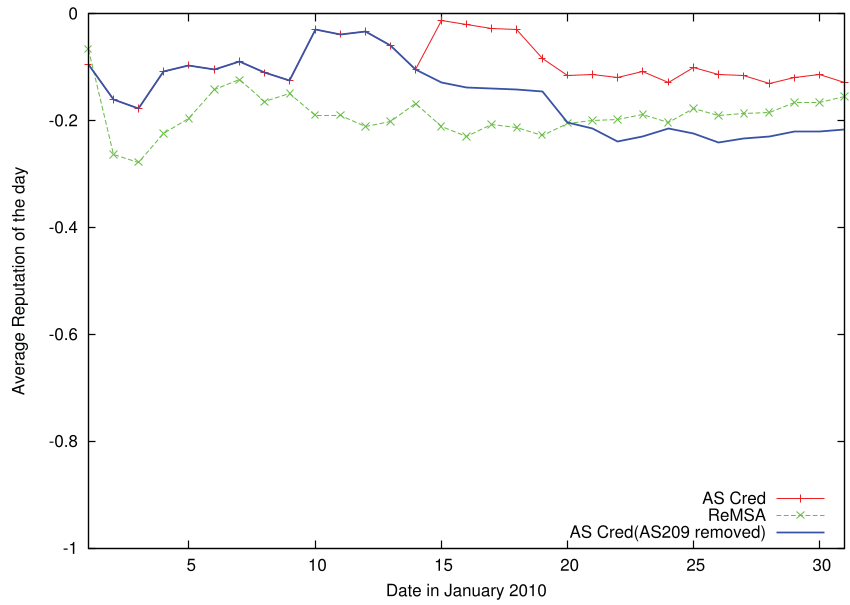 Figure 1: Comparison between AS-CRED and ReMSA. Note how ReMSA maintains a more stable and representative average even when outliers are present.
Topology and Propagation
In simulations of sparse vs. dense networks, the authors found:
- Sparse Networks: Reputation depends heavily on path distance. An observer 6 hops away has a significantly different view than one 4 hops away.
- Dense Networks: Reputation diffuses rapidly. Because the average path length is shorter, the network reaches a "homogeneous view" much faster.
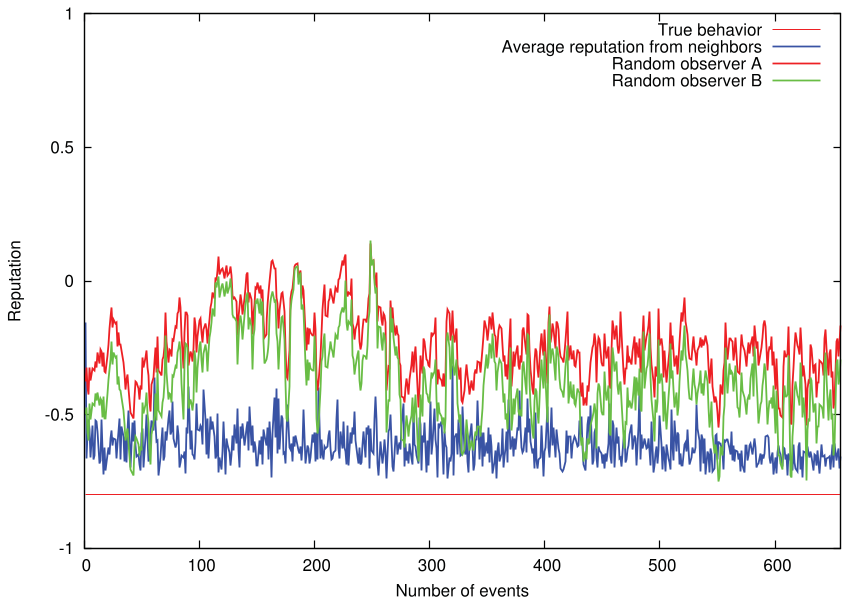 Figure 2: In sparse graphs, subjective views (Observer A vs B) converge slowly toward the true behavior.
Critical Insight & Future Outlook
ReMSA’s brilliance lies in its Inductive Bias: it assumes that the network structure itself is a signal for trust. High-degree nodes are treated as more "confident," which mirrors real-world social dynamics.
Limitations: The algorithm currently assumes a static topology. In high-churn environments (like mobile ad-hoc networks), recalculating the maximum degree and relative coefficients () could be computationally expensive.
The Takeaway: As we move toward more decentralized "Web3" and Multi-Agent Systems, algorithms that synthesize graph topology with temporal dynamics like ReMSA will be essential for building resilient, self-policing social and technical ecosystems.