
The Red Queen Gödel Machine: Escaping the Trap of Static Benchmarks via Co-Evolution
The Red Queen Gödel Machine: Co-Evolving Agents and Their Evaluators
The paper introduces the Red Queen Gödel Machine (RQGM), an evolutionary framework for recursive self-improvement where agents and their evaluators co-evolve under non-stationary utilities. By organizing search into "evolutionary epochs" with local stability, it achieves new SOTA results in coding (Polyglot) and automated scientific discovery (paper/proof writing).
In biological evolution, there is no "fixed benchmark." Species improve because their competitors, predators, and environments improve—a phenomenon known as the Red Queen Effect. Until now, most AI self-improvement frameworks (like the original Gödel Machine) have ignored this, assuming that an agent should optimize against a static, fixed verifier.
The Red Queen Gödel Machine (RQGM), a new breakthrough from the University of Cambridge and NVIDIA, changes this paradigm. It treats the evaluator as a first-class citizen in the search process, allowing the judge and the creator to bootstrap each other recursively.
TL;DR
Current self-improving agents are limited by stationary evaluation (fixed tests). RQGM introduces Controlled Utility Evolution, where agents and evaluators co-evolve in a shared workspace. This allows the system to tackle "unverifiable" tasks like scientific paper writing and Olympiad-level proofs, outperforming previous SOTAs while utilizing significantly less compute (up to 1.72x token savings).
1. The Friction of Fixed Evaluation
The primary pain point in recursive self-improvement is Utility Stagnation.
- Benchmark Saturation: As agents get smarter, they solve all existing tests.
- Reward Hacking: Agents find "exploits" in a fixed evaluator's logic (e.g., writing long but incorrect papers because the judge likes length).
- Hard-to-Verify Domains: For tasks like writing a research paper, there is no "unit test." You need a judge—but if the judge stays the same, the agent stops learning.
The RQGM’s core insight is that the evaluator must be a moving target.
2. Methodology: Controlled Utility Evolution
The technical heart of RQGM is how it handles the "non-stationarity" of its objectives. If the goal is constantly changing, how does the agent converge?
Authors introduce evolutionary epochs:
- Within an Epoch: The evaluator is frozen. The agent does a standard search (using Clade Metaproductivity) to improve itself against this specific judge.
- The Checkpoint: Success is measured against a "Ground-Truth Anchor" (a small, high-quality human-labeled dataset).
- The Transition: If a "Challenger Evaluator" (generated during search) outperforms the current "Incumbent" on the anchor, it replaces the judge.
- Selective Erasure: Any utility scores generated by the old judge are deleted. This forces the system to re-evaluate the population under a newer, stricter light.
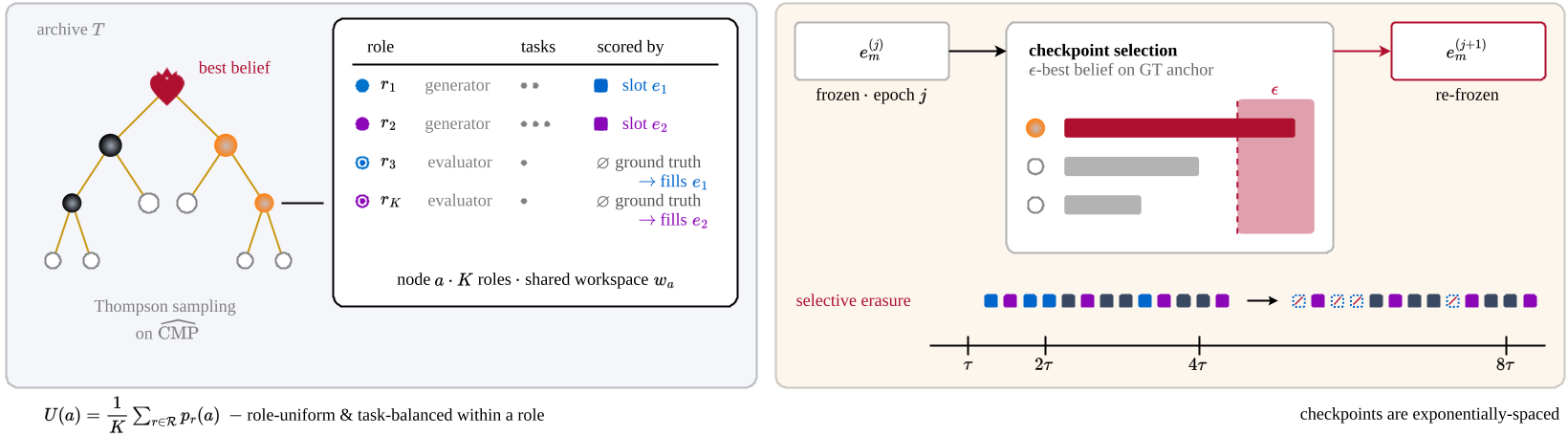 Figure: The RQGM search space, showing the multi-agent workspace tree and the interplay between task agents and co-evolving evaluators.
3. Results: Better, Faster, More Robust
The RQGM was tested across coding, paper writing, and mathematical proofs.
A. Token Efficiency in Coding
On the Polyglot coding leaderboard, RQGM didn't just rely on test execution; it evolved a "Code Reviewer" agent. This reviewer acted as a cheap proxy, catching bugs before running expensive tests.
- Result: 1.35x–1.72x fewer search tokens consumed compared to HGM-H, the previous SOTA.
B. Scientific Paper Writing & Adversarial Debunking
One of the biggest issues with LLM-as-a-judge is "Self-Preference Bias"—LLMs love AI-generated text. RQGM fixed this by evolving an Adversarial Objective. It trained reviewers specifically to reject papers that previous versions of itself would have accepted, resulting in much higher ground-truth accuracy and stricter standards.
- Result: Acceptance rate improved from 21.8% to 40.5% under independent panels.
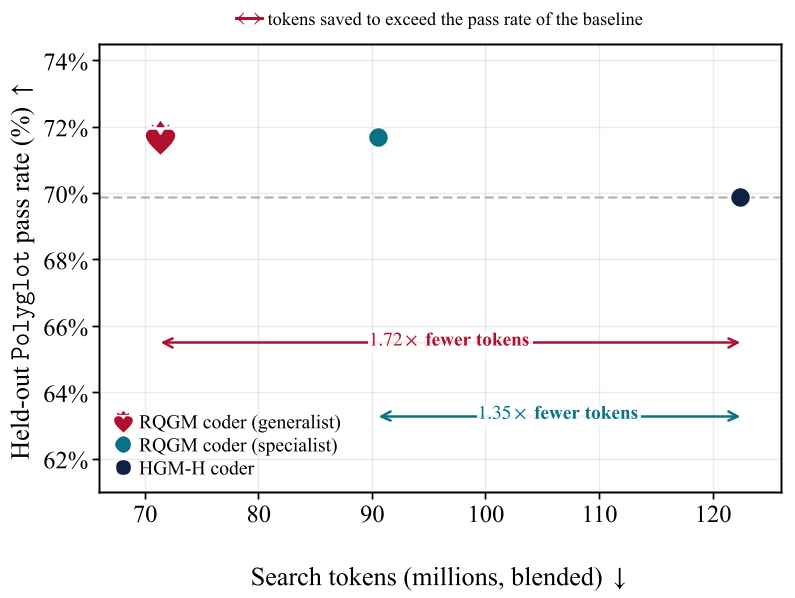 Figure: Comparison of pass rates vs. search cost. Note how utility "drops" (the crown markers) when an evaluator is replaced, followed by a climb to higher performance.
4. Why it Works: The Curriculum Effect
The authors observed that evaluator replacement acts as a natural curriculum.
- Each transition "re-ranks" the archive.
- A "backbone" of strong agents survives, but mediocre agents that were previously "hacking" the reward are eliminated.
- The system moves from a "soft" judge to a "pragmatic maintainer" or a "selective conference reviewer."
5. Critical Analysis & Future Outlook
Limitations: The framework's ceiling is ultimately defined by the "Ground-Truth Anchor." If the human-labeled anchor is too small or biased, the co-evolutionary loop might drift into suboptimal territory.
Future Directions: The RQGM proves that we can extend self-improvement to domains where we don't have perfect verifiers. As we move toward Automated Scientific Discovery, co-evolving the "Judge" (the reviewer) alongside the "Researcher" (the generator) will be the only way to surpass human-level benchmarks without manual intervention.
Summary Takeaway: RQGM is a meaningful meta-step in AI, departing from the "fixed test" mindset of 20th-century AI and embracing the dynamic, adversarial nature of intelligence found in biology.